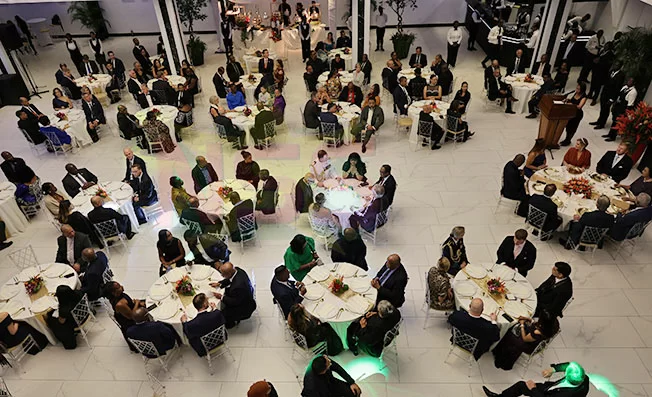
In a remarkably personal address during Monday evening’s state banquet at Ballroom Prince, King Willem-Alexander of the Netherlands delivered an emotionally charged speech that transcended diplomatic formalities. The monarch’s visit to Suriname during its 50th anniversary of independence (Srefidensi) became a profound historical moment as he directly addressed the painful legacy of Dutch colonialism.
The King, visibly moved, reflected on his family’s multi-generational connection to Suriname, noting how his grandparents had made the first state visit to the young republic. “Since then,” he observed, “much water has flowed through the Suriname River”—a poignant acknowledgment of turbulent political decades and enduring connections.
Most significantly, Willem-Alexander built upon the Dutch government’s 2023 slavery apologies by personally requesting forgiveness for the historical failures of Dutch monarchs. “Your history bears the brand of slavery in the name of the Dutch state,” he stated. “The Dutch government has apologized for this, and personally I have added the request for forgiveness for the failure to act against this crime against humanity by stadholders and kings of the House of Orange-Nassau.”
The King had previously repeated these apologies and personal requests for forgiveness during meetings with descendants of enslaved people and Indigenous communities, emphasizing that healing requires continuous generational truth recognition.
Beyond historical reconciliation, Willem-Alexander praised Suriname’s resilience, describing the nation as a “beacon of humanity” in an increasingly polarized world. He specifically honored resistance heroes including the maroons who fiercely defended their hard-won freedom and legendary figures like Boni, whose moral authority inspired fights for dignified existence.
The banquet also focused on future cooperation, with the King highlighting Suriname’s youth potential, rainforest conservation (noting the country absorbs more CO₂ than it emits), and responsible mineral resource management. He emphasized Dutch support would be offered “with due humility.”
In a notable diplomatic gesture, the King announced the Dutch ambassador would lay a wreath at the December Murders monument during December 8th commemorations, acknowledging Suriname’s developing rule of law.
The evening concluded with lighthearted moments as the King anticipated potential World Cup football rivalry between the nations in 2026, and a recitation of Dobru’s famous multicultural unity poem: “Wan Sranan, Someni wiwiri, Someni skin, Someni tongo, Wan pipel” (One Suriname, Many leaves, Many skins, Many tongues, One people).