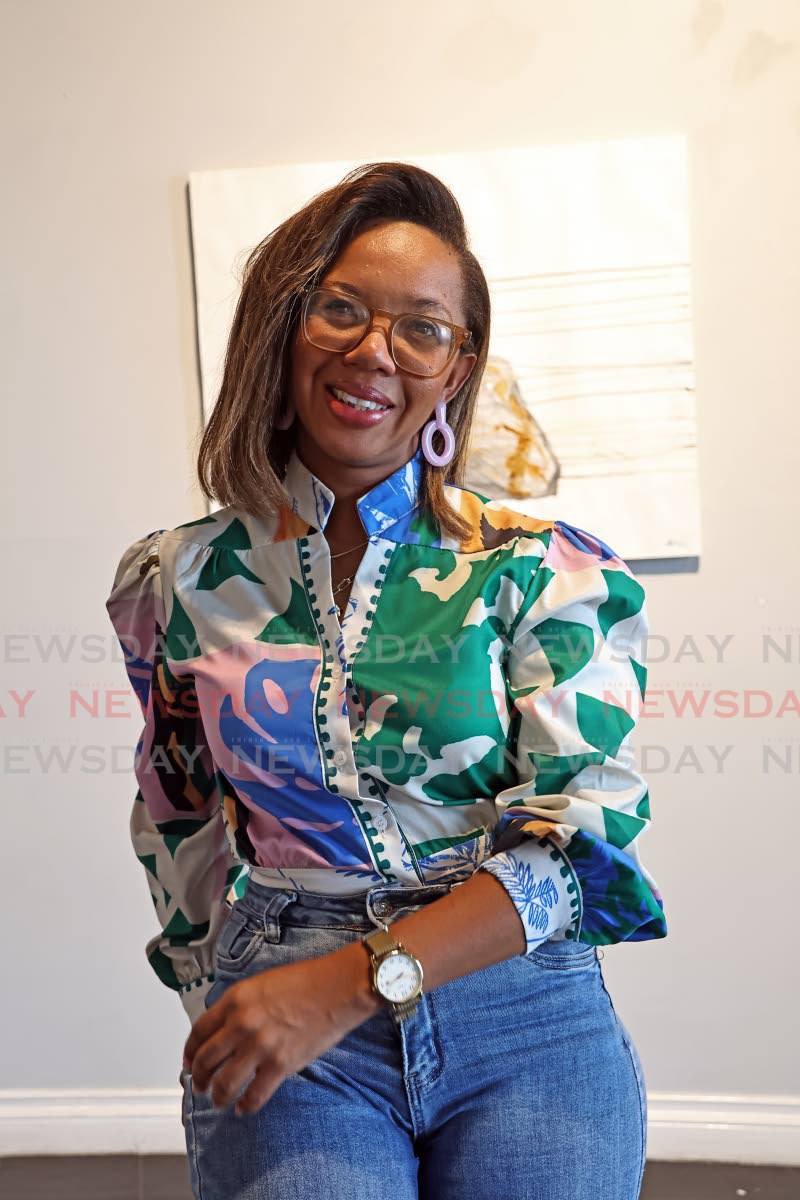
Visual artist Adeline Gregoire has launched her debut solo exhibition, “Vanishing Lines/Lignes de Fuite,” at Loftt Gallery in Woodbrook, presenting an innovative collection that reimagines Caribbean landscapes through abstract cartography. The exhibition, which opened November 15 and runs through November 30, represents a significant departure for Gregoire, who has built her career primarily as a curator and interpreter of others’ work until now.
Gregoire describes the collection as “different types of maps, cartographies of ‘the islands’” that explore profound questions of “history, movement and survival.” Rather than presenting literal geographical representations, her works serve as conceptual mappings that layer references to memory, migration, and colonial histories within abstracted Caribbean landscapes.
The French portion of the exhibition’s title, “Lignes de Fuite,” translates to “lines of flight”—a concept Gregoire employs to examine both physical and metaphorical escape routes. She draws direct parallels between historical marronnage (the escape of enslaved people during colonial times) and contemporary experiences of migration, displacement, and the pursuit of self-determination.
“So many of us are the direct descendants of our maroon ancestors,” Gregoire observes. “And so many of us are not free. We are the runaways of our present time.”
Her artistic process involves innovative techniques including ripping materials, distressing paper, exposing works to the elements, compression, layering, erasing, and scraping—methods that physically echo the themes of erosion, memory, and transformation explored in the content. The resulting works feature richly textured, tactile surfaces that invite both visual and conceptual engagement.
Notable pieces include “Somewhere in Between, Nou La,” which Gregoire describes as “a sort of three-dimensional landscape where you’re supposed to see mountains, coastline and colonial histories all at once,” and “Geographies,” which incorporates thread to suggest connections across spaces divided by man-made borders.
The exhibition benefits from the curatorial expertise of Célia Potiron, a Martinique-born writer and curator based in Paris whose background in Caribbean literature and postcolonial research adds significant depth to the presentation. Gregoire emphasizes the value of this collaboration, noting that Potiron’s “disinterested perspective helped situate the exhibition within wider Caribbean and postcolonial contexts.”
Visitor response has been overwhelmingly positive, with many attendees spending extended periods engaging with individual works and participating in dialogues about their interpretations. Gregoire has enhanced the gallery experience with a curated soundtrack that adds another sensory layer to the exhibition.
While the current exhibition concludes on November 30, Gregoire plans to continue developing these themes in her future work, describing this show as “a stage in an ongoing conversation” about Caribbean identity, history, and landscape.