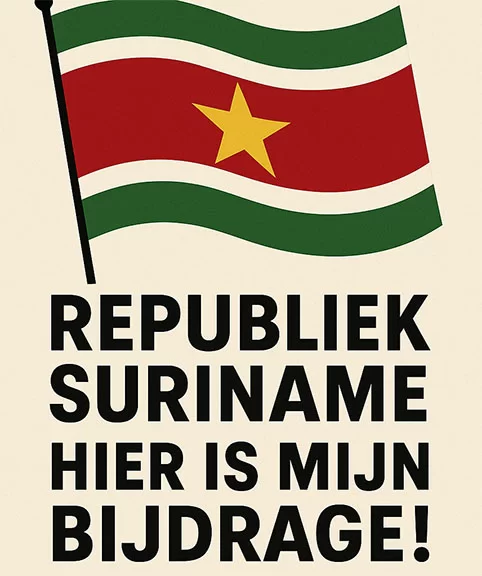
Fifty years ago, the phrase ‘Here is my contribution’ echoed across Suriname as Prime Minister Henck Arron urged every citizen to help build a prosperous nation. The posters were not mere decorations but a mandate. Now, as Suriname marks 50 years of independence (Srefidensi), that mandate rings louder than ever. Despite decades of dialogue, the task of nation-building remains incomplete. Streets are swept, flags are raised, and celebrations abound, but a clean street does not equate to a renewed state. The real question is not how grandly we celebrate but what we will do differently starting tomorrow. In my chapter in the anthology ‘Independent: 50 Writers on 50 Years of Srefidensi,’ I recount how Suriname feverishly established a constitution, a flag, a government, development aid, and UN membership in 1975. Yet, statehood did not guarantee stability. Coups, war, censorship, corruption, fear, and devaluations followed. Independence, it became clear, is not a destination but a responsibility—one often left to leaders who failed to uphold it. Despite systemic failures, Suriname endured, not because of systems but in spite of them. Surinamers supported one another, but resilience is not a strategy; it is a survival mechanism. A nation cannot survive forever; it must develop. The VSB panel discussion recently held up a mirror to these long-avoided truths. Over the past 50 years, Suriname has remained a resource-dependent nation, reliant on bauxite, gold, and now oil. It fluctuates with global prices, lacking buffers, strong institutions, or sustainable value creation. The message was blunt: continuing on the same path means another 50 years of stagnation. Suriname cannot build on hollowed-out institutions, short-term politics, or a culture of unaccountability. It needs a legally anchored long-term vision, a trustworthy government, and a civil society that acts before crises erupt. Leaders must deliver actions, not just speeches. We already know this. Every congress, committee, and report says the same. Yet, the gap between diagnosis and discipline remains wide. We talk progress to death. Now, with oil and gas on the horizon, the opportunity for transformation—or failure—looms. Without transparency and strict rules, oil will not be salvation but repetition, leaving Suriname precisely where Arron sought to protect it: a seemingly rich nation with impoverished people. Thus, his phrase is not a historical echo but a mandate. The government must create conditions for development, as outlined in Article 6 of the Constitution. Institutions must function independently. Businesses must diversify and create value. Labor unions must guide productivity and justice. Citizens must demand discipline, transparency, and accountability. Journalists must reclaim their role as watchdogs, not spectators. ‘Here is my contribution’ is not a phrase from 1975; it is the question of 2025: What will each of us contribute to the next 50 years? Suriname needs a mental shift: less complaining, more oversight; less promising, more action; less ethnic calculation, more national unity; less giving away, more building. Srefidensi is not just a celebration; it is a test: Are we finally ready to mature as a republic? The time for talk is over. Now, the work begins.