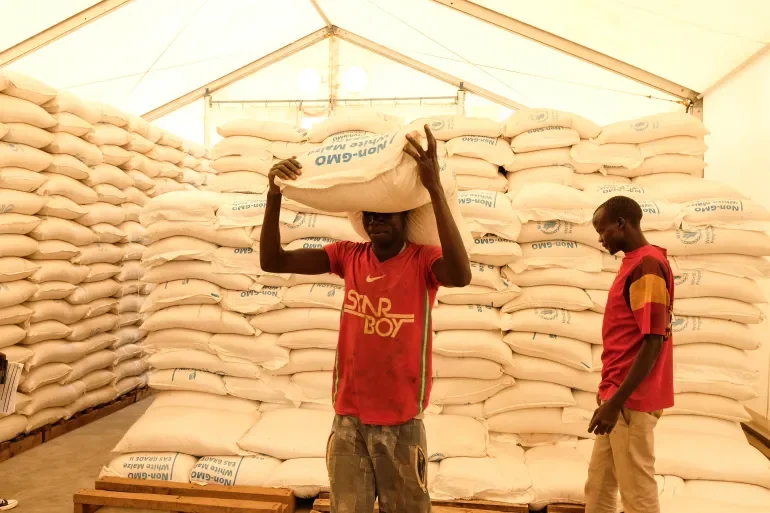
On November 27, the United Nations Food and Agriculture Organization (FAO) and World Food Programme (WFP) released their latest Hunger Hotspots report, covering the six-month period from December 2026 to May 2027, issuing a stark public warning that acute food insecurity will deteriorate significantly across 16 global territories over the coming half-year. The number of designated high-risk hunger zones has risen from 13 recorded in the previous June assessment to 16, with four new entries added to the list: Chad, the Central American Dry Corridor, Southern Africa, and northeast Uganda, while Lebanon has been removed from the high-priority roster. A 2025 file photograph taken at a WFP storage facility in Uganda’s Karamoja region, Moroto district, shows WFP aid workers conducting rigorous quality checks on emergency food supplies ahead of planned community distribution, illustrating the on-the-ground operations supporting vulnerable populations. The joint UN analysis identifies armed conflict and widespread violence as the primary driver of food insecurity in 12 of the 16 hotspots, noting that ongoing hostilities trigger mass population displacement, destroy standing crops and disrupt agricultural cycles, and block safe passage for humanitarian convoys carrying life-saving food and supplies. Compounding these conflict-related strains, soaring global food, energy, and transport costs have drastically reduced low-income households’ purchasing power, leaving millions unable to afford sufficient nutritious meals even where local food supplies are technically available. The report also flags the rapidly intensifying El Niño climate pattern as a fast-growing systemic threat to global food security. The World Meteorological Organization confirms that the current El Niño event, marked by unusual surface water warming across the central and eastern tropical Pacific, is nearly 100% likely to persist through February 2027 and ranks among the strongest such events ever recorded, disrupting seasonal rainfall and temperature patterns on every continent. Three of the four newly added hunger hotspots face severe, El Niño-fueled risks: across Southern Africa, hotter, drier conditions are disrupting planting schedules, halting routine farm activities and threatening upcoming harvests, with projections indicating 3 million people in Zimbabwe, 2.6 million in Malawi and 1.8 million in Mozambique will face acute food insecurity by March 2027. In the Central American Dry Corridor, the 2026 first planting season yielded the driest harvest in 40 years, with over 75% of crops destroyed across large swathes of the territory; dwindling household food stockpiles are expected to trigger an early onset of the annual lean season, leaving 3.2 million people in Guatemala alone facing severe hunger between October 2026 and February 2027. The most alarming crisis scenarios are concentrated in Sudan and South Sudan, where famine remains a tangible, immediate threat. Under a worst-case projection, 13 zones in Sudan’s North Darfur and South Kordofan regions face famine risk through January 2027, and acute malnutrition rates in two displacement camps in South Darfur have already crossed formal famine threshold levels. In South Sudan, famine risk has been documented in four districts across the Upper Nile and Jonglei states under the same worst-case modeling parameters. While Somalia’s overall famine risk has declined in recent assessments, acute food insecurity remains at catastrophic levels for displaced communities concentrated around Baidoa. Additional high-priority territories facing extreme food security concerns include Afghanistan, the Democratic Republic of the Congo, Haiti, and Palestine. In Gaza, food security conditions have seen marginal improvements following the October 2025 ceasefire, but these fragile gains remain easily reversible, while food insecurity levels are projected to rise in the occupied West Bank. Compounding all these overlapping crises, the joint FAO-WFP report highlights a dramatic, 62% collapse in humanitarian food security funding for the five longest-running priority hotspots between 2022 and 2025, dropping from $5.1 billion to just $2 billion. The two agencies note that prior targeted interventions successfully prevented widespread famine in previous years, but these gains remain fragile due to unaddressed structural root causes and sharp funding shortfalls. The report concludes with an urgent call for coordinated international action, sufficient resourcing, and unimpeded, safe humanitarian access to all affected populations, alongside a joint FAO-WFP action plan designed to shield 9 million people across 22 countries from the worst projected impacts of the ongoing powerful El Niño event.