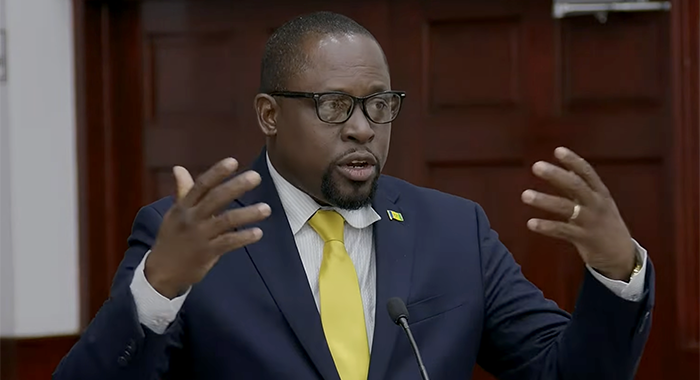
Delivering a landmark ministerial address to the House of Representatives on Tuesday, just three days ahead of the New Democratic Party (NDP) administration’s first year in office, Fisheries, Marine and Land Conservation, and Climate Resilience Minister Conroy Huggins laid out a sweeping overhaul of the country’s long-neglected fisheries sector, detailing years of systemic abandonment under the former Unity Labour Party (ULP) government that left critical infrastructure derelict even as dedicated recovery funding sat unused for years. A lifelong resident of the coastal fishing community of Barrouallie and Member of Parliament for Central Leeward, Huggins opened his remarks by noting that the creation of a standalone fisheries ministry, a key 2020 campaign pledge made by Prime Minister Godwin Friday, had been a long-overdue priority, as the sector had for decades been sidelined under the purview of the agriculture ministry despite its outsized role in sustaining thousands of livelihoods, supporting coastal food security, and powering local economies across the archipelago. Sworn into office on December 2, 2025, Huggins launched an immediate nationwide tour of every fisheries facility across the nation, where he uncovered a pattern of systemic decay: the Kingstown Fisheries Complex, constructed in the early 1990s, had been abandoned by staff back in March 2025 after chronic roof leaks, unaddressed moisture buildup, and rampant mould infestation made the building uninhabitable, forcing employees to relocate to temporary premises after multiple workers fell ill. The derelict building was the first item Huggins brought to the new government’s inaugural cabinet meeting, with funding allocated in the 2026 national budget to complete full roof replacement, plumbing repairs, deep cleaning, and repainting, with procurement for new furniture and equipment currently underway and a full return to the facility scheduled for December 2026. The pattern of neglect extended far beyond the capital: across Calliaqua, Barrouallie, Bequia, Canouan, and Union Island, every public fisheries centre had been left abandoned and unfit for purpose, even after millions in dedicated recovery funds were approved in 2022 to repair damage caused by the 2021 La Soufrière volcanic eruption. No meaningful rehabilitation work had been initiated on any of the sites between 2022 and the ULP’s final months in office at the end of 2025, Huggins confirmed. The Chateaubelair Fisheries Complex, constructed by the previous NDP administration shortly before it left office in 2001, had never been opened by successive ULP governments, falling into such disrepair that unhoused residents had taken up residence in the structure, even after World Bank funding for its restoration was allocated back in 2022. Work to rehabilitate the site is now actively underway and on track for completion in early 2027. Similarly, EU funding earmarked for the Port Elizabeth Fish Market rehabilitation in Bequia was nearly lost entirely after years of administrative inaction, with no progress made on the project across multiple consecutive national budgets until the new NDP administration signed a construction contract in June 2026, launched works in August, and targeted a final completion date of the first quarter of 2027. Huggins also highlighted the administration’s success in reviving decades-long bilateral fisheries cooperation with Japan, a partnership that had been allowed to lapse under the previous government. After Prime Minister Friday dispatched Huggins to a global oceans conference earlier in 2026, three separate Japanese technical missions have visited St. Vincent and the Grenadines to conduct site assessments of local fisheries infrastructure, with a full fisheries value chain development project scheduled to launch in 2027. A team of Japanese engineers will arrive in January 2027 to conduct detailed surveys of five priority facilities, with plans to restore at least three additional sites across the archipelago between 2027 and 2028. Alongside infrastructure upgrades, the ministry has rolled out a suite of progressive conservation and production initiatives: three longline offshore fishing vessels have been registered in 2026, two of which are already in active operation; 11 new fisheries conservation areas have been mapped with draft regulatory frameworks drafted for high-priority sites including Adams Bay and Western Cay in Bequia; coral restoration nurseries hosting transplanted staghorn and elkhorn coral fragments imported from St. Lucia have been established at multiple coastal sites including Cumberland; and a EU-OECS funded mobile Queen conch hatchery laboratory on Union Island, valued at EC$212,510, is nearing completion, with capacity to produce up to 2,000 juvenile conch per year in a pioneering regional model that the administration nearly lost due to prior administrative neglect. The government has also expanded inclusive skills development programs, training 142 people – the majority of them women – in fish handling, processing, and value addition in 2026, with upcoming dedicated training sessions for the Barrouallie Fisheries Development Cooperative, and a specialized program for 25 special needs students focused on fish product development scheduled for December 7 at the Girls’ High School. Outlining the 2027 agenda, which he framed as “a year of implementation and accountability”, Huggins set a national target of 2 million pounds of combined fisheries and aquaculture production, alongside a commitment to deliver formal skills training for 250 fisherfolk, processors, women, and young people in sustainable fishing practices, quality control, value addition, and climate-resilient operations. The year will also mark the 50th anniversary of Fisherman’s Day, with plans for a large-scale national celebration to honour the industry’s legacy and the resilience of local fishing communities. “Our success will never be measured by the number of policy documents we publish,” Huggins told parliament in closing remarks. “It will be measured by how many of our abandoned facilities are brought back into operation, how many fisherfolk gain new skills and fairer market access, how much additional value our industry generates, and how effectively we protect our irreplaceable marine resources. The creation of this standalone ministry was only the first step. Delivering tangible, lasting results for the people who have sustained this sector for generations is the standard we will be held to.”
New ministry rescued fisheries projects ULP did not implement — Huggins