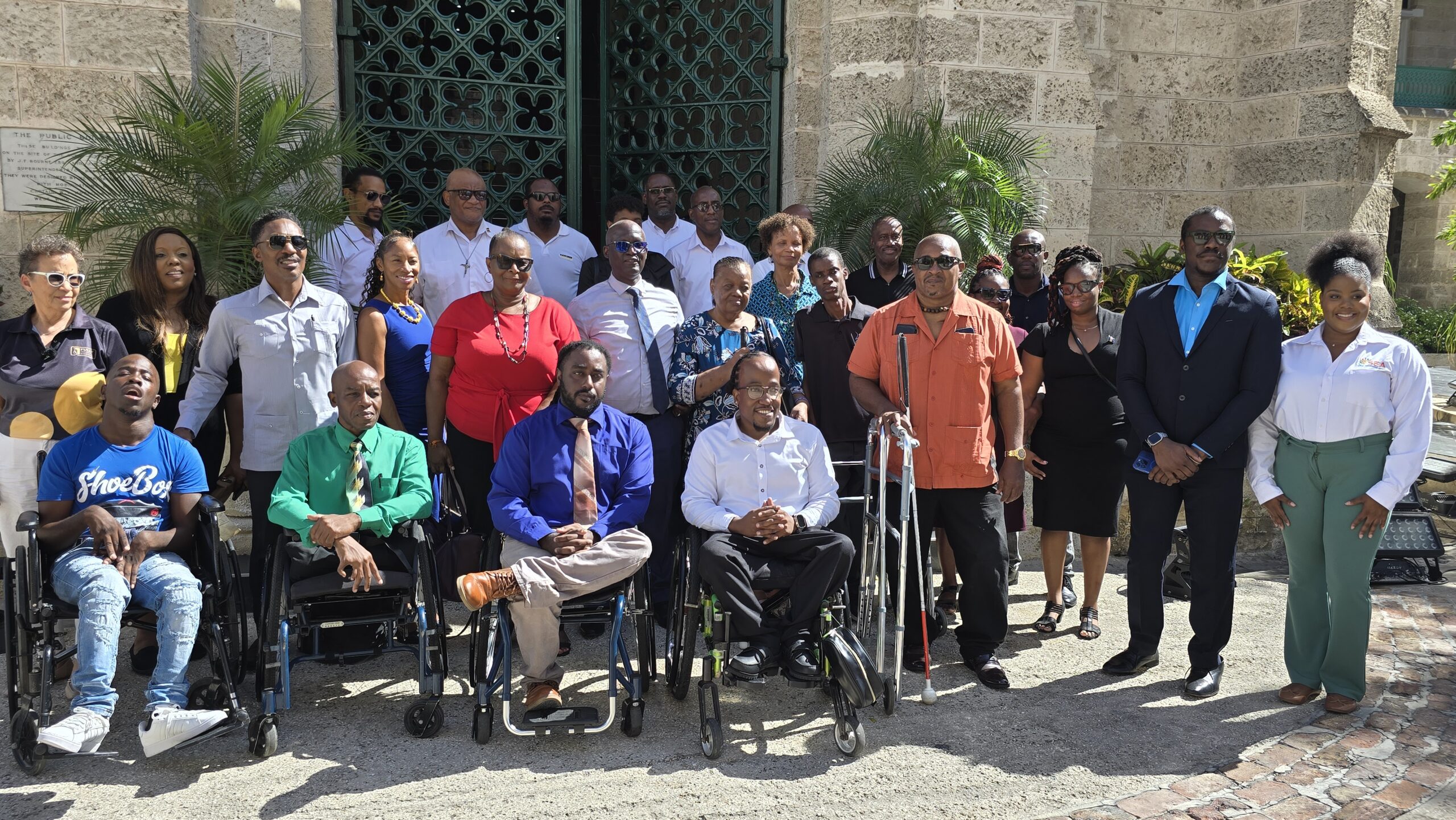
On a Wednesday press briefing, wheelchair users and disability advocacy representatives laid bare longstanding, systemic accessibility barriers that leave dozens of government administrative offices and public healthcare sites across Barbados functionally out of reach for people with mobility impairments, even as the island’s iconic 152-year-old neo-Gothic Parliament Buildings became the first public site to undergo formal evaluation under the newly rolled out national Access for All program. Spearheaded by the Ministry of People Empowerment and Elder Affairs, the landmark scheme is structured to first roll out comprehensive accessibility audits and retrofits across all government-owned facilities, before rolling out targeted guidance and incentives to drive private sector adoption of the same universal access standards. Minister Adrian Forde first unveiled the policy earlier this year, framing the initiative as a critical step beyond just distributing standalone mobility aids for disabled Barbadians, noting that physical infrastructure designed to accommodate all users is the foundational prerequisite for equal civic participation. Speaking at the official project launch held outside the historic Parliament grounds the prior Thursday, Forde emphasized that the government had an ethical and legal obligation to lead by example, rather than imposing new accessibility mandates on private businesses while failing to meet its own internal obligations. He specifically referenced the recently tabled Persons with Disabilities Act 2025, which codifies binding requirements for accessible parking bays, adapted restroom facilities, and a full suite of other reasonable accommodations for disabled members of the public. “We cannot in good faith pass legislation that demands private entities meet these accessibility benchmarks if our own public buildings do not live up to those same standards,” Forde told assembled attendees. He went on to frame the Access for All rollout as a tangible, action-focused milestone: “We have moved past just making statements, and delivered a tangible project that will transform the ability of persons with disabilities to move freely across Barbados and access every public service on an equal footing with their fellow citizens.” Forde confirmed that all auditors conducting the official building assessments are trained members of the Barbados Council for the Disabled, who completed specialized, internationally certified training programs to qualify to carry out the rigorous, standardized accessibility audits. While the government heralded the program as a historic step forward, wheelchair user and long-time accessibility activist Sean Cooke noted that many core government service sites remain effectively inaccessible even today. Cooke cited the Immigration Department and the national Treasury building as two high-traffic sites where he has repeatedly faced insurmountable access barriers, forcing him to request staff to meet him in accessible ground-floor spaces rather than being able to navigate to service counters on upper levels. “If I cannot reach a specific area, we have to ask for help, and staff have to come out to meet me, so we can try to complete our business in a designated accessible zone,” Cooke explained. “Right now, navigating to specific service points in many of these buildings is impossible because of tight, unmodified spaces.” Cooke also flagged widespread accessibility shortfalls at public healthcare facilities, warning that some sites are not adapted even to accommodate people arriving for emergency care. Even with those persistent gaps, he expressed enthusiastic support for the new Access for All project, saying he was optimistic Barbados could achieve full universal public accessibility within a 5 to 10 year timeline. Certified accessibility assessor Christopher Gilkes, who conducted the Parliament audit alongside Roseanna Tudor, operations manager of the Barbados Council for the Disabled, emphasized that accessibility can never be treated as a last-minute retrofit after a building is completed, but must be embedded in the earliest architectural planning stages. He noted that many existing ramps installed across public sites fail to meet official safety and slope specifications, making them unnavigable for many wheelchair users: “There are strict, standardized requirements for ramp gradient, width and landing space, and when we arrive at a site and see a ramp that is far too steep, we have to intervene to correct it before construction finishes. We need to be brought in at the very start of the design process, not halfway through construction or after the building is already finished.” Gilkes also pushed back against the common public misconception that accessibility is limited only to installing ramps, noting that the scope of required accommodations extends far beyond that single feature. “Most people immediately think of ramps when you say accessibility, but it covers so much more: fully adapted restrooms, clear accessible information signage, wide enough doorways that all wheelchair models can fit through,” he outlined. “I have been in public healthcare facilities where standard wheelchairs cannot even fit through the patient room door frames, that is a barrier no one should have to face.” The historic Parliament Buildings, as the first assessed site, presented unique challenges due to its protected heritage status, with audit teams working to adapt modern accessibility upgrades without compromising the site’s 19th century neo-Gothic architectural character. Teams have already installed specialized evacuation mats to address emergency egress gaps created by the building’s single elevator and narrow historic stairways. A second phase of the project will focus on targeted upgrades to make the Senate chamber and House of Assembly fully accessible, though no formal timeline has been released for that next stage of works. Tudor, of the Barbados Council for the Disabled, emphasized the symbolic weight of making the national legislature fully accessible: “This is the space where the voices of all Barbadians are supposed to be represented. How many voices have we never got to hear, simply because that person could not even get through the front door to enter this room?” Senator Janelle Odle, the country’s official National Disability Advocate, echoed that sentiment, noting that every accessibility barrier removed brings Barbados closer to its stated goal of an inclusive, equitable society. “Universal access means exactly that: access for everyone, no arbitrary divides of ‘us’ and ‘them’, no groups excluded from participating in public life,” Odle said, adding that private businesses and non-profit institutions should also integrate accessibility requirements into their core operational planning, rather than treating it as an inconvenient afterthought. Colleen Walcott, executive director of Barbados’ Social Empowerment Agency, confirmed to local outlet Barbados TODAY that the total cost of the Access for All first phase is still being finalized as staff process incoming contractor invoices, and added that the agency’s brand new client centre in Glebe, St George is on track to be fully completed by December of this year.