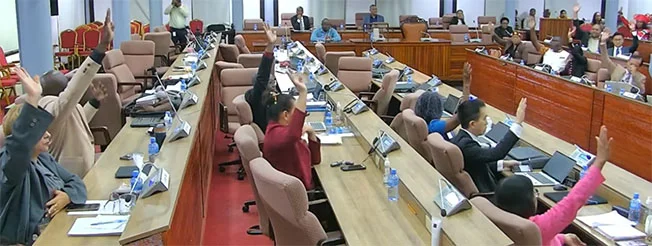
On November 25, Suriname’s National Assembly (DNA) formally adopted two landmark pieces of legislation as part of the country’s sweeping tax system overhaul: the General Tax Act and the Tax Collection Act, following hours of heated parliamentary debate that spanned opposition pushback and even nuanced critical input from ruling coalition members.
The General Tax Act secured passage with 30 votes in favor, though the main opposition VHP faction opted to abstain from the vote rather than cast a formal negative ballot, citing deep-seated objections to the administrative obligations the new rules impose on micro-entrepreneurs and casual supplemental earners. The companion Tax Collection Act passed by a far wider margin of 41 votes.
A central point of contention during floor deliberations was the removal of the longstanding legal distinction between formal tax liable parties and groups previously exempt from mandatory bookkeeping requirements. VHP parliamentarian Krishan Ramsukul argued that this regulatory shift would extend strict administrative mandates to a broad swathe of low-income casual workers, including part-time working students, domestic cleaners, garden maintenance staff, and home-based small sellers who earn modest extra income to top up household budgets. Ramsukul warned that affected individuals would be required to maintain full financial records and retain those documents for a full 10 years, with non-compliance potentially resulting in fines as high as SRD 40,000, and in extreme cases, custodial sentences. VHP faction leader Asis Gajadien and fellow party legislator Mahinder Jogi echoed these concerns, emphasizing that informal assurances from the tax authority that it would apply rules leniently in practice were insufficient legal protection. They noted that vague, unenforced regulatory carve-outs would effectively create dead letter law and open the door to arbitrary, inconsistent enforcement by tax officials.
Adelien Wijnerman, Suriname’s Minister of Finance and Planning, pushed back firmly against these criticisms, stressing that the new framework does not introduce any brand new fiscal obligations, but simply consolidates scattered, overlapping provisions from dozens of older, fragmented tax laws into a single unified formal statute. She emphasized that micro and small business operators would not face extra tax burdens or unfair disadvantage under the new rules, noting that tax authorities already apply differentiated regulatory standards for micro, small, medium and large enterprises in day-to-day operations, and that formalized relaxed rules for small earners will be embedded in upcoming updates to the Income Tax Act as the broader reform process moves forward. Wijnerman also pledged large-scale public outreach campaigns, dedicated training for all tax administration staff, and consistent, equitable enforcement of the new provisions to mitigate implementation risks.
Even members of the ruling coalition raised targeted concerns about the new legislation, however. NDP faction leader and lead rapporteur committee chair Rabin Parmessar noted that the expanded enforcement powers granted to the tax authority under the new rules must be paired with improved public service delivery and timely, accessible legal recourse for taxpayers. He specifically called for robust safeguards for confidential taxpayer data, clear, transparent protocols for publishing tax assessment rulings, and accessible alternative service channels for citizens without reliable internet access or sufficient digital literacy to use online tax portals. Representatives from the NPS faction also pushed for explicit legal guardrails to prevent misuse of the tax agency’s new powers, arguing that a strengthened tax administration without corresponding legal protections for ordinary citizens is incompatible with Suriname’s status as a constitutional state. BEP faction leader Ronny Asabina rejected claims that the new rules were designed to penalize small business owners, framing the two laws as a long-overdue modernization of Suriname’s outdated tax system that prioritizes uniform standards, transparency, legal certainty and equal legal protection for all parties.
The 88-article General Tax Act was amended at the government’s request during debate to adjust its effective date, with the law set to enter into force the day after its official publication. Parmessar hailed the vote as a historic milestone for Suriname’s tax reform journey, acknowledging that the ruling coalition had advanced the legislation on its own after the opposition’s abstention. ABOP faction leader and DNA vice chair emphasized the importance of cross-coalition collaboration to deliver the promised reform benefits to the public.
The newly passed Tax Collection Act grants the national tax administration clear, standardized legal powers and procedural tools to pursue unpaid tax liabilities, with explicit provisions that recognize the unique legal standing of the state as a public creditor. Both laws form the core of a much broader multi-phase fiscal modernization package that will also include full reform of tax court judicial processes, with multiple parliamentary factions calling for close cross-agency coordination to eliminate regulatory gaps and conflicting provisions as the full rollout proceeds.