The Dominican Republic has spent years refining its value proposition to attract global foreign direct investment (FDI), and those efforts are delivering tangible results: as of the close of the first half of 2026, total inbound FDI hit $3.2765 billion, marking a 7.7% rise over the same period in 2025, with roughly two-thirds of that sum, or $2.1946 billion, coming from fresh new capital infusions. The Central Bank of the Dominican Republic projects full-year 2026 FDI will top $5.3 billion, a new milestone for the nation’s investment promotion strategy. Yet as economic analyst and Successment CEO Jonathan Joel Mentor argues, landing that initial foreign capital injection is only the first transaction. The far more impactful, far less discussed “second sale” is convincing the very foreign firms that chose to set up operations in the country to become paying customers for local Dominican businesses, from homegrown software startups and independent service providers to small-scale manufacturers.
Foreign multinational enterprises never arrive on Dominican soil with only their core operations in tow: they bring billions in annual operational spend that spans engineering services, software development, logistics support, legal counsel, accounting and compliance, facility maintenance, construction, cybersecurity solutions, packaging, workforce training, data processing, academic research, heavy equipment procurement and a full spectrum of professional services. While some portion of that global spend will logically remain tied to international suppliers for specialized, niche needs, every category of goods and services that can be competitively sourced locally represents a direct pipeline to turn passive FDI inflows into durable, broad-based domestic economic capability.
This framework deliberately rejects the counterproductive debate over whether multinationals should be legally mandated to purchase local inputs, a policy that often backfires by raising operational costs for foreign firms and shielding uncompetitive local suppliers from global standards. Instead, the critical question centers on how Dominican enterprises, including young tech startups and emerging service firms, can qualify to compete fairly for these procurement contracts, and how large multinational buyers can efficiently discover vetted, capable local vendors. This distinction is non-negotiable: global corporate procurement is not a charitable program, it operates on strict, non-negotiable metrics of consistent quality, cost efficiency, on-time delivery, full auditability and risk mitigation.
OECD’s latest country economic assessment underscores just how high the stakes are to bridge this gap: foreign-owned firms operating in the Dominican Republic deliver 78% higher labor productivity than their domestic counterparts, pay an average of 110% higher wages, and boast far stronger export orientation than local businesses. That massive performance premium makes the lack of deep backward linkages between these high-productivity foreign firms and the broader domestic economy one of the country’s most pressing missed opportunities. The OECD report confirms that these linkages remain extremely limited, especially in the nation’s free trade zones, where surveyed foreign operators consistently note that available local inputs are often either more expensive than global alternatives or fail to meet required international quality benchmarks. This creates a peculiar economic paradox: some of the country’s most productive, globally connected firms and some of its most ambitious, promising domestic suppliers operate within the same national borders, yet almost never connect for commercial transactions.
Productivity gains and technical expertise do not “leak” passively out of multinational headquarters into the wider local business ecosystem, the OECD emphasizes. Instead, knowledge, skills and operational best practices only transfer through concrete, structured channels: formal long-term supplier partnerships, fair market competition, and skilled labor mobility between foreign and domestic firms. Supplier contracts are not a trivial afterthought to FDI attraction: they are the primary transmission mechanism for spreading that high multinational productivity across the entire domestic economy. Without those formal commercial ties, foreign firms can remain isolated high-productivity enclaves, while the vast majority of local Dominican businesses remain locked out of that high-performance operational ecosystem.
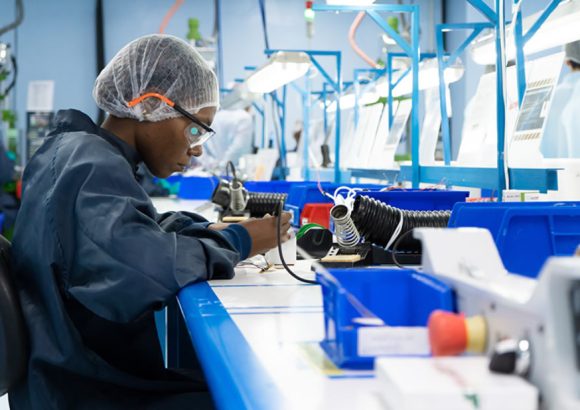
A recent OECD deep dive into the Dominican Republic’s burgeoning semiconductor and microelectronics sector lays bare the scale of this gap in practical terms. Right now, most local firms in the space only supply low-value, basic goods such as paper and cardboard packaging, while one major international electronics manufacturer confirmed it is forced to source all specialized components from overseas, because no local Dominican supplier can meet the strict AS9100 aerospace industry quality standard. The foreign investor is already present in the country, the demand for those components already exists, but local firms have no clear, supported path to qualify for those purchasing contracts. If the barrier is lack of required international certifications, casual business introductions will not fix the problem. If the barrier is limited access to procurement decision-makers, generic matchmaking workshops will not resolve it. If the barrier is insufficient working capital to fulfill a large first order, even a pre-approved contract will go unfulfilled. Public officials routinely celebrate the ribbon-cutting ceremonies that mark a new foreign investor’s arrival, but formal vendor qualification processes are what determine whether that initial investment generates compounding, long-term benefits for the local economy.
Right now, Dominican economic agencies track FDI inflow metrics with extreme precision, but they have almost no visibility into what happens after a foreign firm sets up operations. The full installed base of foreign-invested firms across the country represents hundreds of millions of dollars in untapped potential demand for local software, professional services, logistics support and manufactured inputs, but national investment dashboards offer almost no data on which of those spending categories can be competitively sourced from local businesses, which startups and established domestic firms are just one certification, one tailored financing package or one vendor onboarding step away from qualifying for those contracts, and which public or private stakeholder is responsible for connecting qualified local suppliers directly to actual procurement decision-makers. These granular commercial questions rarely make it to high-profile investment promotion scorecards, but they are the exact factors that determine whether the productivity gains of FDI stay locked inside foreign firm walls, or spread to build widespread, permanent capability across the entire Dominican private sector. This is the point where investment promotion stops being a marketing and branding exercise, and starts actively shaping the long-term competitiveness of the national economy.
To demystify this “second sale” process for local entrepreneurs, economic development firm Successment has outlined four non-negotiable commercial pillars that must be addressed to unlock FDI spillovers: first, demand legibility, to ensure Dominican suppliers have full, transparent information on exactly what foreign-invested firms purchase, and where that demand is allocated; second, supplier readiness, to support local firms to meet every requirement of global buyers around standards, pricing, delivery timelines, quality consistency and regulatory compliance; third, procurement access, to create a trusted, streamlined pathway for fully qualified local suppliers to complete vendor onboarding and connect directly to the budget holders at foreign firms; and fourth, capability capture, to ensure that winning a multinational contract leaves the local firm more productive, internationally certifiable and positioned to enter global export markets. For local startups and small suppliers, this framework turns an abstract economic concept into actionable steps, and prioritizes real contract wins over vanity metrics like the number of networking introductions arranged at industry events.
All too often, public supplier development programs stop at generic workshops, static online supplier directories and superficial matchmaking events. While these activities can create minor incremental value, the only outcome that matters for export-focused local startups and small suppliers is not how many new contacts they make, but whether they can actually meet global buyer requirements and secure paid commercial contracts. Effective, results-driven supplier development programs start from the actual, documented purchasing requirements of existing foreign buyers, use those requirements to define targeted support for local suppliers to close capability gaps, and use a signed, fulfilled contract as the ultimate measure of program success. Local banks, academic institutions, export promotion agencies and industry trade bodies all oversee different pieces of this complex ecosystem, and their collective value is measured by how many real, qualified local suppliers they connect to active multinational procurement pipelines, not by how many separate standalone programs they operate.
Once a local firm wins that first formal multinational supplier contract, the economic benefits compound rapidly: the business gains access to improved operational processes, internationally recognized quality certifications, stronger credibility with local lenders for expanded financing, and a prestigious global client reference that carries enormous weight with buyers in overseas markets. This strategy is not a push for poorly designed, mandatory local content rules that would force multinationals to overpay for low-quality domestic inputs and erode the Dominican Republic’s attractiveness as an FDI destination. The far more ambitious, far more sustainable goal is to cultivate a new generation of Dominican firms that can win global supplier contracts purely on merit, competing on an equal footing with vendors from any other country in the world. A Dominican supplier that learns to meet strict multinational standards does not just become a better local vendor: it becomes a globally competitive enterprise that can sell its goods and services to clients across the world. In this model, the foreign investor is far more than a source of initial capital: it acts as a demanding, high-bar first customer, a credible reference account, and a natural bridge for local firms to integrate into global regional and international value chains.
The Dominican Republic has already mastered how to make itself visible and attractive to global foreign capital. Its next major competitive advantage will be making its own local founders, small business owners and emerging suppliers fully visible to the vast network of multinational procurement teams already operating within its borders. Attracting the initial foreign investment will always be the first transaction, but that critical second sale, the act of turning that foreign investor into a paying local customer, is what separates FDI that simply lands on Dominican soil from FDI that builds permanent, world-class Dominican industrial and technological capability. Capital inflow numbers make for flattering press releases, but actual signed supplier contracts are the far more reliable, far more revealing metric of long-term economic success.