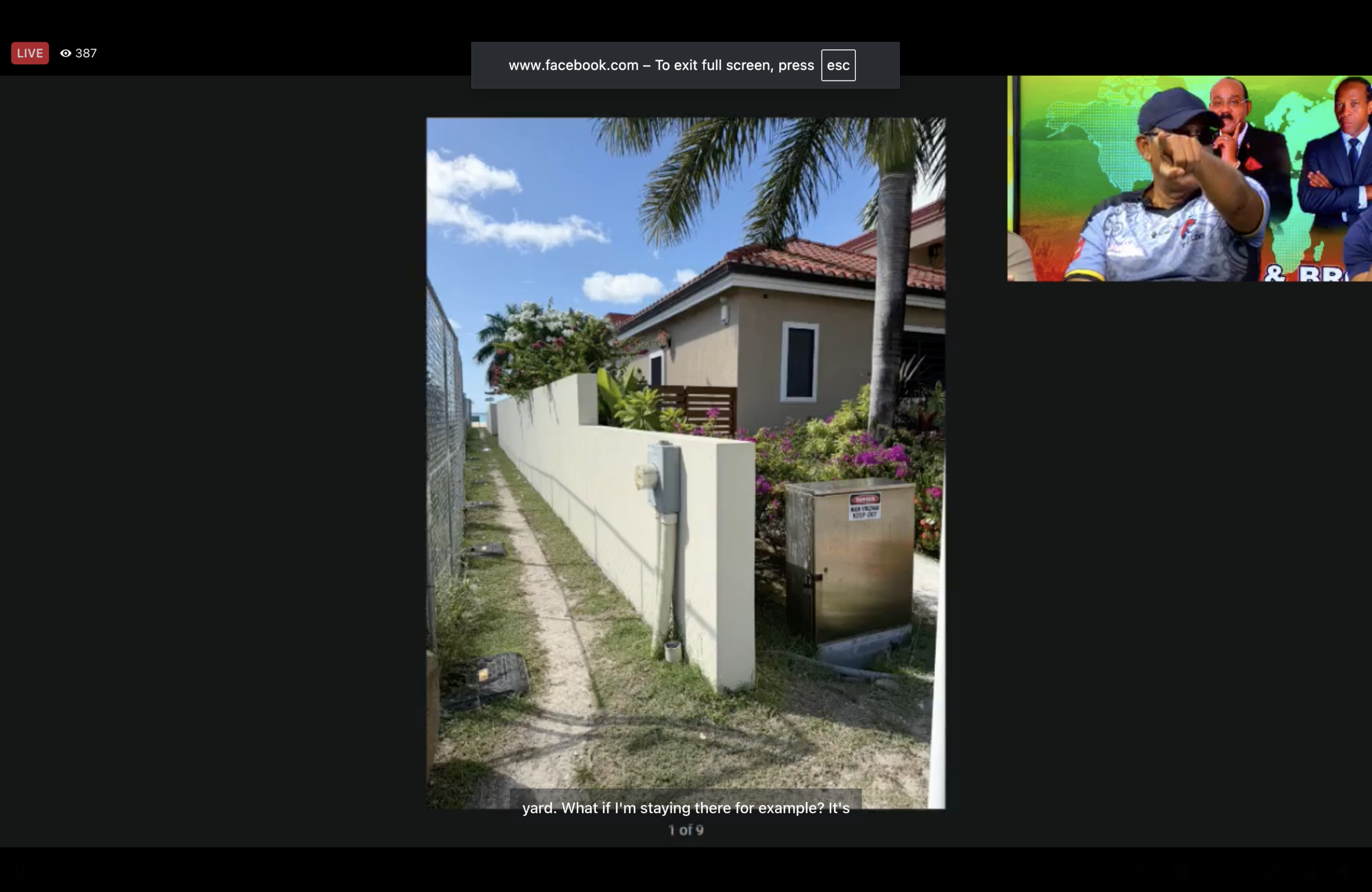
During a recent appearance on the local “Browne and Browne Show” broadcast on Saturday, Antigua and Barbuda Prime Minister Gaston Browne moved to address growing public concerns over restricted beach access at Jolly Beach, confirming that all current parking and shore access protocols are interim measures implemented to accommodate ongoing construction of the new Nikki Beach hotel development.
Browne explicitly pushed back against circulating claims that the government had permanently eliminated public access to the popular shoreline to make way for the private hospitality project. He noted that following negotiations with the hotel developers, a 40-vehicle temporary parking zone had been established for beach visitors, which he personally inspected earlier that same Saturday and found to be holding over 20 parked vehicles at the time of his visit. A temporary wooden pedestrian walkway has also been installed to connect the makeshift parking area directly to the beach, a route Browne emphasized is actually shorter than the previous access path that ran adjacent to the now-defunct Castaways property.
“This is not a permanent setup by any means,” Browne stated during the broadcast. “These temporary rules are only in place for the duration of active construction work on the hotel site.”
The prime minister further clarified that the long-term master plan for the site will repurpose a section of the broader Jolly Beach land parcel to deliver parking spaces positioned far closer to the shoreline, a more streamlined public access route, and upgraded shared amenities including public restrooms, with the full site eventually operating as a dedicated public beach park. He addressed longstanding confusion over the status of the former Castaways parking lot, confirming that the parcel was privately owned and originally reserved exclusively for patrons of the on-site restaurant, rather than a government-managed public parking facility as many local residents had assumed. Browne explained that the entire Jolly Harbour area was subdivided into privately owned parcels back in the 1980s, with no remaining Crown land on the site, and the government never sold any pre-existing public park or public parking land to the Nikki Beach development team. He noted that while local residents had informally used the old Castaways lot for beach trips for years, casual public usage did not legally reclassify the privately held land as a public amenity.
Browne outlined that the temporary access framework was deemed a necessary compromise to avoid disrupting active on-site infrastructure work for the new hotel, and that the administration had already secured formal agreements with developers to deliver far more visitor-friendly permanent arrangements once construction wraps up. The Jolly Beach upgrade is not an isolated initiative, he added, but part of a national government campaign to expand and formalize public beach access across the entire island of Antigua. A dedicated inter-agency committee has been established to audit all existing public shore access points across the country, and negotiate in good faith with private landowners to secure new formal access routes where gaps currently exist. Browne emphasized that the government cannot unilaterally seize or build access roads on privately owned land, so negotiations must balance three core priorities: hotel site security, residential privacy for nearby property owners, and the fundamental public right to access the island’s shorelines.
Formalized upgraded access plans have already been drafted for two high-priority sites: Jolly Beach and Pearns Point, both of which will feature expanded public parking, modern public restrooms, and far more convenient, barrier-free routes to the shore. Browne also voiced his explicit support for a recent grassroots public petition advocating for legal protections for public beach access across Antigua, noting that the widespread public support demonstrated by the petition will significantly strengthen the government’s negotiating position during upcoming discussions with private coastal landowners. While Browne confirmed that the ongoing hotel construction has temporarily altered the public’s usual route to Jolly Beach, he reiterated that permanent public access has never been at risk, though he declined to share a specific completion timeline for the Nikki Beach hotel or the corresponding permanent public beach facilities.
There are two access points to Jolly Harbour Beach, changes temporary during Nikki Beach construction, prime minister says