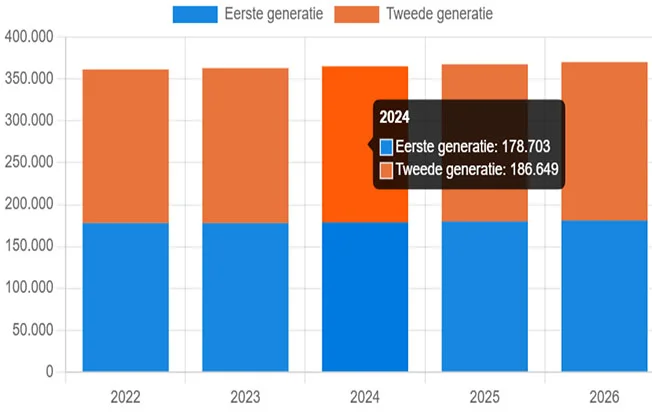
Against the backdrop of Suriname’s 51st independence anniversary celebrations, Robby Makka, chair of the Platform Surinaamse Diaspora (PSD), presented a landmark long-term strategic roadmap titled *The Future of the Surinamese Diaspora (2026–2050)* in Amsterdam on a recent Friday, calling for a fundamental overhaul of the South American nation’s relationship with its global overseas communities. Long framed merely as a network of expats sending remittances and maintaining family ties back home, the diaspora should be recognized as a full, equal stakeholder driving Suriname’s inclusive growth, the proposal argues. Official 2026 demographic data cited in the presentation underscores the scale of this untapped resource: in the Netherlands alone, 180,963 first-generation Surinamese immigrants and 189,318 second-generation residents born locally with Surinamese heritage add up to a community of over 370,000 people, with an additional 11,556 Dutch residents holding active Surinamese citizenship. Beyond the Netherlands, sizable Surinamese communities in the United States, Canada and other host countries hold vast reserves of specialized expertise, cross-border professional networks, entrepreneurial capital and global industry insights that have largely been underutilized under current ad-hoc engagement policies. The roadmap lays out concrete, actionable measures to shift from sporadic, transactional diaspora outreach to a formal, legally anchored structural partnership. A top priority is the introduction of a Framework Diaspora Act, which would codify the rights, obligations and collaborative governance structures for diaspora engagement, eliminating the risk of policy rollbacks with every change of national administration. The proposal also calls for a streamlined, modernized Persons of Surinamese Origin (PSA) scheme to remove administrative barriers for overseas Surinamese seeking residency, launch economic activities, and access core civic rights in their ancestral homeland. To give diaspora communities formal political voice, the strategy floats the creation of a dedicated overseas electoral district to grant expats representation in Suriname’s democratic system, alongside a permanent independent advisory body that would advise the national government and parliament on diaspora policy, investment climate reform and pressing social challenges. Dedicated professional diaspora service hubs would also be established to streamline collaboration between Suriname’s public sector, local businesses, and global expat communities. Makka’s presentation also sounds a critical alarm over a parallel domestic crisis: a 2026 perception study conducted under the Suriname 3.0 trajectory by sociologist Jaïr Schalkwijk found that over half of young Surinamese residents are considering emigrating within the next five years, driven by limited economic prospects, stagnant purchasing power, a severe shortage of affordable housing, uncertain career paths, and widespread public concerns over corruption, weak rule of law, declining education standards and unequal labor market opportunities. The roadmap emphasizes that no diaspora engagement policy can succeed if Suriname continues to lose its domestic young talent pool, and outlines targeted roles for the global diaspora to reverse this brain drain: including mentorship programs, guest lectures, structured internship placements, startup coaching for local young entrepreneurs, and targeted investments in domestic education and small business ecosystems. The presentation frames Suriname’s emerging offshore oil and gas sector as a unique catalyst to unlock diaspora investment, noting that opportunities extend far beyond direct participation in the energy industry: high-priority growth areas for expat engagement include residential construction, sustainable agriculture, tourism, renewable energy expansion, healthcare modernization, digital infrastructure and public works. Proposed mechanisms to de-risk investments for overseas Surinamese include dedicated secured diaspora investment funds, co-investment schemes that pair expat capital with local small business operators, and targeted financial inclusion initiatives to lower barriers to capital formation for community members. The full 24-year strategy is split into three sequential implementation phases: the 2026 to 2030 foundational phase will focus on building trust, passing the Framework Diaspora Act and updated PSA regulations, launching pilot investment funds and rolling out initial joint collaborative projects. Between 2030 and 2040, the partnership will scale up, with a portion of oil and gas earmarked to fund upgrades to education, healthcare and national infrastructure, alongside expanded cross-border student and professional exchange programs. The final 2040 to 2050 phase aims to deliver a globally connected, highly diversified Surinamese economy where the diaspora contributes on a permanent, structural basis to national innovation, entrepreneurial growth and social advancement. Makka repeatedly stresses that the entire strategy is contingent on non-negotiable foundational prerequisites: strong, transparent governance, aggressive anti-corruption enforcement, and guaranteed legal certainty to build long-term trust with diaspora investors, with all collaboration rooted in mutual respect and equal standing, ensuring that diaspora expertise and investment never come at the expense of local Surinamese talent development. Founded in November 2013, the PSD now maintains formal ties with over 100 diaspora organizations across the world, and has delivered more than 50 community-focused initiatives to date. “Suriname’s future is not built solely within its national borders,” Makka concluded in his keynote address. “It is constructed by one interconnected global Surinamese community, working in tandem to unlock the nation’s full potential.”
Makka pleit voor wettelijke verankering diasporabeleid en politieke vertegenwoordiging