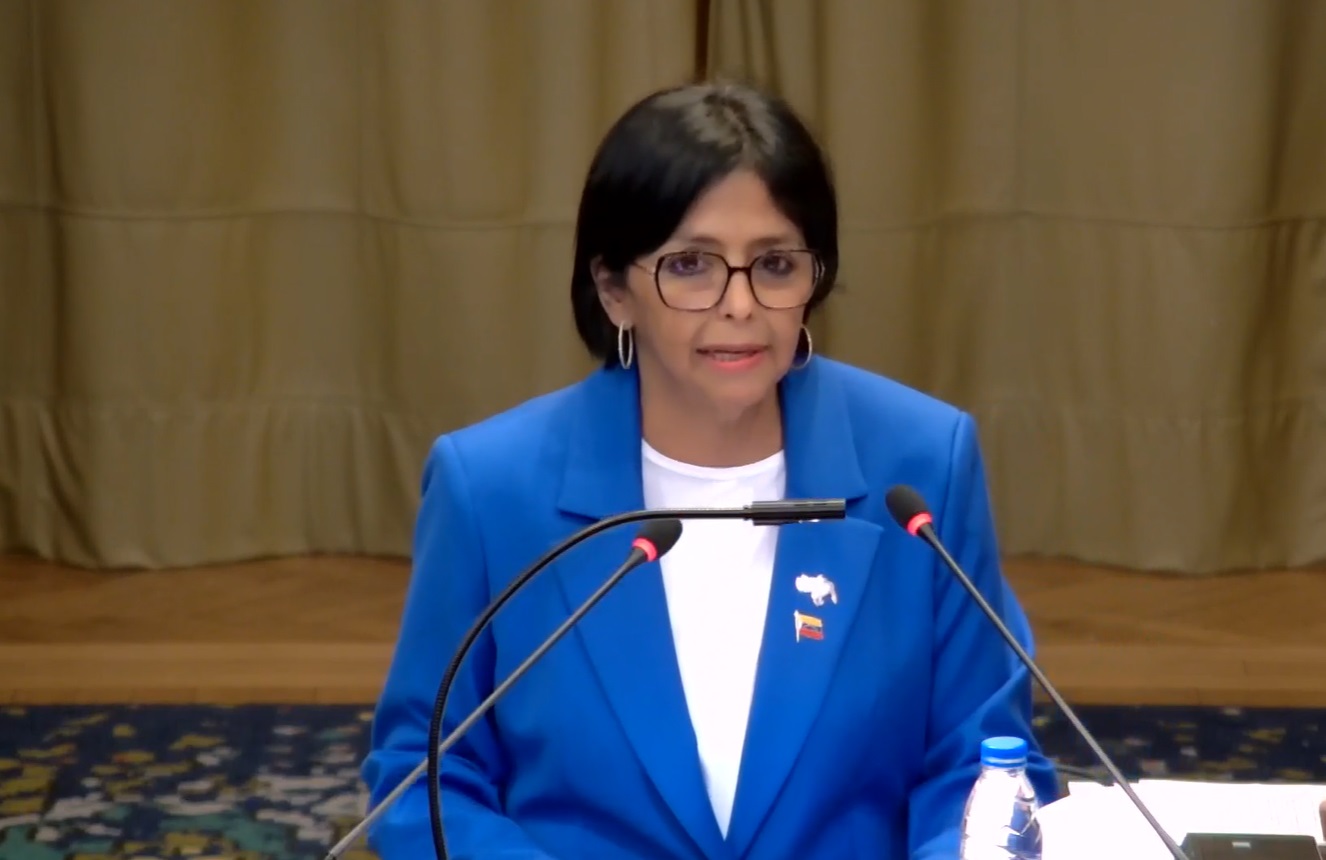
Just 24 hours after the United States publicly reaffirmed its formal recognition of the 1899 land demarcation line between Guyana and Venezuela, or any future boundary set via mutually agreed negotiations or a competent international court ruling, Venezuela’s interim President Delcy Rodríguez Gómez issued a formal public statement doubling down on her administration’s longstanding refusal to abide by any forthcoming verdict from the International Court of Justice (ICJ) on the decades-old Essequibo territorial row.
Rodríguez Gómez framed the 1899 arbitral award that established the border as a fraudulent, illegitimate document, stating explicitly that Venezuela rejects both the original 1899 ruling and any subsequent decision issued by the ICJ to resolve the dispute over the 160,000-square-kilometer Essequibo region, which has been under Guyanese administrative control for more than a century. Instead of proceeding with the ongoing ICJ legal process, the Venezuelan leader pushed exclusively for direct bilateral negotiations between the two South American nations, citing her country’s unilateral interpretation of the 1966 Geneva Agreement, a diplomatic accord signed to mediate the long-simmering border tensions.
In a follow-up post published on her official social media channels, Rodríguez Gómez argued that no nation should be permitted to evade its pre-existing international commitments by outsourcing dispute resolution to external third-party bodies whose involvement runs counter to previously agreed diplomatic obligations. Notably, Venezuela has participated in every stage of the ICJ proceedings to date despite its repeated formal objections, after the global highest court previously ruled that it held full legitimate jurisdiction to hear and adjudicate the substantive case over the validity of the 1899 arbitral award. Even so, Rodríguez Gómez called on the government of Guyana to uphold what she framed as its non-negotiable obligations under the 1966 Geneva Agreement to pursue a bilateral, mutually satisfactory resolution outside of the UN judicial body.
The latest round of diplomatic posturing comes in the wake of unconfirmed reports that former U.S. State Department policy chief Jeremy Lewin held a private meeting with Guyana’s Foreign Secretary Robert Persaud in Washington back in September, during which he allegedly offered to facilitate direct talks between Guyanese officials and acting Venezuelan President Delcy Rodríguez. To dispel public speculation about shifting U.S. positions, the U.S. State Department released an official statement clarifying that its longstanding policy on the Guyana-Venezuela land border remained unchanged: Washington continues to fully back the 1899 Arbitral Award that set the two nations’ territorial boundary, and holds that this line must be respected unless and until a new border is formally established either by a competent legal authority or with the explicit mutual consent of both Guyana and Venezuela.
Guyanese President Irfaan Ali echoed this position during a public address on Thursday, emphasizing that his administration’s stance and the U.S. government’s stance on the dispute are fully aligned. “We have made our position abundantly clear, and the U.S. position has been equally unambiguous: they respect our national sovereignty and our territorial integrity, and we have laid out explicitly that the eventual ICJ ruling is the outcome all parties must accept, full stop. There has been zero deviation from that position,” Ali stated. Guyana’s Ministry of Foreign Affairs also issued a follow-up confirmation that it had received formal assurances from U.S. counterparts that no policy shift had occurred in the months following the informal September meeting between Lewin and Persaud.
However, prominent international relations scholar Dr. Mark Kirton, an Honorary Senior Fellow at the University of the West Indies’ Institute of International Relations, has voiced sharp skepticism regarding the motives behind Lewin’s overture, warning that recent related U.S. diplomatic moves warrant close scrutiny. He specifically pointed to remarks made by U.S. Defence Secretary Peter Hegseth in Caracas shortly after the two nations signed a new bilateral military cooperation agreement, in which Hegseth stated that Venezuela had transitioned from the United States’ most aggressive regional security threat to a fully compliant security partner. “Secretary Hegseth framing Venezuela as a compliant partner strongly suggests there could be backchannel pushes for some form of mediated settlement that would pressure Guyana to either drop its ICJ claim entirely or enter a new round of open bilateral negotiations that would run directly counter to our national interests,” Dr. Kirton cautioned. “I sincerely hope the Guyanese government will continue to consistently assert that the 1899 Arbitral Award is full, final, and legally unassailable.”
In a related development, newly appointed Venezuelan Defence Minister Gonzalez Lopez released his first public statement since taking office, confirming that the newly established military cooperation framework with Washington was forged in the aftermath of the widely documented “painful events of January 3”, during which U.S. military forces removed former longstanding Venezuelan leader Nicolas Maduro from power. Gonzalez Lopez emphasized that all future bilateral military collaboration between Caracas and Washington would operate strictly within the bounds of Venezuela’s national constitution, and would fully uphold the South American nation’s sovereignty, political independence, and territorial integrity. He also stressed that Venezuela’s armed forces would retain unchallenged full authority over its internal leadership structure, operational command chains, and all independent military activities moving forward.
Venezuela’s President pushes back at Guyana, reiterating only negotiations can settle border controversy