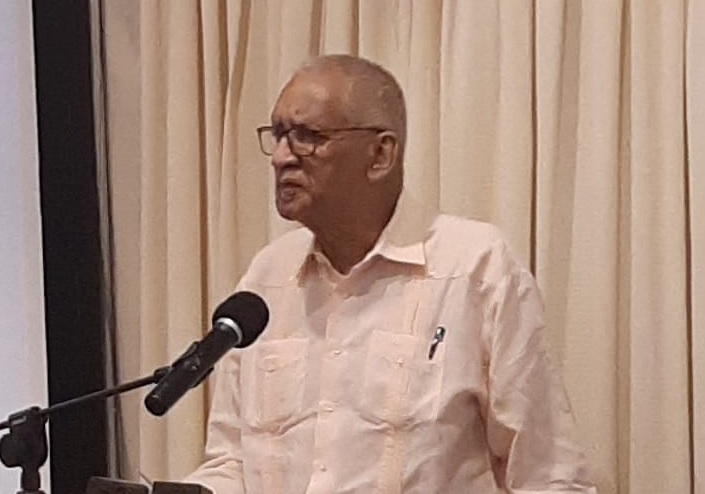
Leading Guyanese international relations scholar Professor Mark Kirton has raised critical concerns that the United States’ public support for Guyana in its decades-long territorial dispute with Venezuela over the resource-rich Essequibo Region is not absolute, creating a clear opening for Washington to push for a U.S.-brokered negotiated settlement even after the International Court of Justice (ICJ) issues its final ruling. The debate has erupted following a recently disclosed September 2026 meeting in Washington, where then-senior U.S. State Department policy official Jeremy Lewin offered Guyanese Foreign Secretary Robert Persaud his assistance to arrange direct territorial talks with Venezuela’s acting President Delcy Rodriguez. Lewin, who departed his post the previous month, is said to have framed the overture as a pathway to de-escalate cross-border tensions, prompting an immediate public rebuke from Guyanese officials. The U.S. State Department later released a carefully calibrated official statement reaffirming backing for the 1899 Arbitral Award, the historic legal ruling that first demarcated the shared land boundary between the two South American nations, while adding caveats that the award would only remain in force unless a new boundary was established either by a competent legal body or with the mutual consent of both Guyana and Venezuela. Kirton, who heads Guyana’s independent Centre for International and Border Studies and serves as an Honorary Senior Fellow at the University of the West Indies’ Institute of International Relations, welcomed Guyana’s swift rejection of Lewin’s unprompted mediation offer, and urged the Georgetown administration to hold firm to its longstanding position that the upcoming ICJ verdict will be the sole legally binding resolution to the dispute. Guyanese President Irfaan Ali reaffirmed this stance publicly on Thursday, stating that both Guyana and the U.S. had made their positions unambiguous: Washington fully respects Guyana’s sovereignty and territorial integrity, and all parties must accept the ICJ’s forthcoming ruling as the final word on the matter. But Kirton warned that the two qualifying clauses in the U.S. State Department’s official statement – referencing the possibility of a new boundary set by mutual party consent – represent explicit markers of Washington’s intent to retain influence over a potential bilateral settlement for the 160,000 square kilometre Essequibo territory, a region rich in mineral reserves, old-growth forest and recently discovered offshore oil deposits. Speaking to Demerara Waves Online News via phone from within the Essequibo Region, Kirton noted that Venezuela’s acting President Delcy Rodriguez had already told the ICJ during September proceedings that bilateral negotiations, rather than a court-imposed ruling, would produce a more durable long-term agreement, even as Caracas continues to reject the ICJ’s jurisdiction over the case entirely, referencing the 1966 Geneva Agreement that first established a framework for bilateral talks. The dispute has grown more complex following a surprise November 18 visit to Caracas by U.S. Secretary of Defence Pete Hegseth, where the two nations signed a formal military partnership agreement – a development Kirton characterizes as a core component of the current U.S. administration’s transactionalist foreign policy approach. Notably, Hegseth made repeated public references to Venezuela’s territorial sovereignty during the visit, but issued no public pushback against Caracas’ 2023 referendum and subsequent constitutional amendment that formally designated the Essequibo as Venezuela’s 24th state, a move that erased the internationally recognized 83,000-square-mile borders of Guyana from official Venezuelan state maps. Kirton questioned whether the newly signed U.S.-Venezuela military cooperation framework was designed to create new avenues for Washington to pressure Guyana to abandon its ICJ case entirely and enter fresh bilateral negotiations, a scenario he emphasized would run directly counter to Guyana’s national interests. Al Jazeera reported Thursday that newly appointed Venezuelan Defence Minister Gonzalez Lopez issued his first public statement since taking office, noting that the new U.S.-Venezuela military partnership was forged in the aftermath of the January 3 military operation that removed former leader Nicolas Maduro from power. Lopez added that all future military cooperation with the U.S. would be conducted in full alignment with Venezuela’s national constitution, and would uphold the nation’s sovereignty, independence and territorial integrity, while confirming that Venezuela’s armed forces would retain full, unchallenged control over their internal leadership structures, command chains and operational activities.
US’ statement on Guyana- Venezuela border opens possibility for negotiations- International Relations Professor