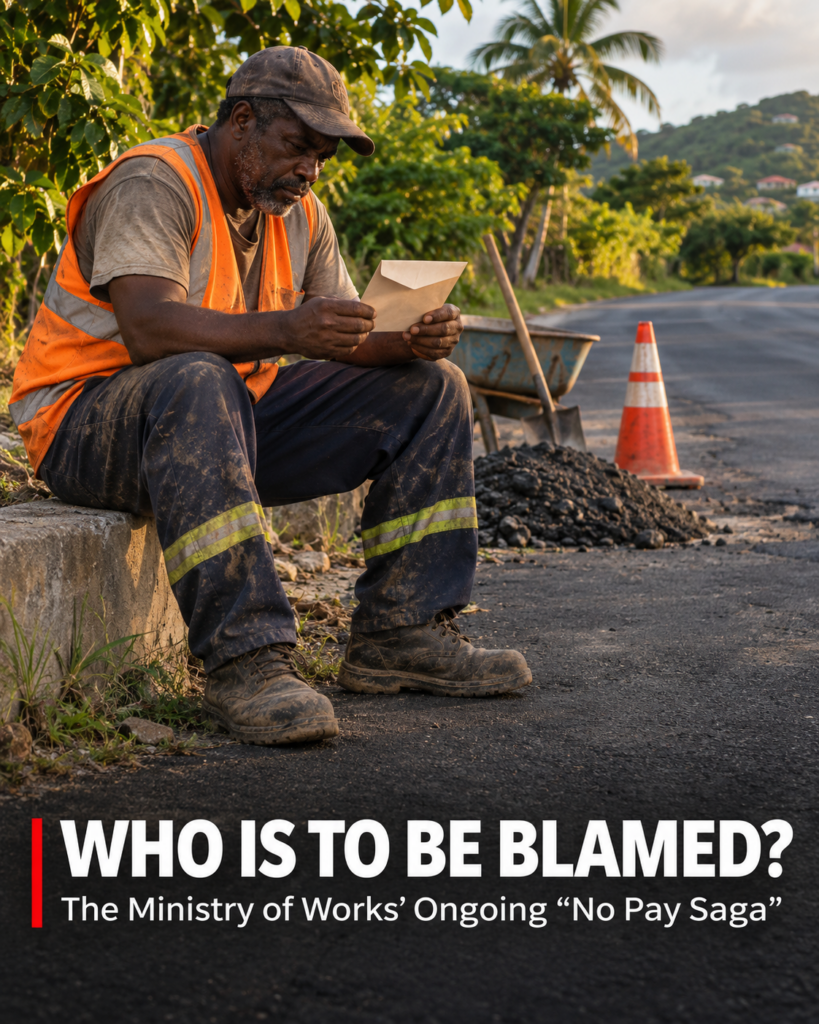
A wave of growing distress is sweeping through rank-and-file staff at Antigua and Barbuda’s Ministry of Works, as hundreds of dedicated public sector employees go months without receiving their legally earned paychecks, with no clear explanation or accountability from senior leadership to resolve the crisis. The ongoing “no pay saga” has left some workers waiting nearly two months for their wages, while others report delays stretching to three, four months or even longer, with many more remaining silent out of fear of professional retaliation. As the Christmas holiday draws near, when most households across the nation are budgeting for festive meals, gifts and family gatherings, these public servants are trapped in a cycle of financial precarity, with no guarantee they will have the resources to provide basic necessities for their loved ones, let alone participate in seasonal celebrations. Long-tenured staff who have served the ministry for decades are still fighting to recoup back wages owed to them, while newly hired employees are forced to plead for compensation for shifts and completed projects they already delivered. None of these workers are requesting special favors, handouts or preferential treatment: they are simply demanding fair payment for hours of honest, consistent labor. Persistent public narratives that dismiss Ministry of Works staff as unmotivated or unwilling to work ignore the stark reality of the dozens of young men and women who show up for their assigned shifts every single day, fulfill all their core job responsibilities, and put in full working hours, only to be denied the wages they are rightfully owed. The daily barriers these workers navigate to even report to their posts are staggering, particularly as regional fuel prices have spiked in recent weeks. Many cannot afford to fill their personal vehicles with enough gasoline to commute to work, while others scrape together scarce funds for round-trip bus fare, often skipping breakfast entirely to save money for lunch and household costs later in the day. The ripple effects of these delayed paychecks extend far beyond the workers themselves, impacting entire households that rely on this income to cover non-negotiable expenses: childcare fees, pending school tuition, medical costs for sick children, monthly rent, grocery supplies, and utility bills that continue to accrue regardless of the ministry’s payment delays. For a growing number of families, electricity disconnection notices are imminent, and the risk of housing instability grows more urgent with every passing week without pay. This crisis has sparked widespread public calls for transparency and accountability, as community advocates and affected employees question who bears responsibility for the systemic breakdown that has allowed these payment delays to drag on for months: the sitting Prime Minister, the assigned Minister of Works, the ministry’s Permanent Secretary, its senior directors, the national Treasury department, or internal accounting teams. Many are also asking if the broader public, which placed its trust in the current administration to prioritize the nation’s best interests, shares partial blame for failing to hold leaders to account sooner. Advocates leading the conversation around the crisis emphasize that this issue is far larger than partisan political posturing, and that frustrated workers should not be dismissed, targeted, or labelled based on perceived political affiliations when they speak out about their lived hardships. They are calling on relevant authorities to stop leaving staff in the dark with no updates, and to openly communicate if the root causes are administrative bottlenecks, procedural hurdles, or unaddressed systemic failures, rather than forcing employees to absorb the entire financial cost of institutional mismanagement. The statement from concerned community contributor “Written In Red” underscores that accountability for public sector operations cannot be optional, and that clear, timely communication from leadership should never be a privilege that workers have to beg to access. The message closes with a heartfelt plea rooted in national pride: as a citizen who loves Antigua and Barbuda and believes deeply in the potential of its people to drive national progress, the author notes that incidents like these erode public hope, and that the nation cannot claim to value hard work as a core cultural principle while refusing to honor the wages of the very people who show up every day to build and maintain public infrastructure. The longstanding principle that “a day’s work deserves a day’s pay” must be upheld, the statement argues, and leaders must step forward immediately to take ownership of the crisis and ensure every affected employee receives every dollar they have fairly earned without further delay.
OPINION: Who Is To Be Blamed? The Ministry of Works’ Ongoing “No Pay Saga”