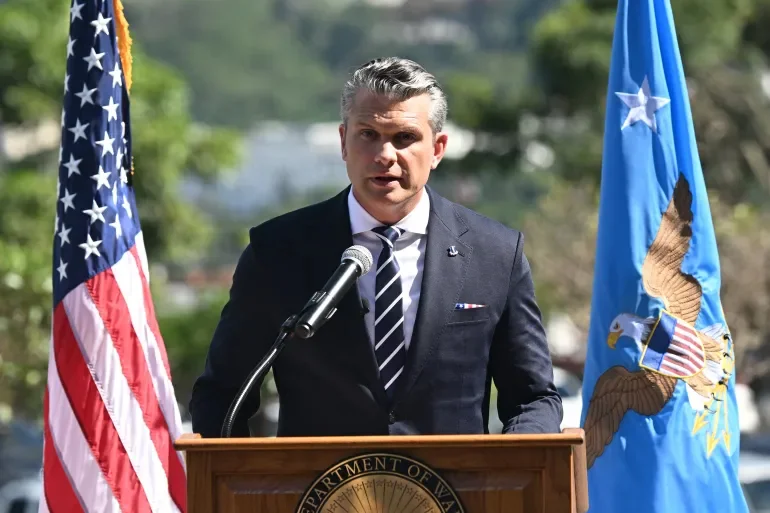
On November 18, 2026, U.S. Defense Secretary Pete Hegseth made an unannounced high-profile visit to Caracas, Venezuela, where he formally announced a landmark bilateral agreement to restart and expand full-scale military cooperation between the two nations, a dramatic pivot after more than a decade of hostile relations, sweeping U.S. sanctions, and mutual diplomatic recriminations. The announcement came during a press conference hosted at the U.S. Embassy in Caracas, following closed-door negotiations with Venezuela’s interim president Delcy Rodríguez.
The newly signed framework covers three core areas of defense collaboration: joint tactical and operational military training, real-time intelligence sharing targeting transnational threats, and coordinated development and procurement of defense equipment and advanced military technology. All formal military ties between the two capitals had been largely frozen for years, until a U.S. military operation in January 2026 ousted the long-standing Maduro administration and paved the way for Rodríguez’s interim government to take power.
Hegseth framed the pact as a historic reset for regional security, noting that Washington no longer views Venezuela as a regional destabilizing threat, but as a critical operational partner to crack down on cross-border drug trafficking, transnational criminal syndicates, and other shared public safety risks across the northern South America corridor. Rodríguez, in turn, hailed the agreement as a transformative step for Venezuela’s national defense, stating that the partnership would raise the professional capacity of the Venezuelan armed forces, upgrade long-neglected military hardware, grant access to cutting-edge defense technology, strengthen territorial border protection, and create more coordinated responses to common security challenges. No public details have been released to date regarding specific implementation timelines, scope of operations, funding allocations, or troop deployment parameters under the accord.
This military cooperation framework is not an isolated development: it is a core component of a broader U.S. strategy to expand its footprint and influence across Venezuela in the months following the January 3 operation that detained former president Nicolás Maduro and transferred him to U.S. custody. The Trump administration has steadily deepened engagement with Rodríguez’s interim government across multiple high-stakes sectors beyond defense, including the Venezuelan oil industry and development of the country’s vast reserves of strategic critical minerals. U.S. firms have already secured expanded access to negotiate deals for developing dormant Venezuelan oil fields and directing new foreign direct investment into the energy sector, giving Washington significant leverage over the long-term economic trajectory of the South American nation. The unprecedented rapprochement has drawn widespread attention because Rodríguez previously served as a senior official in the Maduro government, which Washington spent nearly two decades designating as an adversarial regime, signaling that the current U.S. administration is willing to engage with former Maduro loyalists as long as they align with U.S. strategic priorities for the region.
For Venezuela, the agreement carries tangible potential upsides: improved military training, modernized defense equipment, more robust border security, and more effective disruption of criminal networks could help stabilize a country that has grappled with years of hyperinflation, systemic institutional instability, and widespread public safety crises. The interim government argues that a more secure operating environment will also unlock new foreign investment and kickstart long-stalled economic recovery. At the same time, critics inside and outside Venezuela have raised sharp concerns that the deepening U.S. footprint will erode Caracas’s national sovereignty over its own defense and security policy, noting that U.S. influence has surged dramatically since Maduro was removed from power. Skeptics warn that the terms of future cooperation could prioritize U.S. strategic and economic interests over Venezuela’s domestic public priorities, leaving the country increasingly dependent on Washington. Major unresolved uncertainties hang over the path ahead, including the long-term political legitimacy of the Rodríguez interim government, the restructuring process for the Venezuelan armed forces, and a clear timeline for long-promised national elections.
The ripple effects of the pact extend far beyond the two signatory nations, reshaping long-standing regional security dynamics across the Caribbean and broader South America. The agreement formalizes a major expansion of U.S. military and security engagement in the Western Hemisphere focused on counter-narcotics operations, targeting armed non-state groups, and strengthening maritime security. For Caribbean nations, the expanded U.S. military presence will mean Washington exerts far greater influence over the regional security agenda, potentially leading to more frequent joint patrols, expanded intelligence sharing, and large-scale coordinated military exercises across coastal zones. The shift also risks triggering new geopolitical frictions: Venezuela maintained longstanding close diplomatic and military partnerships with Russia, China, and Iran under the Maduro administration, and the new alignment with the U.S. is expected to force a full recalibration of Caracas’s relationships with those traditional allies. Neighboring nations Suriname and Guyana, which already face shared pressures from cross-border smuggling, disputed maritime territories, and unregulated extractive activities, face a dual set of outcomes: the expanded U.S. security role could bring new funding and operational support for their own domestic security efforts, but it also risks upending the delicate geopolitical balance across northern South America.
Ultimately, the pact represents far more than a simple resumption of long-suspended military ties: it encapsulates a sweeping shift in U.S. hemispheric strategy that explicitly links defense cooperation, access to natural resources, and expanded political influence across the Western Hemisphere. The full scope and long-term impact of the new partnership will only become clear as implementing details are negotiated in the coming months, and as Venezuela’s domestic political transition continues to unfold.
VS en Venezuela hervatten militaire samenwerking en sluiten defensieakkoord