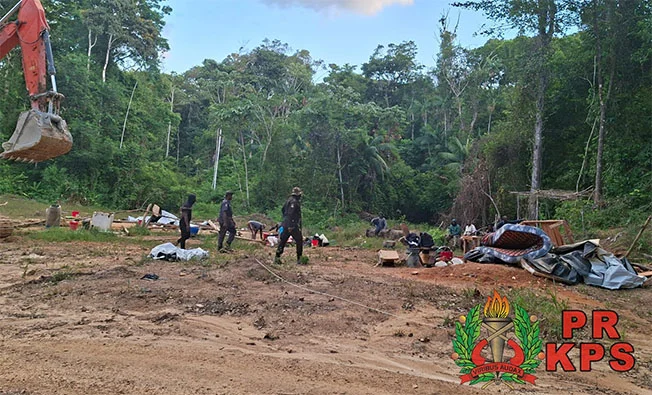
Suriname’s Central Regional Police, acting on formal requests from the national Public Prosecutor’s Office, wrapped up a four-day large-scale enforcement operation across the remote Sarakreek gold mining zone on 17 November. The coordinated multi-agency raid drew specialized support from the National Environment Authority, Suriname Water Supply Company, and the national Trafficking in Persons unit, targeting unregulated, unlawful gold extraction operations that had operated with impunity for months. Officers first moved to shut down multiple unlicensed mining sites, detaining a total of eight suspects on a range of alleged offenses. The most high-stakes discovery during the sweep was a series of unmarked processing basins positioned just a short distance from the critical regional reservoir, where authorities suspect untrained operators have been using cyanide to separate gold from raw ore without any environmental safety protocols. Cyanide exposure at even low concentrations can trigger irreversible damage to aquatic ecosystems, contaminate drinking water supplies for nearby communities, and cause acute life-threatening health harm to human populations. Field teams from the National Environment Authority and water utility collected comprehensive water and sediment samples from the basin sites and surrounding reservoir stretches, which are now being analyzed in the capital Paramaribo to confirm the presence of toxic substances and measure the scope of any existing contamination. One Brazilian national who operated the unlicensed cyanide processing sites was arrested and placed in pre-trial custody, but was released the same day following an out-of-court settlement approved by the Public Prosecutor’s Office, after paying a sum of 1 million Surinamese dollars. Official police disclosures have not yet clarified the specific legal basis for this settlement, the full list of formal charges against the Brazilian operator, or whether the payment was designated as compensation for potential environmental harm. During searches of makeshift mining settlements and a nearby general store, officers encountered armed private guards who stated they had been hired to protect mining operations and valuable extracted gold. Six of these individuals were taken into custody, facing charges of violating national firearms regulations and participating in a criminal organization. Seized weapons from the sites include two AK-47 assault rifles, two FAMAS light machine guns, multiple handguns and hunting rifles, alongside a massive stockpile of assorted ammunition. The operation also followed up on verified tips shared by the International Organization for Migration, the U.S. Embassy in Paramaribo, and Australian diplomatic partners, regarding reports of women being coerced into sexual labor at an unlicensed local cabaret linked to the mining camps. Investigators located four young women aged 18 and 19 who are believed to be victims of human trafficking, and one suspected trafficker was arrested before the case was formally transferred to the dedicated anti-trafficking unit. Authorities also responded to an on-site tip that a wooden boat loaded with suspected cyanide cargo had sunk in the reservoir near the Stong Kampoe settlement, with initial unconfirmed reports of mass fish deaths in the area. Patrol teams were unable to locate the sunken vessel during sweeps of the waterway, and no dead fish were observed at the scene, though additional water samples were collected to test for potential cyanide leaks. All heavy mining equipment found operating without valid extraction permits was seized during the operation, including an excavator, front-end loader, two all-terrain vehicles, a generator and a utility trailer, which were transported more than 235 kilometers to the Klaaskreek official law enforcement checkpoint for secure storage. National police spokespeople confirmed that all parallel investigations into illegal gold mining, unregistered firearms possession, human trafficking networks, and reservoir contamination risks remain ongoing, with lab test results for the collected water samples expected to provide critical evidence to guide follow-up enforcement and public safety measures.
Politie ontdekt cyanidebassins nabij stuwmeer bij grote actie in Sarakreek; aanhoudingen verricht