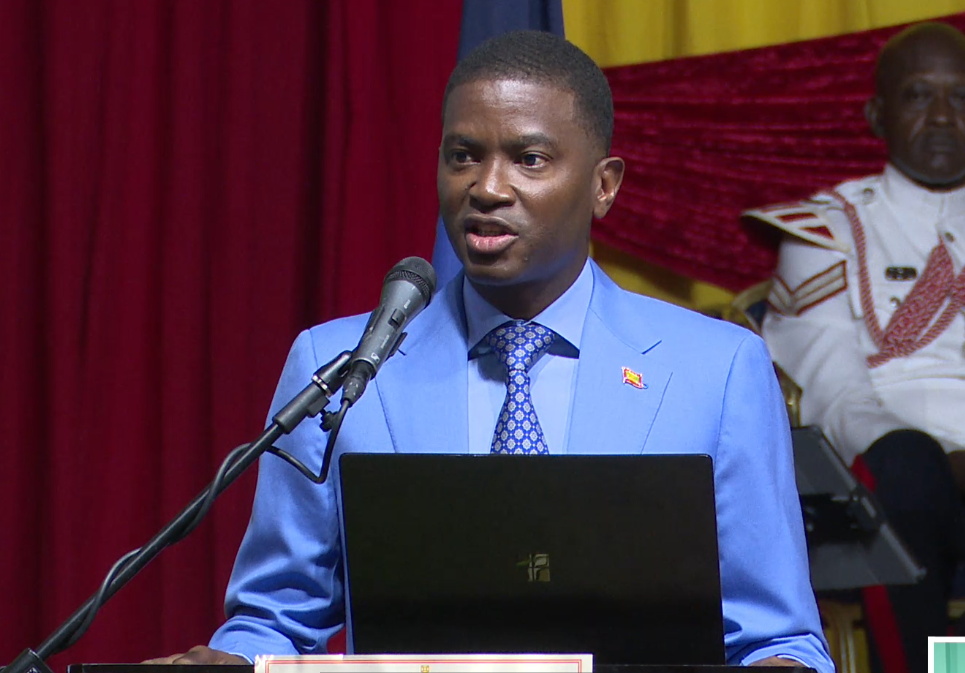
Following a landslide general election victory that secured his National Democratic Congress (NDC) a second consecutive term in Grenada’s parliament, Prime Minister Dickon Mitchell formally swore in his newly restructured 15-member Cabinet on Monday, laying out a strict, people-first mandate for incoming ministers during a public ceremony presided over by Governor-General Dame Cécile La Grenade.
The decisive 5 November electoral win saw the NDC capture 14 of 15 parliamentary seats, a marked improvement from its 2022 victory where it ousted the long-ruling New National Party (NNP) after the latter held every single parliamentary seat for a decade. The NNP, which spent nine years in the political wilderness before Mitchell’s 2022 upset, was left with just one legislative seat this month, handing the NDC an overwhelming popular mandate to advance its national transformation agenda.
In his address to the new ministerial team and gathered citizens of Grenada, Carriacou and Petite Martinique, Mitchell emphasized that the pomp of the swearing-in ceremony was not the true measure of the Cabinet’s success. “I remind all my cabinet colleagues that we must lead with humility, act with urgency, and deliver every policy with clear, purpose-driven intent,” he stated. Acknowledging public expectations for transparency, the prime minister openly conceded that the administration would not achieve perfect outcomes at every turn, but stressed that the government would never stray from its core governing mission. “There will be unforeseen hurdles, tough tradeoff decisions, and periods where progress moves slower than our communities hope for,” he told the public. “But I give you my unwavering assurance: this Cabinet will remain focused, fully accountable to the people, and unshakably dedicated to the fundamental reason we were entrusted with power: to serve every Grenadian.”
Mitchell emphasized that the era of partisan electoral competition had concluded, and the entire government’s focus must now shift exclusively to inclusive national development. The carefully structured Cabinet, he explained, was intentionally redesigned to navigate an increasingly complex domestic and global operating landscape that demands targeted expertise across high-priority sectors. Key portfolio realignments include former Attorney General Claudette Joseph taking leadership of the newly combined Ministry of Petroleum, Hydrocarbon, Constituency Affairs and Community Development; former U.S. Ambassador Tarli Francis stepping into the role of Minister of Foreign Affairs and Export Development; Delma Thomas appointed as Minister of Family, Social Affairs, Wellness and Religious Affairs; Afi Ventour named the new Attorney General and Minister of Legal Affairs and Justice; and former Finance Minister Dennis Conwell shifting to lead the Ministry for National Security, Home Affairs, and Disaster Management.
Mitchell outlined three non-negotiable guiding principles that shaped every Cabinet appointment: proven competence and capacity to deliver effective governance, clear distribution of responsibilities to strengthen individual ministerial accountability, and intentional selection of candidates equipped to advance Grenada’s long-term national transformation roadmap. The decision to expand the ministerial cohort to 15 members, he noted, was a deliberate choice to avoid overburdening a small group of officials with oversight of multiple sprawling, high-stakes portfolios, a common pitfall that can lead to neglected national priorities. A larger, specialized team, he argued, unlocks critical benefits: deeper sector-specific expertise, more rigorous oversight of government departments and public programmes, faster response to citizen concerns, and the cultivation of a broader, more diverse pool of national leadership talent.
The prime minister was quick to add, however, that the expanded Cabinet would never be used as justification for bloated bureaucracy, unnecessary public spending, or operational inefficiency. “Public office is not a reward for political service — it is a profound responsibility,” he stated plainly. “Every minister will be judged by tangible performance, every ministry must demonstrate clear value for public funds, and every government programme must have a clearly defined, people-centred purpose. Our only metric for success is how measurably we improve the daily lives of the Grenadian people.”
Notably, three of the appointed ministers will enter the Cabinet via the Senate rather than as elected parliamentary candidates, a structural choice Mitchell framed as a deliberate effort to strengthen rather than dilute democratic governance. He explained that the diverse technical expertise required to tackle Grenada’s most pressing 21st century challenges — from overhauling the education system and strengthening public healthcare to building climate-resilient infrastructure, advancing food and energy security, and creating economic opportunities for young people — is not limited exclusively to citizens who contest public elections. These senatorial appointees, he confirmed, are seasoned professionals with decades of experience across public service, law, business, education, technology, and community development, who bring specialized skills to complement the democratic legitimacy of elected representatives. Crucially, he emphasized that these senatorial ministers will be held to exactly the same strict standards of accountability, integrity, discipline, and performance as their elected counterparts, with no exemption from full public scrutiny.
The full statement followed official election results certified by Grenada’s electoral commission, confirming the NDC’s historic second-term mandate to steer the island nation through a period of rapid global economic and environmental change.