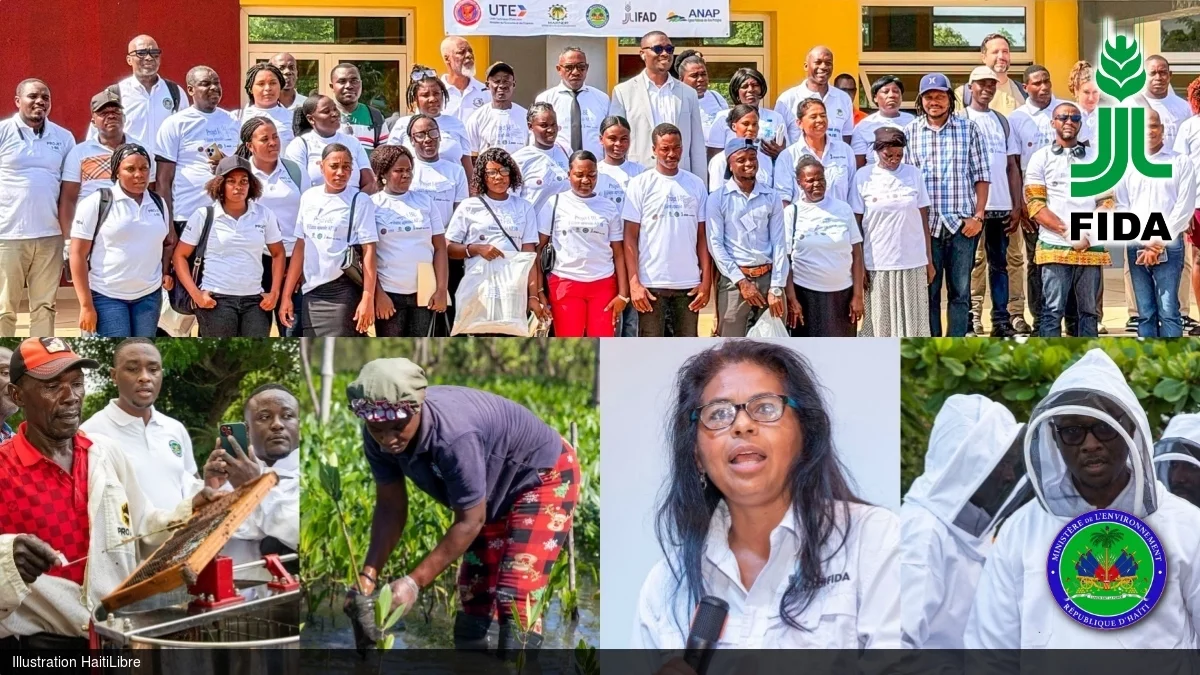
From November 8 to 11, 2026, Haiti’s Ministry of the Environment (MoE) joined a cross-agency official field mission across the nation’s North and Northeast departments, timed to the official visit of Rocio Medina Bolivar, Regional Director for Latin America and the Caribbean at the International Fund for Agricultural Development (IFAD). The on-site tour was designed to showcase tangible outcomes of the IFAD-backed Inclusive Blue Economy (I-BE) Project, while reaffirming a core governance framework that integrates inclusive economic growth, native biodiversity conservation, and long-term climate resilience for coastal and rural Haitian communities.
Representing Environment Minister Valéry Fils-Aimé was his Chief of Staff Yves Bernard Remarais, who joined a multi-stakeholder cohort including Agriculture Minister Marcelin Aubourg, the Chief of Staff for the Ministry of Finance Mousse Mac Kenley, IFAD country representatives, staff from the Ministry of Economy and Finance’s Technical Execution Unit (UTE), and cross-sector partner organization delegates. The MoE’s official contingent also included Sener Alvert Daphinis, Director of the National Observatory of Environmental Quality and Vulnerability (ONQEV) and designated focal point for the I-BE project.
The mission’s signature milestone unfolded on November 10 at the University of Limonade, where 287 small-scale beekeepers received formal professional certification under the I-BE Project’s skills-building portfolio. The initiative is structured to upskill local producers, boost the profitability of their livelihood activities, and embed eco-friendly operational practices that avoid harm to fragile local ecosystems.
Delivering remarks on behalf of Environment Minister Fils-Aimé, Chief of Staff Remarais emphasized the dual value of the certification rollout: “Today we are not merely handing out paper credentials. We are celebrating hard-earned technical skills, scaled-up production capacity, and tangible new pathways to stable income for thousands of Haitian households.” He went on to highlight the non-negotiable ecological role of pollinator species, noting the inextricable link between conservation and long-term productivity: “Sustainable beekeeping cannot exist in a degraded environment, and sustainable agricultural growth is impossible without intact, protected biodiversity.”
For her part, IFAD Regional Director Medina Bolivar shared positive feedback after completing direct on-site assessments of I-BE Project interventions across the two northern departments, singling out the beekeepers’ consistent dedication for special praise. She noted that their work delivers dual public good, lifting rural household incomes while safeguarding critical local ecosystems, and encouraged the newly certified producers to fully apply their new skills and continue advancing sustainable beekeeping practices across their communities.
The multi-day mission extended far beyond the certification ceremony, with the delegation touring a full portfolio of I-BE supported community assets. In Terrier Rouge, representatives held collaborative working sessions with local producers to map pathways for scaling beekeeping operations and expanding the market value of locally harvested honey. A stop in Paulette brought the group to a rehabilitated community lake, a key infrastructure asset that underpins local livestock rearing and broader regional economic activity, where Chief of Staff Remarais called for cross-agency feasibility studies to develop targeted reforestation and woodland buffer zones around the lake to strengthen long-term site protection.
Additional site visits included tours of community-led salt production operations and mangrove restoration planting sites in Jacquesyl, as well as roundtable discussions with artisanal fishermen and seafood vendors in Bord-de-Mer de Limonade. These community interactions underscored the deeply interconnected nature of sustainable natural resource stewardship, household economic security, and the climate adaptive capacity of Haiti’s coastal populations.
Following the full tour, the Ministry of the Environment released an official statement noting that the verified on-the-ground successes of the I-BE Project demonstrate the urgent need to deepen coordinated collaboration between Haitian public institutions, international technical and financial partners, and grassroots community organizations to lock in existing project gains and ensure long-term operational sustainability. “Protecting biodiversity is protecting our national productive capacity, and investing in our small-scale producers is a direct investment in Haiti’s shared future,” Remarais affirmed during his Limonade ceremony address. The MoE further reaffirmed its formal policy commitment to scaling inclusive development initiatives that simultaneously create formal economic opportunities, restore degraded ecosystems, and drive measurable improvements in quality of life for marginalized Haitian populations.