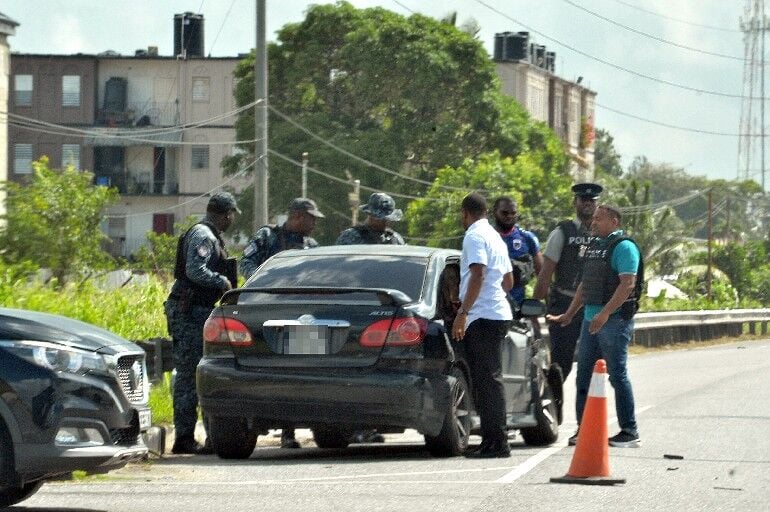
Hundreds of Maloney area residents gathered at the Maloney Indoor Sporting Facility for a Wednesday evening community consultation with senior law enforcement representatives, where they laid out a litany of urgent grievances over newly enforced measures under the Special Operations Act, which has designated parts of the suburban neighborhood as a cordoned restricted zone. The forum was initially organized by police leadership to walk local residents through the fine print of the new legislation, including the mandatory permit system required for all entry to and exit from the closed perimeter, but quickly shifted to an unfiltered public airing of practical, everyday harms the rules have already imposed on the community. Multiple attendees flagged crippling traffic bottlenecks along the main access route leading into Maloney from Port of Spain, noting that the already overburdened roadway has become gridlocked at peak hours as uniformed officers stop every vehicle to verify identification and check for valid entry permits. One long-term local resident shared her firsthand frustration navigating the commute to the Wednesday meeting itself, noting that traffic had backed up for miles long before she even reached the official police checkpoint, and that the curfew appeared to be rolling out hours earlier than the publicly posted 9 p.m. start time, cutting short the window residents have to run errands, pick up family members, or stock up on supplies for the following day. The most impassioned complaints came from the neighborhood’s large cohort of unregistered self-employed workers, who warned that the movement restrictions are on track to push many of them into financial ruin. A small business owner who operates a local home-based food service told the panel that dozens of her regular customers have already notified her they will no longer travel into Maloney due to fears of being detained or delayed at checkpoints, leaving her with no steady stream of income to cover household costs. A local waste picker who makes a living collecting and reselling discarded plastic and glass bottles alleged that patrolling officers recently seized his work supplies and threw them into a roadside drain, completely eliminating his ability to earn a living overnight, and questioned how he would be expected to pay rent and feed his family with no viable alternative source of income. Other unregistered self-employed attendees pressed law enforcement officials for clarity on how they would be able to apply for mandatory movement permits, since the official application process requires formal business documentation many informal workers do not possess. Widespread alarm also centered on gaps in emergency medical access under the new rules. A father from the adjacent La Resource neighborhood, who noted his community sits just outside the formal Maloney restricted zone, raised a panicked question about what would happen if his young daughter, who lives with severe asthma, suffered a life-threatening attack in the middle of the curfew hours, and he was blocked from getting her to a hospital. Senior Superintendent Avalon Frank, the lead officer overseeing the Special Operations deployment, clarified that La Resource is not included in the cordoned perimeter, and emphasized that no officer would ever block a resident in the midst of a medical emergency from accessing care. He cited a real-world example from earlier that same evening, when local police received a call about a 13-year-old Maloney resident in urgent need of medical support, and immediately escorted an awaiting ambulance through the checkpoint network to her home, then accompanied the teen and her family all the way to the treatment facility to avoid any delays. Frank shared his direct personal contact number (686-2000) with all attendees, urging any resident who faces interference during a medical emergency to call him immediately to resolve the issue. Residents also raised sharp questions about the sweeping warrantless search powers granted to police under the Special Operations Act, with one local woman demanding clarity on what legal thresholds officers must meet to search private property, and alleging that law enforcement failed to respond to a domestic dispute call she placed to local precincts the previous Sunday. Frank confirmed that under the provisions of the current Special Operations Act, officers operating within the designated closed zone do not require a judicial warrant or reasonable suspicion of criminal activity to enter and search private residential or commercial premises. Additional concerns came from residents who live outside Maloney but have elderly, infirm relatives residing within the cordoned area, who warned that the permit application process could prevent them from reaching their loved ones quickly in the event of a fall, sudden illness, or other urgent crisis. By the end of the 8:30 p.m. meeting, the first official movement permit under the new regime was issued to an elderly Maloney resident with documented chronic health conditions, while dozens of other attendees stayed behind long after the formal forum concluded to speak one-on-one with officers, clarify permit requirements, and submit their applications in time to meet the 9 p.m. curfew deadline.