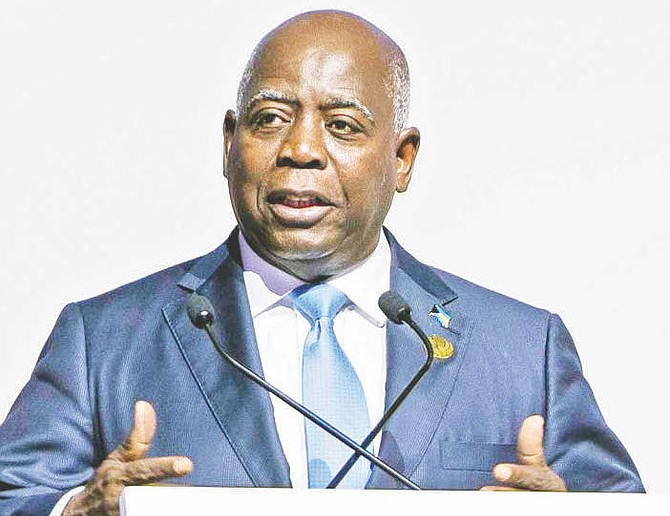
Addressing global heads of state during his national statement at the UN’s 31st annual Climate Change Conference (COP31) hosted in Antalya, Türkiye, Bahamas Prime Minister Philip Davis issued a stark, action-focused warning that no external savior will step in to rescue nations from the accelerating climate crisis, pointing to the systemic flaw that has stalled decades of collective progress. Davis, who secured a historic consecutive re-election in May as the first Bahamian leader to win back-to-back terms since 1997, argued that the global community has long misdiagnosed the core barrier to meaningful climate action: it is not a lack of political will, but a dangerous overreliance on the fleeting goodwill of individual elected leaders. He noted that nearly every COP summit sees sincere, committed leaders step forward to make ambitious public pledges, only for those promises to unravel when incumbents lose elections, governing coalitions collapse, or national budgets are slashed, leaving incoming administrations to reset priorities with no accountability for prior commitments. This revolving door of leadership, he emphasized, means today’s policymakers are constantly forced to inherit unfulfilled promises from predecessors no longer in power, creating a cycle of unmet obligations that leaves vulnerable nations adrift. Davis laid out a clear remedy rooted in institutional permanence, rather than temporary individual pledges: automatic, uninterrupted flows of dedicated climate finance that do not require repeated annual fundraising rounds, all high-stakes climate commitments codified in binding international treaties and domestic national law instead of non-binding summit communiqués, and the permanent enshrinement of small island developing states’ (SIDS) unique structural vulnerabilities as a universally recognized baseline, rather than a marginalized status that advocates must re-litigate every decade. Drawing on years of consistent advocacy across every UN climate summit since he took office in 2021, Davis highlighted that global temperature records continue to be broken annually, greenhouse gas emissions keep climbing, and tropical cyclones are growing more intense and frequent, leaving low-lying island nations like the Bahamas trapped in a brutal cycle of catastrophic hurricane damage and costly reconstruction. He noted that promised climate funding rarely arrives in time to support post-disaster recovery, and SIDS still have not received the level of targeted support required to prevent their territories from eventually being submerged by rising sea levels. Davis clarified that his opening declaration that “no-one is coming to save us” was not an expression of despair, but a deliberate call to reject complacency. He traced his years of consistent climate advocacy across prior COP gatherings: at his first summit, COP26 in Glasgow just 10 weeks after taking office, he warned leaders that the world was already out of time, that pledges were trivial compared to the courage required for tangible action; at COP27 in Sharm el-Sheikh, he decried non-binding statements as a deliberate tactic to delay real progress, warning that inaction would consign SIDS to a “watery grave”; at COP28 in Dubai, he called for the rapid capitalization of the global loss and damage fund, noting that vulnerable nations could not afford to waste limited remaining time; at COP29 in Baku, he challenged global leaders to marshal the same level of funding and urgency for the climate crisis that they deploy during major wars and public health pandemics; and in his pre-recorded address to COP30 in Brazil last year, he emphasized that SIDS are bearing the brunt of a planetary crisis they did almost nothing to create. Anchoring his COP31 address to a tangible, homegrown Bahamian solution, Davis outlined the nation’s long-developing Blue Carbon Programme, centered on the 53,657 square kilometers of seagrass meadows beneath Bahamian territorial waters, the largest contiguous seagrass ecosystems on the planet. He noted that these meadows sequester carbon at a faster rate than the Amazon rainforest, support the fisheries that feed local Bahamian communities, and act as a natural coastal buffer to weaken incoming storm surges before they reach populated shorelines. The Bahamian government has already committed $25 million to the initiative, completing foundational work on its scientific, legal, and fiscal operational frameworks, and Davis is now calling for international partners to join the effort with long-term, sustained commitments that are not subject to short donor funding cycles or shifting ideological political trends. Rejecting the idea that self-reliance for small island nations means isolation, Davis noted that no country, large or small, can tackle the existential climate crisis alone, and positioned the Bahamas as a potential global trailblazer rather than a passive victim of climate change. “For a generation, the world has looked at Small Island States and regarded us as the first to follow,” he told assembled delegates. “Look again. With our Blue Carbon Programme, we will be the first to lead.”