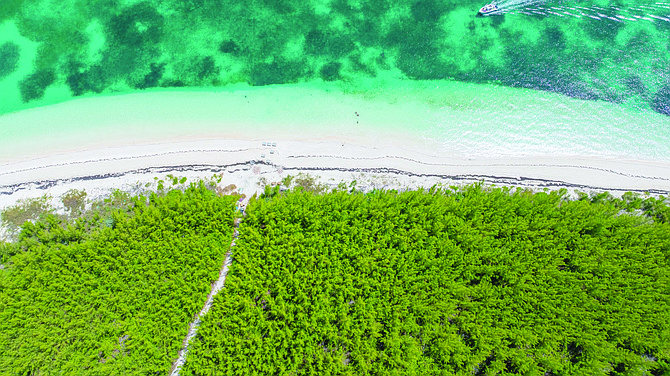
In a landmark judicial ruling delivered on November 11 by Supreme Court Justice Franklyn Williams, all construction activity at the contested Seashells at Gillam Bay resort project on Green Turtle Cay, Abaco, has been immediately frozen pending a full judicial review of the government’s original approval of the development. The sweeping interim injunction bars developer Reginald Curry and all his affiliated personnel from carrying out any further land clearing, excavation, foundation laying, trenching, drilling, or shoreline modification across the 3-acre Crown Land site, as well as banning all works and outdoor storage of mooring blocks within a 300-foot buffer of the high water mark along the bay’s foreshore, coastal waters, and seabed. The legal challenge was filed by the Save Gillam Bay Collective Ltd, a grassroots non-profit group composed of long-term Bahamian residents, local homeowners, and adjacent landowners with deep intergenerational ties to Green Turtle Cay, who flagged imminent risk of irreversible ecological harm to the sensitive coastal ecosystem if construction was allowed to proceed while the lawfulness of the project’s approval remained untested. Justice Williams explicitly criticized Dr Rhianna Neely-Murphy, Director of the Department of Environmental Planning and Protection (DEPP), for issuing the project’s Certificate of Environmental Clearance (CEC) on April 22, 2026, without first mandating a mandatory Environmental Impact Assessment (EIA) or any form of public community consultation. The judge dismissed the reasoning Dr Neely-Murphy provided for waiving the EIA requirement as “formulaic, circular and de minimis”, noting that while existing statute does not legally compel the director to publish formal justifications for such decisions, established regulatory best practice in this high-stakes coastal development case demanded far more robust, transparent documentation of her risk assessment. The ruling further exposed critical gaps in the government’s approval process: no formal full development application for the Seashells project was ever submitted to or held on file by the Department of Physical Planning, the CEC was never shared with local residents, and two prior limited 2023 permits for preliminary botanical survey clearing and access road construction had already expired before current works commenced. Dr Neely-Murphy’s formal justification for waiving the EIA, submitted in a September 11 letter, claimed the project was low-density, built on elevated stilts, located entirely on upland terrain more than 50 feet from the nearest dune, contained no marine components, and posed no threat to protected species. Justice Williams noted this assertion was directly contradicted by the developer’s own submitted environmental documentation, which explicitly outlined planned construction of moorings, a dock, and multiple other shoreline and marine infrastructure components. The judge also flagged major unaddressed environmental risks in the original approval: plans for on-site reverse osmosis operations and deep injection effluent wells for septic waste had not received pre-approval from relevant regulatory bodies including the Department of Environmental Health Services, the Water and Sewerage Corporation, and the Ministry of Works, despite raw sewage mismanagement carrying clear risk of permanent, irreversible contamination of the bay’s fragile waters. Additional evidence presented to the court by the Save Gillam Bay Collective highlighted severe flaws in the developer’s baseline ecological surveys: a certified local birdwatcher documented 57 resident and migratory species at the site over a 10-day observation window earlier this year, including protected at-risk species such as the Red Knot, Piping Plover, Wilson’s Plover, and Peregrine Falcon, while the developer’s entire avian survey was conducted in a single 3-hour site visit. The collective also raised alarms that the developer’s proposed vegetation management plan permitted use of Garlon 3A, a triclopyr-based herbicide toxic to aquatic life, with no site-specific safeguards to prevent runoff into the bay’s shallow coastal waters, and that no mandatory storm surge risk assessment had been completed to model the impact of a major hurricane on the development and surrounding shoreline ecosystem. The Bahamian government’s legal team, led by David Higgins, had fought aggressively against the injunction application, arguing that the project would deliver significant economic benefits to Abaco and the wider Bahamas, and that the state held a direct stake in its successful completion. Notably, developer Reginald Curry and his legal representation Geoffrey Farquharson failed to participate in the entire court proceeding, despite being formally notified of all hearing dates on multiple occasions via telephone, email, and in-person acknowledgement during open court on November 4. Justice Williams confirmed the court had granted the Save Gillam Bay Collective full leave to proceed with the substantive judicial review, finding the group held sufficient legal standing to challenge the approval, had acted with reasonable promptness, and had presented multiple legally arguable grounds with a realistic prospect of success. While the judge acknowledged the developer would face financial losses as a result of the halted works, he noted the full extent of those losses could not be quantified due to Curry’s non-participation in proceedings. The collective has submitted a formal damages undertaking to the court, agreeing to compensate Curry for verified losses if the judicial review later finds the interim injunction was incorrectly granted. The full substantive judicial review was scheduled to commence the same day as the ruling, November 11, with Justice Williams noting he expected the proceedings to be relatively concise. The injunction marks the latest major setback for the highly divisive development, which has faced widespread local community opposition since public awareness of the project first emerged in July. All five elected members of the Green Turtle Cay District Council formally voted against the proposal earlier that summer, and by August the collective’s public petition opposing the development had amassed more than 3,300 verified signatures. High-profile local conservation and political figures have also publicly criticized the DEPP’s original approval, including former long-serving Member of Parliament for the area and ex-Prime Minister Hubert Ingraham, who stated a full public EIA was the absolute minimum standard of due process the project should be required to meet, and former Bahamas National Trust Executive Director Eric Carey, who described the decision to waive an EIA for the ecologically sensitive, previously undeveloped shorebird habitat as “kind of strange”.