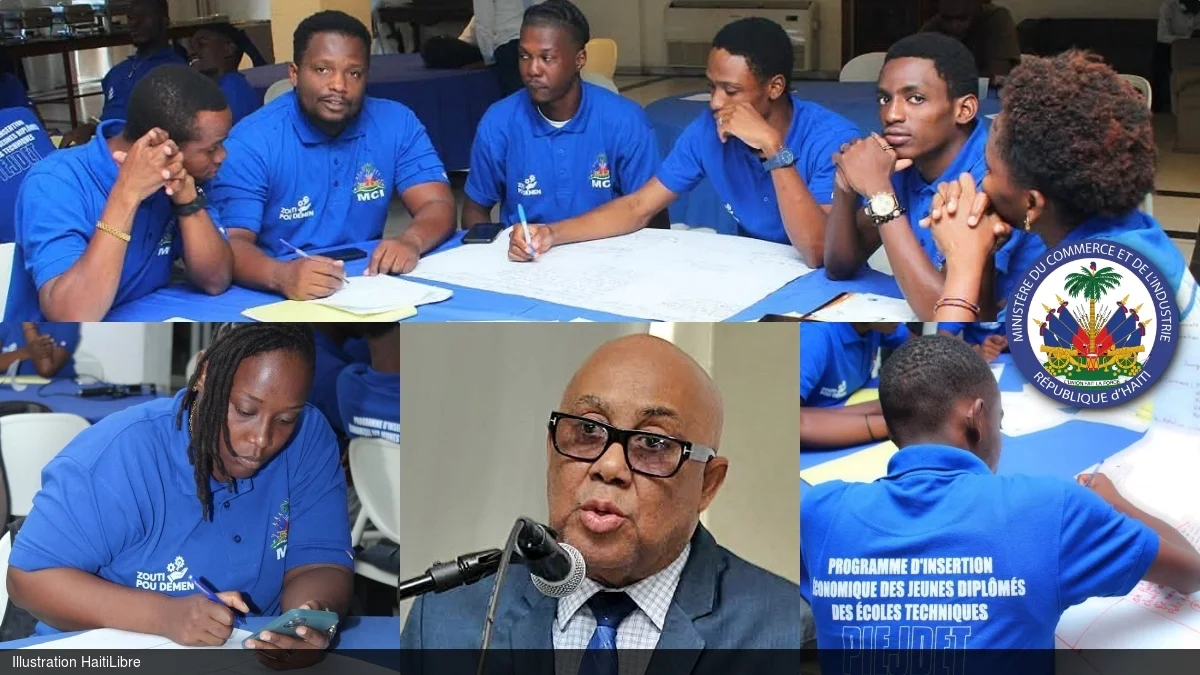
On November 10, 2026, Haiti’s Minister of Trade and Industry James Monazard officially concluded a two-day targeted entrepreneurship training session hosted at Pétion-ville’s Hôtel Montana, tailored for participants in the national “Zouti pou Demen” initiative. Launched under the broader Economic Integration Program for Young Graduates of Technical Schools (PIEJDET) and coordinated by Stanley Bastien, the project forms a core pillar of the Ministry of Trade and Industry’s (MCI) strategy to turn young technical talent into self-sustaining economic contributors, rather than leaving their specialized vocational skills underutilized amid Haiti’s ongoing economic constraints. The first day of the training, held on November 9, centered on foundational frameworks for new venture creation and regulatory formalization. Facilitators walked participants through evidence-based methods to vet and refine viable business concepts, outlined the full spectrum of legal business entity structures available in Haiti, and laid out the tangible long-term benefits of registering formal enterprises, from access to public grants to eligibility for formal commercial partnerships. The second day shifted to hands-on operational skill-building, with deep dives into practical management tools including the Business Model Canvas, a globally recognized framework for mapping value propositions, operational workflows and revenue streams. Additional modules covered end-to-end customer lifecycle strategies for identifying target audiences, driving initial acquisitions and building long-term loyalty, as well as core small-business financial management best practices designed to prevent cash flow gaps that often sink early-stage Haitian micro-enterprises. To anchor theoretical lessons in real-world application, attendees collaborated in peer working groups to draft customized business models aligned with their unique vocational skill sets, ranging from construction and textile production to digital repair and agri-processing. Each group presented their draft plans in a public showcase, receiving targeted feedback, actionable recommendations and constructive critique from industry mentors and MCI officials to refine their models for long-term viability. Delivering the closing address, MCI Director General Panel Paulémont emphasized that technical toolkits alone cannot guarantee sustainable livelihoods for young graduates, and that paired entrepreneurial and management training is the critical missing link to reduce high new business failure rates across the country. He urged all participants to translate their newly acquired skills into actionable ventures, noting that successful youth-led enterprises would not only deliver personal financial autonomy but also create local jobs to lift surrounding communities out of cyclical poverty. Over its planned three-year implementation timeline, the “Zouti pou Demen” project is set to reach more than 5,000 graduates of Haitian technical and vocational schools, with additional support measures including trade-specific professional tool kits, step-by-step guidance through the business registration process, and a 50 percent reduction in all MCI administrative fees associated with formalizing new youth-led ventures.