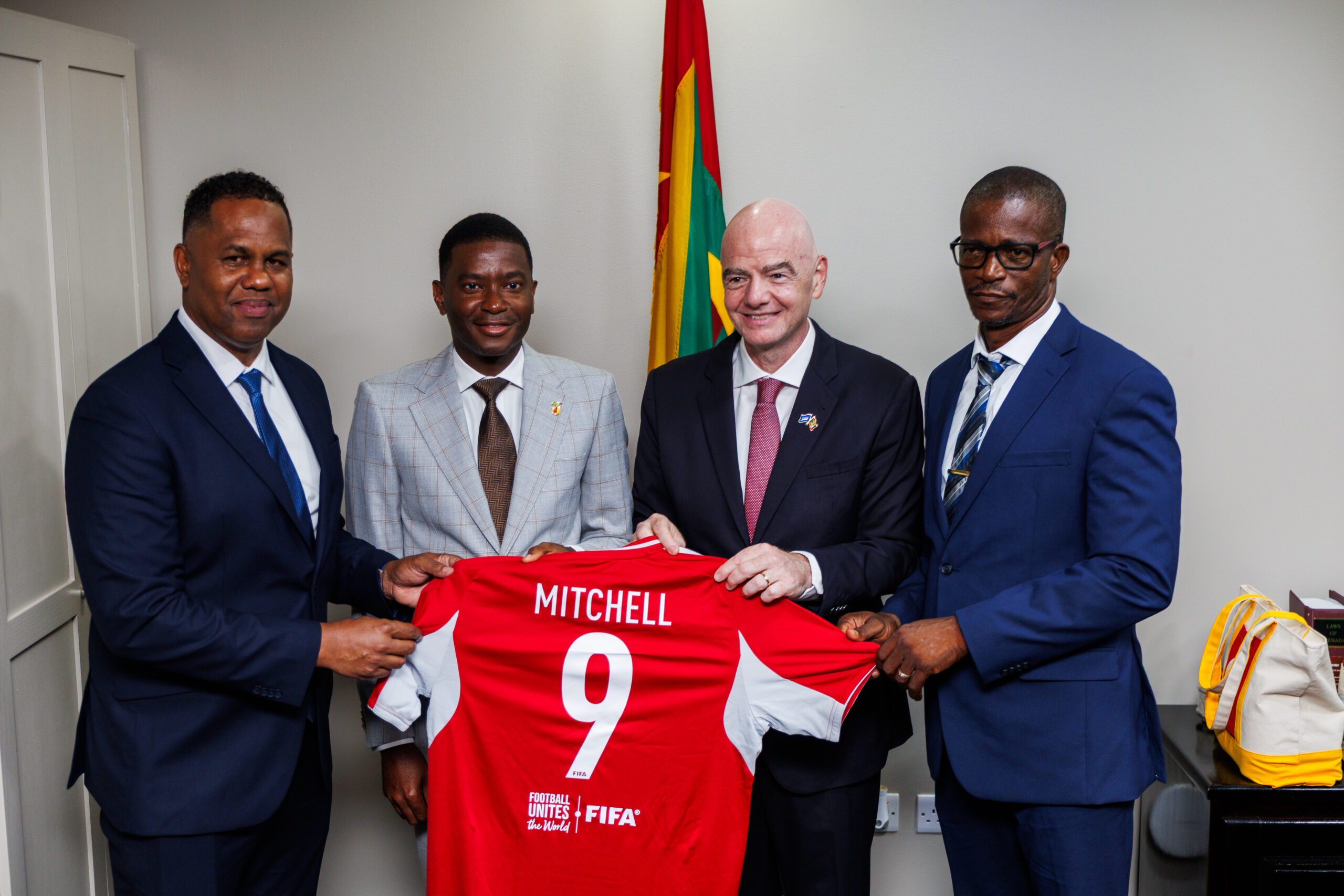
On 6 November, Grenada Football Association (GFA) President Marlon Glean orchestrated a series of high-stakes, milestone engagements during FIFA President Gianni Infantino’s official visit to the Caribbean island nation, bringing together top state leadership and global football governance to chart a new era for football development across Grenada and the broader Caribbean region.
The centerpiece of the visit was a closed-door strategic discussion between Infantino and Grenadian Prime Minister Dickon Mitchell, where three landmark collaborative proposals were tabled for joint advancement: the establishment of a FIFA-operated Technical Development Academy headquartered in Grenada, streamlined administrative frameworks for citizenship and national team eligibility for diaspora players of Grenadian heritage, and a feasibility assessment to host a FIFA Series international competition on the island. Mitchell offered full-throated endorsement of the proposals, singling out the planned regional academy as a uniquely high-impact initiative that could position Grenada as a central hub for football skill-building across the Caribbean.
Infantino’s itinerary also included a formal courtesy call at the official Point Salines residence of Grenada’s Governor-General, Her Excellency Dame Cécile La Grenade, where he was joined by Glean and a delegation of regional football leaders. As the official representative of Grenada’s Head of State, Dame Cécile lauded the GFA and FIFA’s shared development roadmap, emphasizing that expanded access to structured football programmes would drive tangible gains for youth empowerment, community cohesion, and Grenada’s global international profile. Both the courtesy call and the subsequent formal working session at the Ministerial Complex within the Sir Eric Gairy Botanical Gardens, hosted by Prime Minister Mitchell, underscored cross-institutional recognition of football’s untapped potential as a catalyst for inclusive youth advancement and national economic opportunity.
These high-level meetings were anchored to a tangible, pre-existing milestone: the official inauguration of Grenada’s first purpose-built FIFA Arena mini-pitch at St John’s Anglican School in Gouyave, a visible demonstration of what sustained, coordinated investment between global football bodies, local associations, and state stakeholders can deliver for grassroots communities. During the full itinerary, Glean laid out the GFA’s multi-tiered advocacy agenda, which spans expanded investment in youth football education, formal technical training pathways, national team talent pool strengthening, and expanded access to elite international competition opportunities for local players.
The working session at the Prime Minister’s Office included a cross-section of key stakeholders: GFA Vice President and Member of Parliament-elect for St Patrick East Carl Andall, Trinidad and Tobago Football Association President Kieron Edwards, and a cohort of regional football administrators. Glean outlined that the proposed FIFA Technical Development Academy had already garnered preliminary interest from multiple other Caribbean national football associations, making Grenada’s central geographic position and existing local football infrastructure an ideal fit to host the regional hub. Mitchell formally committed government support to fast-track feasibility and planning work for the academy, noting the project would create ripple benefits for local job creation and regional sporting cooperation.
The discussion also addressed a longstanding pain point for Caribbean football: competitive global recruitment of dual-heritage diaspora talent. Glean emphasized that second- and third-generation Grenadian athletes based overseas, many of whom hold dual nationality and are eligible to represent multiple national sides, represent an underutilized resource for Grenada’s national teams, and that coordinated, streamlined government processes for citizenship documentation and eligibility verification would allow the country to act quickly to secure top talent before rival regional nations extend competing offers. This recruitment strategy was framed as a core pillar of the GFA’s broader 10-year development framework, which ties grassroots school participation, structured talent identification, and elite national team performance into a single integrated ecosystem.
Delegates also explored the viability of hosting a FIFA Series international tournament in Grenada, a prospect Mitchell framed as a high-value opportunity to drive international media exposure for the island, boost local tourism and hospitality revenue, and create new competitive pathways for local players to test their skills against global opposition. The prime minister also referenced parallel ongoing discussions about a new pan-Caribbean regional football competition, designed to reduce travel costs for regional sides and create more regular high-caliber match play for Caribbean national teams. Notably, Mitchell stressed that football development should not be limited to on-pitch player performance, but should also create structured career pathways for young Grenadians in underrepresented sporting fields including coaching, sports administration, sports medicine, broadcast media, and sports event management — a priority that aligns directly with Glean’s longstanding focus on embedding formal education and professional skill-building into all GFA programmes. Glean also confirmed that he is in active exploratory talks with officials from the Ghana Football Association to establish bilateral collaborative partnerships and exhibition matches between the two nations, an initiative that dovetails with ongoing state-level diplomatic cooperation between Grenada and Ghana.
A core practical outcome of the high-level discussions was a formal set of new support commitments from FIFA, building on existing collaborative programmes. Infantino publicly praised Glean’s leadership of the GFA and the association’s track record of delivering results for local communities, and pledged an additional 4 FIFA Arena mini-pitches to expand access to safe, high-quality playing surfaces across the country, bringing the total national pipeline of FIFA-funded mini-pitches to 8, including the newly inaugurated Gouyave facility. The GFA’s long-term infrastructure roadmap aims to roll out these new facilities across Grenada, Carriacou, and Petite Martinique, including a dedicated pitch at the under-development Technical Development Centre in Simon, St Andrew. FIFA also committed 500 pairs of brand-new football boots for primary school students across Grenada via its global Boots for All initiative, directly addressing two of the most common barriers to grassroots youth participation: lack of dedicated playing space and prohibitive costs for basic sporting equipment.
Moving forward, the GFA will lead ongoing coordinated engagement with FIFA and relevant Grenadian government departments to turn the high-level proposals into formal, actionable programmes. The full alignment between state leadership, global football governance, and local sporting administrators creates an unprecedented foundation for Grenada to evolve from a small Caribbean football nation to a regional leader in football development, with tangible benefits for players, coaches, young professionals, and local communities across the entire Caribbean region.