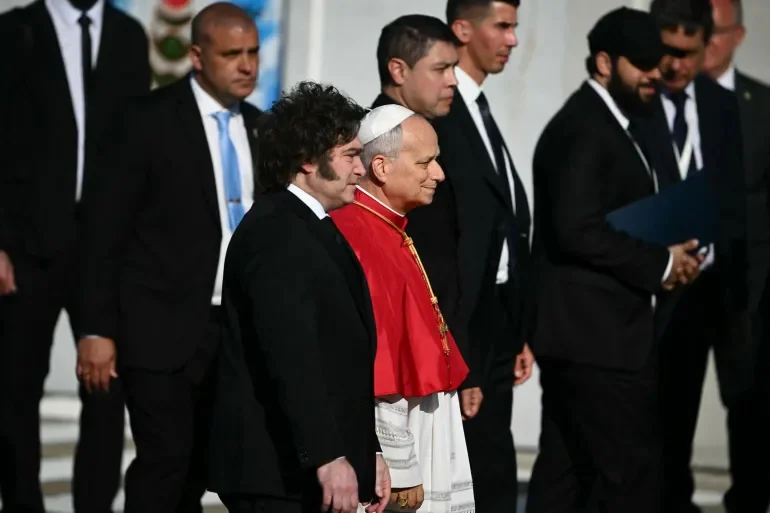
Pope Leo XIV touched down in Buenos Aires, Argentina on Sunday, November 8, 2026, kicking off the second leg of his sprawling 12-day apostolic journey across South America, following a historic stop in Uruguay. The multi-country itinerary, running through November 17, will cover 10 cities across Uruguay, Argentina, and Peru, marking a high-stakes pastoral and diplomatic mission for the 71-year-old pontiff who recently recovered from a malignant lung tumor surgery just three weeks prior to departure.
The first segment of the tour, held November 6 to 8 in Uruguay, marked the first papal visit to the secular-majority nation since 1988. During stops in Montevideo, Paysandú, and Florida, Pope Leo met with government officials, civil society leaders, and local parish communities, delivering a core message calling for coordinated regional action to curb drug-fueled violence and end systemic child poverty. The visit was framed as a deliberate outreach effort to reconnect the Catholic Church with growing segments of Uruguay’s population that have drifted away from religious affiliation amid decades of rising secularization.
The Argentina leg of the tour stands as the most politically sensitive stop of the entire journey, marking the first papal visit to the nation since Pope John Paul II’s 1987 trip. The country also holds deep symbolic weight as the birthplace of the late Pope Francis, who died in 2025 and never returned to his homeland during his 12-year pontificate. Upon the pontiff’s arrival at Buenos Aires’ Aeroparque Jorge Newbery, libertarian President Javier Milei hosted a formal welcome ceremony, with the two leaders holding a closed-door meeting that drew global scrutiny over long-running frictions between the Argentine government and the Catholic Church.
In his first public address to Argentine state leadership, Pope Leo emphasized that human dignity must take priority over narrow economic metrics, arguing that private sector growth and fiscal reforms must deliver tangible benefits to vulnerable groups including pensioners and low-wage workers struggling to cover basic living costs. The remarks directly engage with Milei’s signature aggressive austerity agenda, implemented since he took office to slash public spending, tame sky-high inflation, and stabilize national finances. While the administration touts policy wins including a sharp drop in inflation and a restored federal budget surplus, widespread public outcry has mounted over deep cuts to public healthcare, university funding, social safety nets, and pension programs that have pushed millions deeper into poverty. The Argentine bishops’ conference has repeatedly issued public rebukes of the policies’ disproportionate harm to disabled citizens and marginalized communities. Observers note the Pope is not expected to openly confront Milei, but his public teachings on solidarity and social justice are being closely monitored for implicit pushback against the administration’s agenda. The meeting also offers Milei a chance to repair ties with the Vatican after he made highly publicized derogatory remarks about the late Pope Francis during his 2023 presidential campaign over Francis’ staunch advocacy for economic equity.
Following his Argentina stay, Pope Leo will travel to Peru on November 11 for the most personal leg of his journey. Born Robert Francis Prevost in the United States, the pontiff spent decades of his early clerical career in Peru, serving as a missionary, parish priest, and later Bishop of Chiclayo. His Peru itinerary includes stops in Lima, Cusco, Pucallpa, and his long-time adopted home of Chiclayo, where local communities have planned massive welcoming events. A key highlight of the Peru visit will be a November 15 stop in Amazonian Pucallpa, where the Pope will meet with indigenous community leaders and long-serving local missionaries, and lead a public mass centered on protecting Amazonian indigenous populations and their threatened rainforest homelands. He will also address pressing national challenges including widespread rural poverty, transnational criminal violence, deep racial inequality, and accelerating deforestation.
Vatican officials have confirmed no adjustments have been made to the grueling schedule, which includes 12 separate international and domestic flights, nearly 40 speeches almost entirely delivered in Spanish, and back-to-back public masses with tens of thousands of attendees. The trip unfolds against a broader regional backdrop of steady secularization across historically Catholic Latin America, where declining affiliation rates have pushed the Church to expand outreach to disaffected young people and marginalized groups. For Pope Leo, the journey is framed as a pivotal effort to re-center the Church’s core mission of advancing human dignity, cross-community solidarity, and peaceful conflict resolution across a region roiled by economic uncertainty and political division.