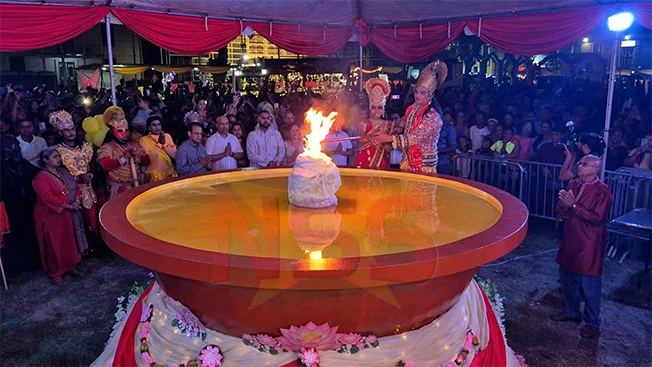
On 8 November, Suriname joined global Hindu and multicultural communities in marking Divali, the beloved Festival of Lights that has long been a cornerstone of the nation’s diverse cultural tapestry. The official national inauguration of the holiday unfolded the previous evening at the capital’s Independence Square, drawing government leaders, cultural organization heads, and hundreds of local residents to a vibrant ceremony steeped in both traditional ritual and calls for cross-community solidarity.
The landmark event opened with a visually striking ceremonial procession that brought beloved Hindu mythological figures to life for onlookers: the deity Hanuman made a dramatic flying entrance over the square, while the divine trio of Ram, Sita, and Lakshman arrived seated atop a ceremonial swan float. In keeping with longstanding Divali custom, Ram and Sita were tasked with lighting the massive, specially constructed national “Suriname Dia” – a giant clay oil lamp that serves as the centerpiece of the country’s official public Divali celebrations. Immediately after the ceremonial flame caught, National Assembly Chair Ashwin Adhin stepped forward as the first guest to pour clarified ghee into the lamp, nurturing the flame to keep it burning bright as a symbolic gesture of collective care for community bonds.
Delivering the keynote address to the gathered crowd, Kirti Ramautar – the first woman ever elected to lead the Cultural Union Suriname (CUS) – emphasized that the holiday carries far deeper meaning than the popular tradition of lighting small diyas around homes and public spaces. She framed Divali as an annual reminder of the universal triumph of knowledge over ignorance, love over hatred, and inclusive connection over division, pushing back against rising social trends where differences of background, belief, and opinion are increasingly driving rifts between Suriname’s diverse population. “Lighting a small clay diya takes only a moment, but the far harder work is keeping the flame of empathy, respect, and compassion burning steadily in our own hearts every single day,” Ramautar told attendees. She went on to stress that darkness can never be erased by fighting it with more darkness: the only way to dispel shadow is for a single person to choose to kindle a light of their own, starting with small, intentional acts of goodwill. Those acts, she noted, could range from offering unconditioned help to a neighbor, honoring the cultural and religious traditions of communities different from one’s own, teaching children that diverse identities are a source of national enrichment rather than division, and prioritizing constructive dialogue even when people hold strong opposing views.
Later in the evening, Suriname’s President Jennifer Simons joined the celebration and fully aligned with Ramautar’s call for collective action, framing Divali’s message as uniquely urgent for the South American nation. Simons noted that Suriname does not need grand, heroic gestures from its citizens to build a stronger, more cohesive society: every single person has the power to act as a bridge-builder, prioritizing the collective public good over narrow personal interests, and spreading small sparks of kindness that can ripple out to touch entire communities. She drew a direct parallel to the physics of the Divali lamps: one single small flame has the power to ignite thousands of other flames, no single one of which is diminished by sharing its light. The head of state also called on all Surinamese communities to actively safeguard Divali’s rich cultural heritage and pass its core messages of unity down to future generations, using the annual holiday as a recurring opportunity to learn more about neighbors from different cultural backgrounds and foster greater mutual appreciation. As private households across Suriname prepared to light their own diyas on the official Divali day, Simons urged the public to carry the spirit of the festival beyond decorative rituals, embedding its values of warmth and respect into their everyday interactions with others.