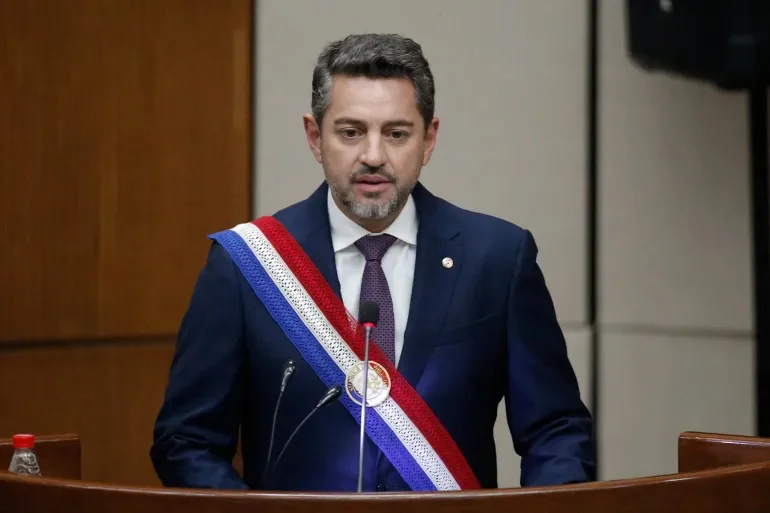
On November 6, 2025, 52-year-old conservative politician Pedro Alliana was formally sworn in as Paraguay’s new head of state in the capital Asunción, capping a 48-hour period of unprecedented political upheaval triggered by the spectacular collapse of Ueno Bank, the country’s largest digital financial institution. The dramatic transfer of power came hours after the national parliament voted overwhelmingly to impeach and remove sitting president Santiago Peña, who was subsequently taken into custody by law enforcement as part of a sweeping corruption and economic misconduct probe tied to the failed lender. The legislative process moved at extraordinary speed: the lower Chamber of Deputies approved impeachment proceedings on Thursday with a unanimous 78-0 vote, followed by a near-unanimous Senate ballot the next day where 44 out of 45 sitting senators backed removal, with one legislator abstaining. Peña had submitted a formal resignation offer one day prior to the vote, but lawmakers opted to move forward with the full impeachment process specifically to strip him of the lifelong legal immunity granted to former presidents under Paraguay’s constitution, a privilege that would have shielded him from criminal prosecution for life. Immediately after his ouster, Peña was placed under house arrest at his private residence, but escalating public unrest forced a security relocation overnight: hundreds of angry demonstrators gathered outside his home in Asunción, demanding he be moved to formal pre-trial detention rather than remaining in private custody, leading to minor clashes with deployed riot police. Authorities ultimately transferred the former president to the headquarters of the Presidential Escort Regiment, a dedicated military security unit, to spend the night ahead of his scheduled 11 a.m. local time appearance before the Public Ministry’s specialized economic crime and anti-corruption division. His legal counsel Ricardo Preda confirmed Peña will fully cooperate with questioning, but argued there is insufficient legal basis to approve formal pre-trial detention, warning that any restriction of his liberty during the ongoing investigation should not function as a premature punitive measure. The wide-ranging probe has extended far beyond Peña himself: former Central Bank of Paraguay president Carlos Carvallo, who resigned earlier that week as the Ueno crisis erupted, voluntarily turned himself in to authorities on Friday evening. Carvallo previously served as a senior executive at Ueno Bank before taking the top central bank post, where he was legally responsible for overseeing national financial sector supervision, creating a major conflict of interest that is now a core focus of investigators. Prosecutors have opened three separate formal criminal inquiries examining the circumstances of Ueno’s collapse, the placement of hundreds of millions in public funds at the bank, and alleged misconduct by current and former senior public officials. In total, at least 27 people have been formally charged in the case, including top bank executives, major shareholders, and eight former board members who were taken into custody in the days leading up to Peña’s impeachment. The crisis first accelerated on Tuesday, when the Central Bank announced Ueno Bank no longer met mandatory legal solvency requirements, holding insufficient capital and properly valued assets to cover its outstanding financial obligations. Regulators immediately seized control of the institution to prevent systemic damage to Paraguay’s broader financial system, suspending all customer services and leaving millions of account holders temporarily locked out of their savings and regular payment access. Ueno, a fast-growing digital lender, counted 2.94 million registered customers across Paraguay’s total population of 6.1 million, making it one of the country’s top three financial institutions, with a large user base of previously unbanked low-income citizens who had no prior access to formal financial services. The collapse has inflicted disproportionate harm on vulnerable populations, including 32,000 retirees who received their monthly pension disbursements exclusively through Ueno accounts. Investigators have confirmed roughly $800 million in public funds were held or invested at the failed bank, with $355 million of that sum originating from state-run public pension funds. A central line of inquiry is focused on allegations that Ueno received preferential regulatory treatment due to its close political ties, including previously disclosed 2023 public filings where Peña acknowledged he held shares in the Ueno parent holding company, claiming he sold off his entire stake in 2025. Investigators are actively examining potential conflicts of interest, improper regulatory favoritism, and whether the bank received deliberate state protection from oversight scrutiny as it expanded rapidly despite growing signs of financial instability. In his first public address immediately after taking the oath of office, new president Pedro Alliana, a longstanding member of the dominant conservative Colorado Party who previously served as Peña’s vice president starting in 2023, pledged full, unconditional compensation for every Paraguayan citizen harmed by the Ueno collapse, with priority support directed at low-income account holders and affected retirees. The Central Bank previously estimated the national deposit guarantee scheme will fully cover roughly 97% of Ueno’s customer base, but officials have not yet laid out a clear timeline for when locked funds will be fully accessible, or how remaining uncovered losses will be distributed. Alliana will serve out the remainder of Peña’s presidential term, which is set to end in August 2028. The unprecedented impeachment has already put significant internal strain on the Colorado Party, which has held unbroken political dominance in Paraguay for decades, with powerful former president and influential party kingpin Horacio Cartes publicly endorsing the impeachment vote to prioritize restoring public trust in state institutions. The cascading crisis has laid bare how a single unregulated digital bank failure can escalate into a full-scale national political meltdown when public trust in state regulators and top elected officials collapses entirely. Paraguay now faces a dual urgent challenge: rebuilding shattered public confidence in the national financial system, and demonstrating that even the highest-ranking elected and appointed public officials can be held fully legally accountable for alleged corruption and misconduct.