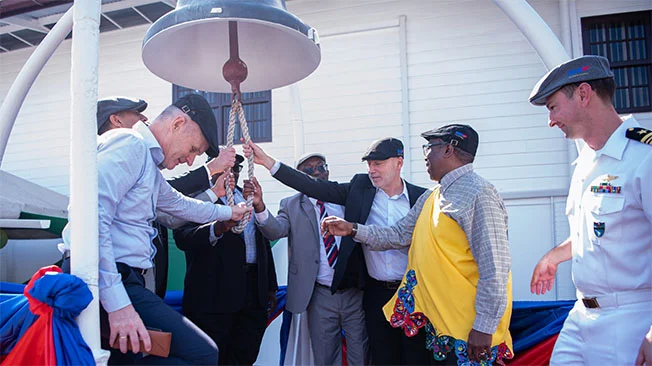
On November 6, the Maritime Authority Suriname (MAS) launched its three-day 15th annual Maritime Open Days, a public outreach event designed to connect local youth, secondary vocational students, and industry stakeholders with fast-expanding career and training pathways in the country’s booming offshore oil and gas maritime ecosystem. The event, running through Saturday, features exhibits from dozens of sector companies and public organizations that showcase hands-on maritime operations, accredited vocational programs, and long-term career trajectories for new entrants to the blue economy.
Presiding over the opening ceremony on behalf of President Jennifer Simons, Transport, Communication and Tourism Minister Raymond Landveld emphasized that the rapid expansion of Suriname’s offshore energy sector brings far more than short-term economic gains: it imposes new, non-negotiable obligations for operational safety, rigorous environmental stewardship, and the deliberate cultivation of local professional expertise to ensure national wealth stays within domestic borders. Landveld pushed back against narrow metrics of industry success that center only on total oil production volumes or foreign direct investment inflows, arguing that the true measure of progress is how much generated value circulates to benefit Suriname’s general population. He specifically called on young Surinamese people to pursue specialized maritime training to claim active, leading roles in the fast-growing blue economy.
During the event, Oil, Gas and Environment Minister Patrick Brunings unveiled a sweeping new set of regulatory measures to strengthen national marine ecosystem protection and oil spill response capacity. The government will first conduct a comprehensive baseline survey of Suriname’s entire maritime territory to map the current ecological health of coastal and offshore waters, creating a standardized reference point to accurately measure future environmental shifts and assess the impact of industrial activity. Brunings also announced that the national oil pollution disaster response framework will be fully expanded to cover not just offshore oil leaks, but also chemical spill incidents occurring in both marine zones and inland river systems. He framed access to higher specialized maritime education as a core national priority, stating that advanced technical training is no longer a personal choice for Surinamese citizens in the country’s current “Suriname 3.0” development phase, but a collective national duty to build long-term self-sufficiency.
Industry leaders also highlighted the critical role of targeted skill development for sustainable sector growth. TotalEnergies Suriname General Manager Artur Nunes da Silva noted that robust hydrographic expertise forms the foundational backbone of safe commercial shipping, sustainable extraction of maritime resources, and long-term, inclusive economic expansion. MAS Director Michel Amafo praised the cross-sector participation that made the 15th Open Days a success, and announced that the president of the World Maritime University will attend the 2027 iteration of the event, as a growing cohort of Surinamese students graduate from the prestigious international institution to fill high-skilled roles in Suriname’s maritime and offshore energy sectors.
Maritieme sector biedt jongeren nieuwe kansen door groei olie- en gasindustrie