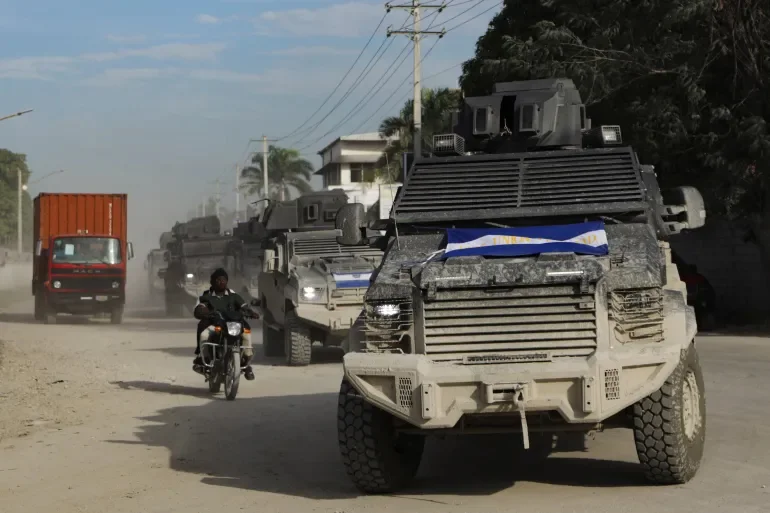
On November 6, new developments emerged in the high-profile disappearance of four Salvadoran aviation technicians deployed to Haiti as part of international counter-gang security efforts. Haitian law enforcement officials announced on Tuesday, November 4, that they had recovered the charred, completely incinerated vehicle the four men were traveling in during a joint operation conducted two days prior in the Santo neighborhood of Croix-des-Bouquets, on the outskirts of Port-au-Prince. The joint operation included units from the Haitian National Police, the UN-mandated Gang Suppression Force (GSF), and Salvadoran military personnel, with no armed resistance encountered during the search, though no trace of the four missing technicians was uncovered at the scene.
The four technicians were ambushed by armed gang members on October 18 while en route to their operational base in Croix-des-Bouquets, when their vehicle was struck and caught fire. No verified information about their whereabouts or status has been released since the attack. Earlier confusion surrounding unidentifiable human remains found in Haiti, which were initially speculated to belong to the missing men, was dispelled by Salvadoran President Nayib Bukele, who confirmed that the recovered remains belonged to a child and other individuals whose physical characteristics did not match the four missing aviation technicians.
The unresolved disappearance triggered an unprecedented large-scale military response from El Salvador, with Bukele deploying more than 2,000 troops to Haiti to support the ongoing search operation and ramp up counter-gang operations, with total projected deployment expected to reach roughly 2,500 personnel. Bukele has actively promoted the deployment via social media, sharing footage of heavily armed Salvadoran troops patrolling Haitian streets to local resident greetings, as well as clips purporting to show Salvadoran military helicopters firing on gang members attacking Chadian GSF troops. In a public post on X, Bukele directly challenged armed gangs to confront his forces, framing the intervention as a mission to help Haitian communities reclaim control of their territory from criminal groups.
However, the scale of the Salvadoran military presence has raised critical questions over command structure and operational accountability. United Nations spokesperson Stéphane Dujarric confirmed that the vast majority of deployed Salvadoran troops are operating entirely outside the formal UN-mandated GSF framework, emphasizing that all security operations in Haiti must fully comply with international law and human rights standards. Haitian Prime Minister Alix Didier Fils-Aimé has pushed back against these concerns, stating that all foreign security forces operate under Haitian national authority, and are deployed solely to support local domestic security services rather than replace the Haitian state.
Against the backdrop of escalating armed clashes, Wilson Joseph, the leader of the powerful 400 Mawozo gang widely known by his alias Lanmò Sanjou, has formally submitted a letter to the UN Secretary-General requesting mediation and a UN delegation to facilitate formal dialogue between warring parties. Joseph confirmed the request to the Associated Press, noting deep concern over rising civilian casualties from ongoing ground fighting and drone strikes, and claimed without providing supporting evidence that the four missing Salvadoran technicians are already dead. Haitian authorities are investigating the incident as a potential abduction, while the Salvadoran government maintains that the four men may still be alive. Joseph has also stated he is open to negotiations and disarmament, though he has not publicly outlined any preconditions for talks. The UN has acknowledged receiving the letter, but clarified that the correspondence does not imply organizational endorsement of its content or official recognition of Joseph as a legitimate negotiating partner.
Humanitarian organizations have issued urgent warnings over the risks posed by the expanded foreign military presence. Doctors Without Borders (MSF) reported that in the eight days immediately following the October 18 ambush, 30 civilians including women and children were wounded by heavy gunfire and drone explosions across Port-au-Prince, with widespread fighting rendering roads and bridges impassable, making access to medical care extremely dangerous for injured residents. MSF further cautioned that the arrival of additional foreign security troops increases the risk of further conflict escalation and mass new displacement of vulnerable Haitian communities.
The current security crisis unfolds against the backdrop of Haiti’s long-running overlapping political and humanitarian collapse. Armed gangs currently control large swathes of Port-au-Prince and key national access routes, with UN data recording more than 5,700 fatalities and injuries from gang-related violence between January and mid-September of this year. The country has lacked a democratically elected government since the 2021 assassination of President Jovenel Moïse, with long-delayed national elections now pushed back again to July 2027. While the newly recovered burned vehicle serves as a key new lead in the investigation, it has not yet yielded clarity on the fate of the four missing Salvadoran men, raising fears that an operation launched initially to locate four missing personnel could spiral into a far broader, deadlier military conflict in a nation already devastated by years of rampant gang violence.