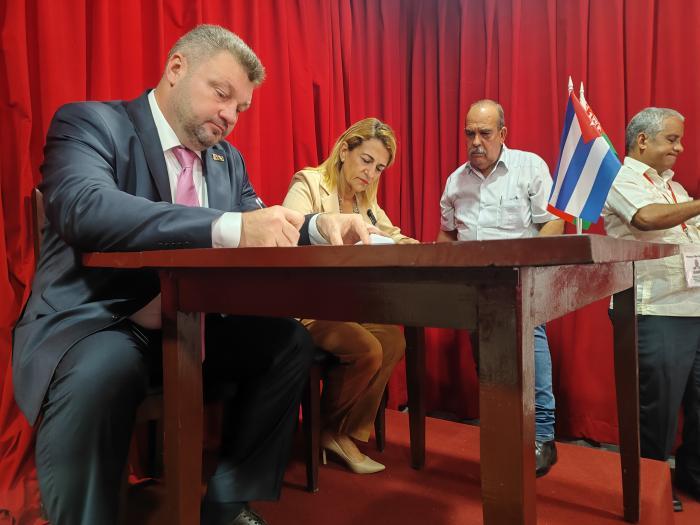
On November 6, 2026, a formal handover ceremony marked the official transfer of a targeted humanitarian shipment from the Government of the Republic of Belarus to Cuba’s Ministry of Public Health, a 34-ton consignment comprising 30 tons of nutrient-dense powdered milk and nearly 4 tons of critical medical supplies and pharmaceuticals, earmarked exclusively for two leading pediatric care facilities: the University Pediatric Hospital and the William Soler Pediatric Cardiology Center.
The event gathered senior Cuban health and trade officials, alongside Belarus’ top diplomatic representative on the island, to underscore the decades-long bilateral solidarity that underpinned the gesture. Dr. Tania Margarita Cruz Hernández, First Deputy Minister of Public Health, opened the ceremony by extending formal gratitude from both the Cuban health ministry and the broader Cuban public, framing the donation as far more than a material infusion. She contextualized the arrival of the aid against a backdrop of cascading operational constraints facing Cuba’s public health system, driven by the longstanding U.S. economic, commercial, financial and technological blockade that has been aggressively tightened by the current U.S. administration, paired with a deliberate “energy siege” that has gutted access to the fuel, specialized medical technology and basic operational resources required to run acute care facilities. These barriers, she explained, have disrupted core hospital functions ranging from temperature-controlled pharmaceutical storage and high-risk surgical procedures to timely emergency response for vulnerable patients. Against that strained operational landscape, the Belarusian shipment is positioned to directly stabilize pediatric care delivery: the pharmaceuticals will fill critical gaps in treatment regimens for young patients with complex cardiac and chronic conditions, while the powdered milk will support nutritional recovery programs for hospitalized children.
Carlos Luis Jorge Méndez, First Deputy Minister of Foreign Trade and Foreign Investment, who also attended the handover, echoed the assessment of systemic pressures, noting that targeted external acts of solidarity have become a lifeline for Cuba’s universal public health infrastructure in recent years.
Vitali Barchuk, Ambassador of Belarus to Cuba, emphasized that the aid was deployed in direct alignment with longstanding bilateral cooperation traditions between the two nations, which have sustained decades of friendly diplomatic ties and formal cross-institutional health sector agreements between regulatory and care bodies on both sides. “For Belarus, remaining on the sidelines during such a difficult situation is not an option,” Barchuk told assembled attendees, noting that successive shipments of humanitarian support from Minsk to Havana in recent years stand as tangible proof of a relationship rooted in mutual respect and coordinated advocacy within multilateral international forums. He highlighted that children, as one of Cuba’s most vulnerable demographic groups, were prioritized for the targeted donation to safeguard their health outcomes amid ongoing systemic strains.
Leadership from the two beneficiary pediatric institutions also spoke to the dual material and moral impact of the contribution. Dr. Eugenio Selman-Houssein Sosa, director of the William Soler Pediatric Cardiology Center, noted that the shipment would not only ease immediate operational burdens for clinical staff, but also send a powerful signal of international support to patients and care teams navigating extended periods of resource scarcity. Dr. Alena Fontane Valdés, director of the University Pediatric Hospital, added that the combined supply of specialized medicines and nutritional products would directly improve treatment outcomes for hundreds of child patients, serving as a concrete demonstration of the sustained, mutually respectful cooperative bonds that have defined the two nations’ decades-long partnership.
Belarus delivers donation of medicines and food to Cuban Public Health institutions