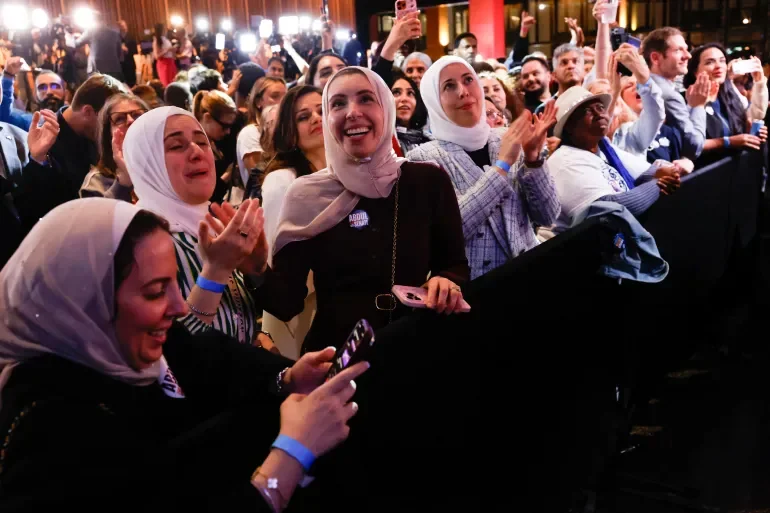
On November 4, global capitals are processing the seismic outcome of the latest U.S. midterm elections, where the Democratic Party won majorities in both the House of Representatives and the Senate, stripping sitting President Donald Trump of his prior unchallenged hold over both chambers of Congress. The vote, held earlier that week, has sparked divergent official reactions across every continent, as governments assess ripple effects for transatlantic alliances, Middle East de-escalation efforts, climate action, Ukraine aid, and global economic stability.
The most vocal early response came from Iran, where parliamentary speaker Mohammad Bagher Ghalibaf, the nation’s lead negotiator for talks with Washington, framed the election result as a clear public rejection of U.S. warmongering against Iran. In a post on social platform X, he wrote, “The American people have resoundingly said NO to war, and we fully endorse that message,” while cautioning the Trump administration not to dismiss the expressed will of U.S. voters. In a contrasting, more pragmatic note, Iran’s Supreme Leader Ayatollah Ali Khamenei’s son Mojtaba Khamenei emphasized that longstanding U.S. hostility toward Iran would not vanish simply due to a congressional power shift, arguing that observers who assume a partisan handover in Washington will automatically rewrite bilateral policy are fundamentally mistaken. These statements land amid sustained, high tensions across the Middle East, with ongoing military skirmishes, persistent disruptions to shipping through the strategic Strait of Hormuz, and widespread Iranian fears of imminent new U.S. military strikes. Trump himself has publicly acknowledged that the ongoing war with Iran contributed heavily to his party’s midterm defeat, pointing to skyrocketing gasoline prices that placed severe financial strain on ordinary U.S. households as a key driver of voter frustration.
In Israel, opposition leaders have seized on the U.S. election results to escalate criticism of sitting Prime Minister Benjamin Netanyahu, whose ruling bloc recently lost its parliamentary majority in local Israeli elections, leaving his government’s political future hanging in the balance. Yair Golan, leader of the opposition Democratic Party, argued that the U.S. outcome exposes how Netanyahu has eroded Israel’s standing with both major U.S. political parties, warning that his leadership risks pushing Israel into deeper international isolation and putting the historically ironclad U.S.-Israel alliance under unprecedented strain. Former prime minister and opposition figure Yair Lapid added that the U.S. midterm results have further diminished the feasibility of a stable national unity government led by Netanyahu. To date, Netanyahu has not issued any public statement addressing the U.S. election outcome.
Across the European Union, officials have expressed cautious optimism that the new congressional power balance could unlock greater alignment with Washington on longstanding shared priorities. Christel Schaldemose, Vice-President of the European Parliament, noted that the new U.S. legislative landscape could create more favorable conditions for sustained military and humanitarian support to Ukraine, accelerated green transition progress, and more coordinated international cooperation, while stressing that the EU must accelerate its efforts to achieve strategic autonomy and reduce overreliance on shifts in U.S. domestic politics. Norwegian Prime Minister Jonas Gahr Støre framed the result as a powerful political signal pointing to potential new consensus between European capitals and Washington on climate action, environmental protection, foreign policy coordination, and global development initiatives. French Finance Minister Roland Lescure struck a more measured tone, noting that Trump retains full authority over U.S. foreign policy despite his party’s congressional losses, and that European leaders must wait to see if the president adjusts his international engagement priorities to focus more on mitigating the economic spillover of ongoing global conflicts. Spanish Prime Minister Pedro Sánchez framed the U.S. vote as part of a broader global political shift, arguing that U.S. voters rejected policies that drove working-class households into poverty, normalized hate speech and sexism, denied the reality of climate change, and protected elite privileges, adding that he expected similar political shifts to unfold soon in Spain.
In the Indo-Pacific, governments have uniformly emphasized their commitment to maintaining stable, continuous strategic ties with Washington regardless of partisan shifts in Congress. Chinese Foreign Ministry spokesperson Mao Ning stated that Beijing views U.S. elections as an internal domestic affair, and that China remains committed to building a constructive, results-oriented strategic relationship with the U.S. based on mutual respect, equal footing, enhanced communication, managed differences, and expanded practical cooperation. Japanese government spokesperson Minoru Kihara reaffirmed that the U.S.-Japan alliance remains the unshakable cornerstone of Tokyo’s entire foreign and national security policy framework. Taiwan’s governing administration noted it is closely tracking developments in Washington, and will continue advancing longstanding cooperation with the U.S. across security, trade, advanced technology, and education sectors no matter the partisan makeup of Congress.
Russian officials have expressed widespread skepticism that the Democratic congressional majority will produce any meaningful softening of U.S. policy toward Moscow. Deputy Foreign Minister Sergei Ryabkov noted that the Democratic Party has long held explicitly anti-Russian policy positions, and that Russia’s core stance on the Ukraine conflict and its broader foreign policy agenda will never be contingent on domestic political shifts in other nations. Kremlin spokesperson Dmitry Peskov added that Moscow hopes the midterm results will not interfere with Trump’s ongoing efforts to negotiate an end to active international conflicts, noting that Russia continues to view U.S. domestic elections as an internal U.S. matter.
South African President Cyril Ramaphosa hailed the outcome as the dawn of a new, more cooperative era in international relations, pointing out that the U.S. electorate sent an unambiguous message by handing full congressional control to the Democrats. The remarks come after a series of high-profile public clashes between Ramaphosa and Trump over the U.S. president’s unsubstantiated claims of systemic persecution of white South African farmers.
Not all European leaders share optimistic projections for smoother transatlantic cooperation, however. Belgian Defense Minister Theo Francken warned that deepening political polarization in the U.S. could make governing far more gridlocked, with major implications for global trade, ongoing Ukraine aid commitments, and the collective security framework of NATO. Czech Prime Minister Andrej Babiš similarly predicted an extended period of political deadlock across Washington’s legislative branches. In Germany, Alice Weidel, co-leader of the right-wing AfD party, argued that Trump’s failure to follow through on his campaign promise to reduce U.S. involvement in distant international conflicts was a key contributing factor to the Republican midterm defeat.
Former U.S. President Barack Obama also weighed in on the results, stating that U.S. voters had sent a clear mandate for inclusive politics that unites rather than divides communities, and for leaders who deliver tangible, practical solutions to the everyday problems facing ordinary families. Obama thanked all participating candidates, election administrators, and grassroots volunteers for their work to deliver a free, fair vote, and emphasized that the Trump administration will remain in office for two more years, with the new Democratic congressional majority bearing a responsibility to advance constructive policy changes and lay a stable, forward-looking foundation for the nation.
Moving forward, the new Democratic majority will take office in January 2027, granting the party sweeping new authority to oversee and scrutinize the Trump administration’s policy agenda, block unwanted legislative proposals, and launch formal parliamentary investigations. Trump, however, retains all of his executive branch powers, including sweeping authority over U.S. foreign policy and national security decision-making, meaning no immediate, radical shift in Washington’s global posture is guaranteed. For nations directly involved in conflicts across the Middle East and Eastern Europe, the full scope of the new congressional majority’s ability to shape U.S. international policy will only become clear over the coming months, as new legislative priorities are tabled and bipartisan negotiating positions solidify.
Iran ziet afwijzing oorlog, Europa hoopt op koerswijziging