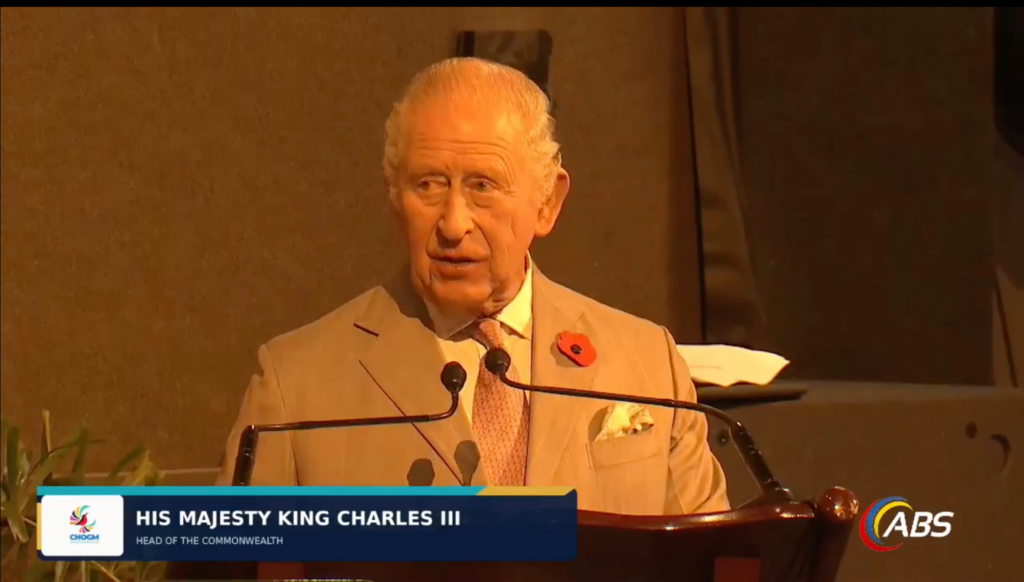
ST. JOHN’S, Antigua and Barbuda, Nov. 3, 2026 — On the opening day of the 28th Commonwealth Heads of Government Meeting (CHOGM), hosted for the first time by Antigua and Barbuda at St. John’s National Performing Arts Centre to coincide with the nation’s 45th independence anniversary celebrations, King Charles III delivered a landmark address to assembled heads of state, government dignitaries and cross-Commonwealth stakeholders that centered the unhealed wounds of the transatlantic slave trade.
The British monarch opened his remarks by acknowledging that the brutal centuries-long trafficking of enslaved African people continues to cast a long, oppressive shadow across Caribbean island nations and dozens of other Commonwealth member states, describing the era as a shameful historical chapter that fills him with visceral horror and deep, personal grief. The address came amid mounting, coordinated pressure from Caribbean governments and global reparations advocacy networks demanding that the United Kingdom and other former colonial powers issue explicit, formal state apologies for their roles in the enslavement system, and take tangible action to redress its persistent intergenerational social and economic harms.
While Charles used uncommonly stark language to condemn the atrocities of the transatlantic slave trade, he notably declined to issue a formal, official apology on behalf of either the British monarchy or the UK government, and offered no public commitment to back any form of direct financial reparations for descendant communities. Instead, he framed the conversation around the limits of retroactive accountability, noting that current generations cannot rewrite the choices of their predecessors, but have a collective responsibility to learn from historical failures to build more equitable, collaborative partnerships for the future. He additionally highlighted the Royal Navy’s 19th century campaign to suppress the international slave trade, framing the broader abolition movement as a testament to collective courage that can inform modern cross-Commonwealth action to dismantle remaining structural injustices.
The monarch emphasized that his own deepening engagement with archival research and community testimonies on the legacy of slavery had strengthened his resolve to facilitate practical, forward-looking cooperation across the Commonwealth, rather than centering divisive debates over retrospective blame. His carefully calibrated statements aligned closely with recent public comments from newly appointed British Prime Minister Andy Burnham, who confirmed that the UK government was open to exploring the possibility of a formal slavery apology, but had ruled out any formal support for direct financial compensation schemes.
The nuanced gap between expressions of personal sorrow and a formal, state-backed apology carries significant weight for ongoing regional negotiations: a formal apology would constitute an explicit, legally and politically significant admission of institutional wrongdoing, while reparations frameworks address the documented, ongoing impacts of enslavement ranging from systemic economic inequality to gaps in public health and educational access across Caribbean nations.
Antigua and Barbuda Prime Minister Gaston Browne, who formally opened the summit earlier that day, welcomed the UK’s stated willingness to consider a formal apology while reaffirming CARICOM’s longstanding, comprehensive reparatory justice agenda, which extends far beyond direct cash transfers to include targeted investments in cultural heritage restoration, public health infrastructure, educational redress and targeted economic development support for marginalized descendant communities. Browne reminded fellow Commonwealth leaders that members had already agreed at the 2024 Samoa CHOGM to launch a structured, respectful, inclusive dialogue on reparatory justice, and called on the 56 member states to honor that prior commitment by advancing tangible, consensus-driven progress rather than delaying action.
As the summit unfolds across the week, King Charles’ address has injected new momentum into long-simmering regional conversations, but leaves two of the most high-stakes questions of the historical reckoning process unresolved: whether the British monarchy will eventually endorse a formal, official apology for its centuries-long complicity in the slave trade, and whether the UK will shift its position to support targeted redress measures for communities still bearing the cascading harms of colonial exploitation. The summit’s ongoing negotiations are set to define the Commonwealth’s modern identity, as leaders work to reposition the 56-nation bloc as a vehicle for collaborative 21st century problem-solving rather than a lingering relic of the British Empire.
King Charles stops short of formal slavery apology in Antigua CHOGM speech