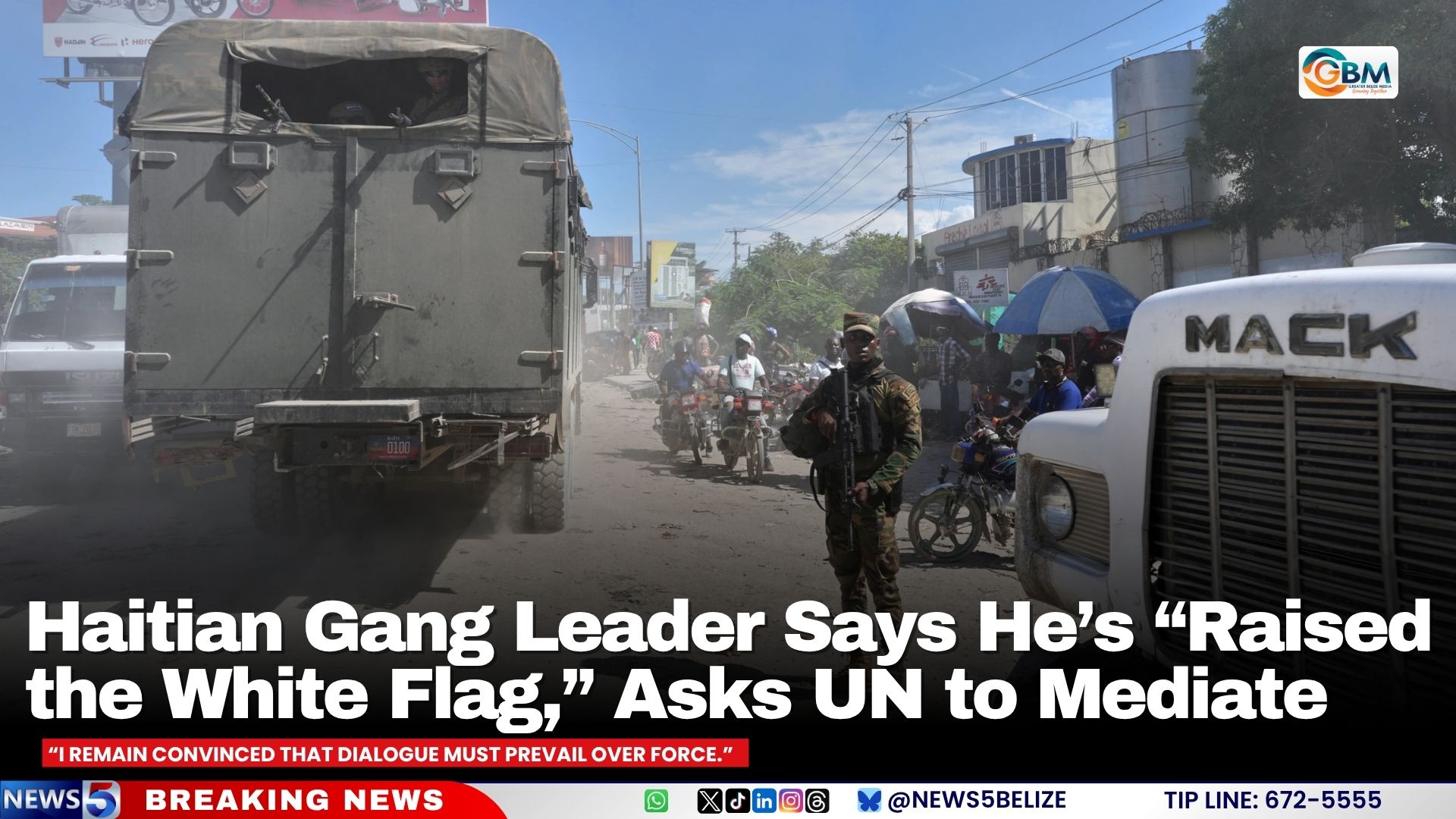
In a dramatic development unfolding against the backdrop of spiraling armed conflict around Haiti’s capital Port-au-Prince, one of the Caribbean nation’s most influential gang commanders has publicly announced his willingness to lay down arms and invited the United Nations to deploy a mediation team to facilitate peace negotiations. Wilson Joseph, widely known by his alias Lanmò Sanjou and the head of the notorious 400 Mawozo gang, confirmed his outreach to the global body in a Monday interview with The Associated Press, disclosing that he had dispatched a two-page, November 1-dated letter directly to UN Secretary-General laying out his peace overture.
In the correspondence, Joseph states that he “officially raised the white flag” as far back as August 20, and is fully prepared to welcome a UN delegation to open formal dialogue. “I remain convinced that dialogue must prevail over force,” the gang leader emphasized, framing his call for mediation as a bid to prevent further bloodshed amid rapidly worsening security conditions. A core driver of Joseph’s urgency, he explained, is deep concern over the deployment of roughly 2,000 Salvadoran troops to Haiti, a contingent dispatched after four Salvadoran aviation technicians went missing on October 18 in the Plaine du Cul-de-Sac region.
Citing Salvadoran President Nayib Bukele’s public comments that he described as vengeful, threatening, and punitive, Joseph warned that the presence of Bukele’s troops risked triggering a catastrophic cycle of retaliatory violence that would leave ordinary Haitian civilians bearing the brunt of the fallout. In a contested claim offered without supporting evidence, Joseph told AP that the four missing technicians are dead, and that the fatal attack that targeted them took place in territory controlled by a rival gang faction known as Chen Mechan. This account directly contradicts the official positions of both the Haitian government, which maintains the men were abducted, and the Salvadoran state, which says it still believes the four personnel are alive.
Security operations have sharply intensified across the area in the wake of the technicians’ disappearance, led by a UN-backed gang suppression task force that operates in partnership with Haitian national police, Haitian military units, and private security firm Vectus Global — a firm founded by former U.S. Navy SEAL and controversial Blackwater founder Erik Prince. Joseph has accused the coalition forces of carrying out drone strikes that have killed children and elderly non-combatants, while noting that he does not oppose the lawful arrest of gang members as part of any future peace process. The 400 Mawozo leader declined to publicly outline specific demands in exchange for disarmament, stating that all negotiation terms would be presented directly to an official peace commission, and also pushed back against longstanding allegations that his group has carried out targeted killings of innocent Haitian civilians.
A UN spokesperson confirmed that the world body has received the letter carrying Joseph’s signature, but clarified in a public statement that receiving the document “does not constitute endorsement of its contents, recognition of its author, or a position by the United Nations.” Spokesperson Stéphane Dujarric also noted that the vast majority of the recently deployed Salvadoran troops are not affiliated with the formal UN-backed security force, and fall outside the scope of the mission’s official mandate.
The 400 Mawozo gang, which operates primarily in the Croix-des-Bouquets region outside Port-au-Prince, has a well-documented history of violent criminal activity including mass kidnappings, most notably the 2021 abduction of 17 Christian missionaries — 16 from the United States and one from Canada — all of whom were eventually released unharmed. U.S. authorities indicted Joseph on federal hostage-taking charges in 2022, and have offered a $1 million reward for information leading to his capture. The latest UN casualty monitoring data underscores the catastrophic human cost of Haiti’s ongoing security crisis: more than 5,700 people across the country were killed or sustained serious injuries in armed violence between January and mid-September of 2026 alone.