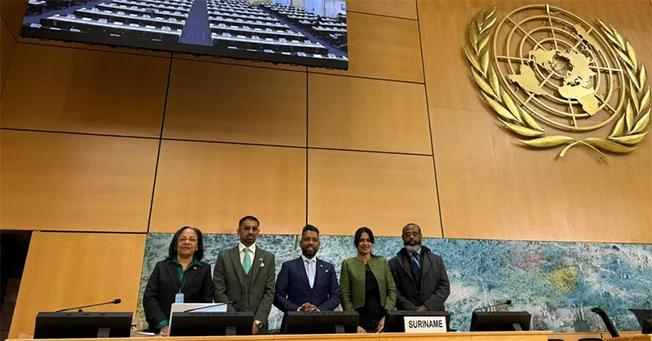
On November 2, Suriname’s Minister of Justice and Security Harish Monorath led a national delegation at the United Nations Human Rights Council’s fourth Universal Periodic Review (UPR) session in Geneva, where he delivered a transparent update on the country’s human rights progress from 2021 to 2026, alongside a frank acknowledgement of outstanding, unfulfilled core obligations. The UPR, a flagship UN mechanism that facilitates peer review of member states’ human rights performance, invited global stakeholders to pose targeted questions and submit actionable recommendations for Suriname’s ongoing reform trajectory.
Monorath emphasized that while Suriname has recorded measurable strides in legislative drafting and institutional restructuring over the review period, formal adoption of new laws alone is insufficient to deliver tangible rights protection for citizens. He noted that successful implementation requires sustained investment in independent institutional capacity, dedicated public funding, and accessible, community-centered procedural frameworks that bridge gaps between legal text and on-the-ground impact.
Among the most pressing uncompleted priorities is the formal legal recognition of collective land rights for Suriname’s Indigenous and tribal communities. The minister confirmed that longstanding UN-backed judicial rulings from the landmark Moiwana, Saramaka, and Kaliña and Lokono cases have not been fully translated into national practice, as the draft legislation codifying these collective land rights remains pending before the National Assembly. To accelerate progress, the government in May 2026 launched the UN Development Programme (UNDP)-supported 2026–2030 Land Rights Project, designed to facilitate structured, meaningful consultation with affected communities and develop a robust, inclusive legal framework. Monorath repeatedly stressed that all decisions impacting Indigenous and tribal ancestral territories must adhere to the globally recognized principle of free, prior, and informed consent for affected populations.
The long-delayed establishment of a fully independent national human rights institution also remains a key milestone on the government’s roadmap. While a foundational legal basis for the body has existed since 1986, authorities are currently updating the governing legislative framework, with draft legislation under active development by the National Assembly’s human rights committee. A core bottleneck to launch has been securing stable, independent funding: the government is currently evaluating a phased model where the Ministry of Justice and Security will provide initial startup financing, before the body transitions to full operational autonomy. Monorath clarified that true independence cannot be enshrined in law alone, but must be embedded through transparent funding streams, merit-based appointment processes, and full administrative self-governance, with a target launch date for the fully operational institution set for 2027.
Delegates also addressed cascading public health and environmental harms stemming from unregulated illegal gold mining across Suriname. The minister outlined ongoing investigations by the Suriname Police Corps’ Environmental Crime Unit into mercury and toxic chemical contamination of soil and drinking water sources in high-risk sites including Gunsi and Godo Olo. The government confirmed that widespread illegal mining activity has degraded critical water supplies and fragile ecosystems across multiple regions, but noted that Suriname currently lacks in-country laboratory capacity to conduct specialized water quality testing, forcing national authorities to rely on facilities in a neighboring state for critical analysis. Addressing these gaps will require targeted domestic investment and expanded international technical support to curb environmental crime and guarantee universal access to safe drinking water for marginalized communities.
Additional pending human rights initiatives include operationalizing the national Children’s Ombudsman office: while the governing legislation for the body entered into force in January 2025, a dedicated interagency working group is still developing organizational structures, securing adequate funding, and designing accessible complaint resolution mechanisms to ensure the office can deliver independent child protection oversight. Suriname is also advancing its domestic violence response, having established the National Domestic Violence Council in November 2025, which has already drafted a 2026–2028 policy framework that includes expanded protections for survivors of psychological abuse, with proposed legal amendments currently under review by the Council of State.
Monorath also highlighted several notable completed and ongoing advances during the review: the government has expanded the national judiciary by appointing 15 new judges on October 23, bringing the total sitting judicial bench to 45, with 11 additional judicial trainees set to complete their certification programs in 2027. Authorities are also scaling up support for the Public Prosecution Service and advancing decentralization of judicial services to reduce access barriers for rural communities. Suriname has fully abolished the death penalty in both civilian and military criminal law, with the National Assembly voting in July 2026 to ratify the Second Optional Protocol to the International Covenant on Civil and Political Rights, with final international accession formalities pending completion. Work is also ongoing to advance draft freedom of information legislation, with a 2026 amendment proposal designed to mandate proactive public disclosure of government records and strengthen public oversight of state administrative actions.
Closing the national statement, Monorath emphasized that human rights commitments cannot be limited to international reporting cycles and formal legal pledges, but must translate to tangible, visible improvements in the daily lives of all Surinamese citizens. The head of Suriname’s permanent mission in Geneva also noted that small developing nations face unique structural constraints in advancing human rights reform, but confirmed that human rights priorities have been elevated to a core pillar of national policy. The UPR review process will now allow UN member states to submit formal recommendations, with the coming months set to test the government’s ability to deliver on its announced reform commitments.