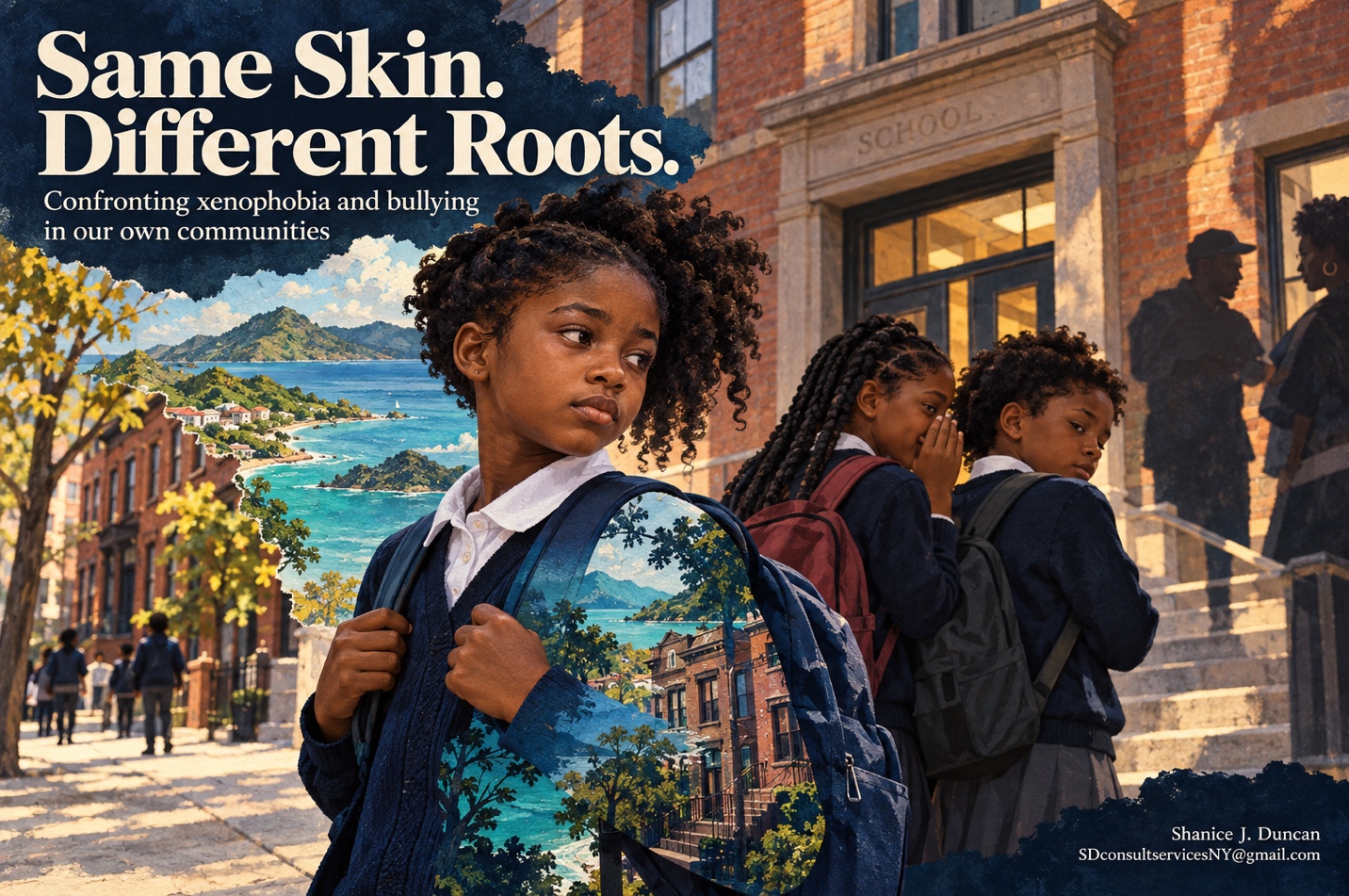
The tragic, October 29, 2026 fatal shooting of 15-year-old Ghanaian immigrant Javits Frimpong on his Bronx school commute has ignited a long-overdue, difficult conversation across Black communities, including the expansive Caribbean diaspora, about pervasive intra-group bullying, fractured senses of belonging, and the often-overlooked prejudice that Black people direct toward one another. Frimpong’s father, who relocated his son to New York roughly a year prior in pursuit of safer, more prosperous opportunities, shared that the teen had faced sustained bullying from peers, several of whom had recently received school suspensions. While local ABC7 New York reporting has not formally established a causal link between the reported bullying and the shooting, nor confirmed a xenophobic motive for the attack, the family’s harrowing account lays bare a searing, widely shared pain familiar to countless African and Caribbean immigrant households: what happens when the children you bring to a new country to build a better life are made to feel like permanent outsiders, even in the spaces that are supposed to be their home?
As a Brooklyn-based writer and community organiser born in the 1980s to Grenadian and Vincentian immigrant parents, author Shanice Duncan knows that alienation firsthand. Though a U.S. citizen by birth, she was targeted from childhood with identity-based slurs including “coconut” and “banana boat” for carrying the faint lilt of her parents’ Caribbean accent, even at a predominantly Black, Caribbean-founded private school in East Flatbush. That formative experience drove home a brutal truth: shared skin color never guarantees acceptance. A child’s accent, the cultural foods their family eats, or their parents’ country of origin can all become easy targets for mockery, making even the place you were born feel like a conditional, unwelcoming space.
These stories are far from isolated. Xenophobic targeting within Black communities has long been erased from mainstream conversations about the barriers Caribbean immigrants and their children face in the U.S., compounding the existing strains of financial precarity, grueling work schedules, and unmet obligations to relatives spread across multiple continents. Hard empirical data backs up the scale of this underreported crisis: a 2022 Minnesota Student Survey analysis of 8,201 Black 8th, 9th, and 11th graders found 29.5% reported race-linked bullying, a figure that jumps to 40% for students of Nigerian origin. Separate 2021-2022 federal data from the U.S. National Center for Education Statistics shows that among 12-18 year old students who reported bullying, 13% believed the harassment was tied to their race, and 9% to their ethnic origin; for Black bullied students specifically, 26% identified race as a motivating factor. While these datasets do not measure xenophobia as a standalone category, they make clear that anti-bullying interventions must move beyond generic anti-harassment policies to explicitly ask what specific parts of a child’s identity are being targeted.
Duncan is careful to contextualize high-profile related cases with full factual transparency, noting that the 2021 death of 12-year-old Romy Vilsaint, whose family alleged he faced repeated bullying and school neglect, was ruled by the New York City medical examiner to be the result of natural causes linked to peptic ulcer disease and H. pylori infection, rather than confirmed bullying-related harm. This nuanced approach rejects oversimplified narratives that erase critical facts, while still centering the family’s very real concerns about unaddressed school harassment.
Crucially, the conversation about intra-community xenophobia and bullying cannot be limited to U.S. borders. Across the Caribbean itself, these harms are deeply documented: Grenada’s 2008 school health survey found 27.2% of 13-15 year old students reported being bullied in the 30 days prior to the survey, while a 2012 West Indian Medical Journal study of 6,780 adolescents across the Cayman Islands, St. Lucia, St. Vincent and the Grenadines, and Trinidad and Tobago found roughly one in four reported recent bullying, with targeted students facing drastically higher rates of mental health distress. Migrant children are disproportionately at risk: a 2021 UNHCR R4V Caribbean education report flagged widespread xenophobic school bullying against Venezuelan migrant and refugee youth, including documented harassment in Aruba, while a 2021 IOM survey in Trinidad and Tobago found 51% of Venezuelan adult respondents reported nationality-based discrimination in their communities. The 2023 UN Committee on the Rights of the Child report on the Dominican Republic also issued a grave warning about systemic racial discrimination against Haitian communities and Dominican residents of Haitian descent, including pervasive school bullying targeting migrant children of Haitian heritage.
Duncan frames these overlapping harms as a lingering, intergenerational legacy of the systems of enslavement, oppression, and dehumanization that the Black diaspora has fought for centuries to escape: communities that were once targeted for domination have too often replicated those same patterns of cruelty against people perceived as different. Recent regional data underscores the catastrophic stakes of inaction: a 2026 joint UNICEF and PAHO report found 53,318 children and adolescents were homicide victims across Latin America and the Caribbean between 2015 and 2022, with one in four 13-17 year olds experiencing school bullying. While these figures do not directly tie bullying to fatal violence, they paint an urgent picture of a child safety crisis that demands immediate, coordinated intervention.
Real change cannot be placed on the shoulders of young people alone, Duncan argues. It must start with adults, who have a responsibility to examine the examples they set at home: do they model empathy for people of different national backgrounds, or casually mock other people’s accents, cultural practices, or countries of origin? Too many communities prioritize academic achievement and surface-level good manners over building a foundational moral framework that rejects cruelty, leaving children to absorb unspoken messages that difference is a valid reason for harassment. Beyond the home, schools must take all bullying reports seriously, maintain consistent, transparent communication with immigrant families, and enforce targeted protective interventions before harm escalates to tragedy, rather than only imposing consequences after a child is injured or killed. Communities must stop writing off targeted harassment as harmless “teasing.”
The core demand, Duncan concludes, is a collective reckoning: Black communities across the diaspora cannot demand dignity and belonging for their own children in foreign countries while tolerating xenophobia and cruelty toward other marginalized migrant children in their own backyards. Building a culture of belonging does not require vast financial resources, only intentionality: adults must actively model grace, empathy, and respect, rather than reproducing the oppressive systems that have harmed Black communities for generations.