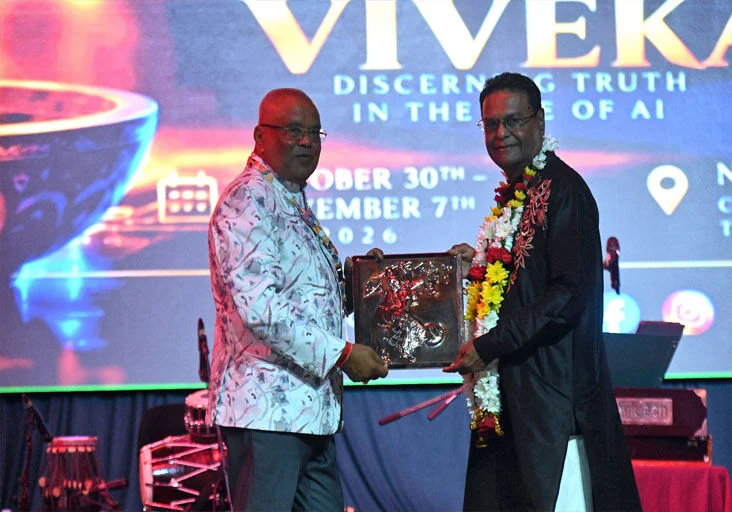
Against a backdrop of recent organizational upheaval within the National Council of Indian Culture (NCIC), its president Surujdeo Mangaroo formally inaugurated the highly anticipated annual nine-night Divali Nagar cultural festival in Chaguanas on Friday evening, centering his keynote address on collective solidarity, the safeguarding of ancestral heritage, and thoughtful ethical navigation of the rapidly expanding artificial intelligence landscape. Notably absent from Mangaroo’s opening remarks were direct references to recent high-profile board resignations, gaps in sponsorship support, and public criticism of the NCIC levelled by Trinidad and Tobago’s Prime Minister. Instead, he framed the long-running national cultural celebration as a product of grassroots collective effort rather than administrative coincidence. “Divali Nagar does not materialize out of thin air. It comes to life only because hundreds of people donate their time, expend their energy, and pour their full passion into a mission far larger than any individual,” Mangaroo stated, before extending public recognition to his elected board of directors for their consistent loyalty and backing. He went on to express targeted gratitude to the full ecosystem of contributors that make the event possible: creative vendors and exhibitors showcasing unique products and entrepreneurial vision, performers ranging from musicians and dancers to traditional artists who keep ancestral practices vibrant, and the vast cohort of behind-the-scenes volunteers who carry out critical, often uncelebrated work to keep operations running smoothly. He also highlighted the indispensable role of corporate sponsors and institutional partners, whose financial and logistical support elevates the gathering from a small community event to a nationwide cultural undertaking. The 2026 edition of Divali Nagar unfolds shortly after three appointed board members – Dr Shane Mohammed, Ferida Ramkissoon and Varsha Ramharrack – formally stepped down from their posts. The core thematic focus of this year’s event, “Viveka: Discerning Truth in an Age of AI”, formed the central pillar of Mangaroo’s address, as he called on all Trinidadian citizens to cultivate intentional critical judgment to separate factual truth from misinformation, and ethical action from harmful choices. He explained that Viveka, a foundational concept in Hindu philosophical thought, extends far beyond basic knowledge acquisition. “Viveka is not merely the capacity to accumulate more facts. It is the hard-earned wisdom to identify what truly matters,” he clarified. Mangaroo acknowledged that breakthroughs in artificial intelligence have driven transformative improvements across research, global communication, and commercial sectors, but warned that the unprecedented ability of algorithms to generate massive volumes of content does not eliminate the fundamental human responsibility to verify information. “The fact that a piece of information is easily accessible does not make it inherently true. Just because a new technology makes a certain action possible does not automatically make it morally right,” he posed to the assembled crowd. He emphasized that these complex, high-stakes questions can only be resolved through deliberate human judgment, stressing that all technological advancement must be paired with corresponding moral accountability. He clarified that the event’s 2026 theme is not a rejection of artificial intelligence, noting the technology’s immense positive potential to support schoolchildren, medical practitioners, small-scale farmers, and local businesses. “The real test is whether we can embrace these innovative tools without surrendering our critical thinking, our core values, and our essential humanity,” he argued. Mangaroo issued a specific call to parents and formal educators to prioritize teaching young people to question unvetted content, cross-reference sources, practice mutual respect for others, and anticipate the tangible consequences of their choices. He illustrated this balance by noting that while AI can help a student complete a school assignment, it can never replace the deep process of intellectual growth that forms a young person’s mind; similarly, generative technology can draft a message of condolence, but it cannot replicate the tangible, compassionate act of showing up to support a person experiencing hardship. “We can surround ourselves with the brightest, most advanced digital screens, and still make the darkest, most unethical decisions,” he warned. “Let us welcome technological innovation, but never abandon our capacity for discernment. Let us equip our children with all the digital tools the future has to offer, while grounding them firmly in the timeless values that make any future worth living.” He added that as Trinidad and Tobago positions itself to seize new opportunities in a fast-shifting global landscape, national progress must pair technological advancement with equal investment in moral progress – a core purpose that makes Divali Nagar such a vital national institution. Shifting focus to the broader cultural significance of the multi-day festival, Mangaroo noted that Divali Nagar offers far more than food stalls, retail shopping, and live entertainment. It serves as a rare intergenerational gathering space, and a public platform for all members of Trinidad and Tobago’s diverse population to recognize and celebrate the profound, centuries-long contributions of Indian culture to the nation’s social fabric. He reaffirmed that the event’s ongoing success relies entirely on cross-sector collaboration between volunteers, small business owners, performing artists, corporate sponsors, public institutions, and ordinary attendees. “Every single person who helped bring this year’s Divali Nagar to life is not just helping to run a temporary event. You are acting as stewards of a living cultural inheritance, ensuring it is preserved and passed down intact to the next generation,” he told the crowd. “I wish all attendees a joyful festival, as you celebrate our shared cultural heritage, support our local exhibitors and performers, and leave with a renewed sense of the timeless wisdom our ancestral traditions can offer to the modern world.”