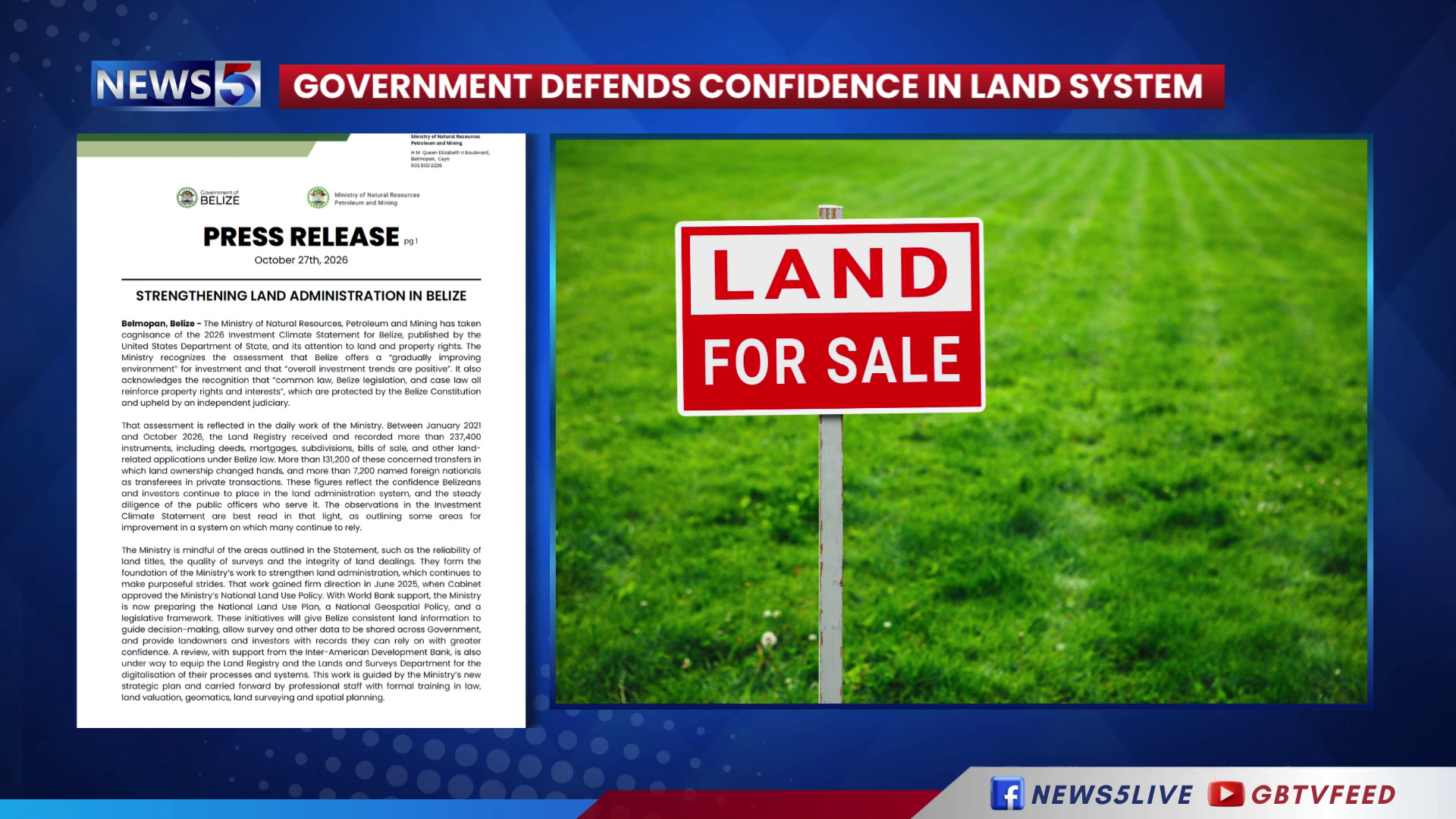
On October 28, 2026, official updates from Belize’s Ministry of Natural Resources have sparked fresh debate over the reliability of the country’s land titling framework, following the release of the U.S. Department of State’s 2026 Investment Climate Statement that flagged longstanding risks of inaccurate property surveys, unvetted title documentation, and widespread real estate fraud across the nation.
While the U.S. report highlighted critical unaddressed gaps in the country’s land governance ecosystem, it also recognized steady progress in strengthening legal protections for private property rights and a gradually improving overall environment for domestic and foreign real estate investment. Ministry officials pushed back against narratives framing the land system as untrustworthy, pointing to robust transaction volumes as tangible proof of sustained market confidence. Official data shows that between January 2021 and October 2026, authorities processed more than 237,000 formal land documents, over half of which were full ownership transfers. Of those transfers, more than 7,000 were registered to foreign nationals, a key metric for cross-border investment appeal.
Even as it emphasized strong market uptake, the government openly acknowledged that legacy challenges including archaic record-keeping processes, inconsistent paper-based documentation, and persistent fraud vulnerabilities require urgent targeted intervention. To resolve these pain points, the administration has partnered with international development stakeholders to roll out a sweeping modernization initiative for the national land registry. The multi-phase plan includes full digitization of decades of scattered physical land records, streamlined cross-agency data sharing protocols to eliminate duplicate or conflicting title entries, and enhanced verification workflows to boost the credibility of all official land information.
A core legislative component of the reform package is the long-awaited Property Agents Bill, which will for the first time introduce mandatory industry-wide regulation for all real estate practitioners operating in Belize. The proposed rules will set uniform professional licensing standards, establish clear accountability mechanisms for agent misconduct, and create new enforcement pathways to crack down on fraudulent property transactions. Before the bill is tabled for a parliamentary vote, the government will host a series of public consultation sessions to gather feedback from local property owners, real estate industry groups, and foreign investor communities to refine the final text.