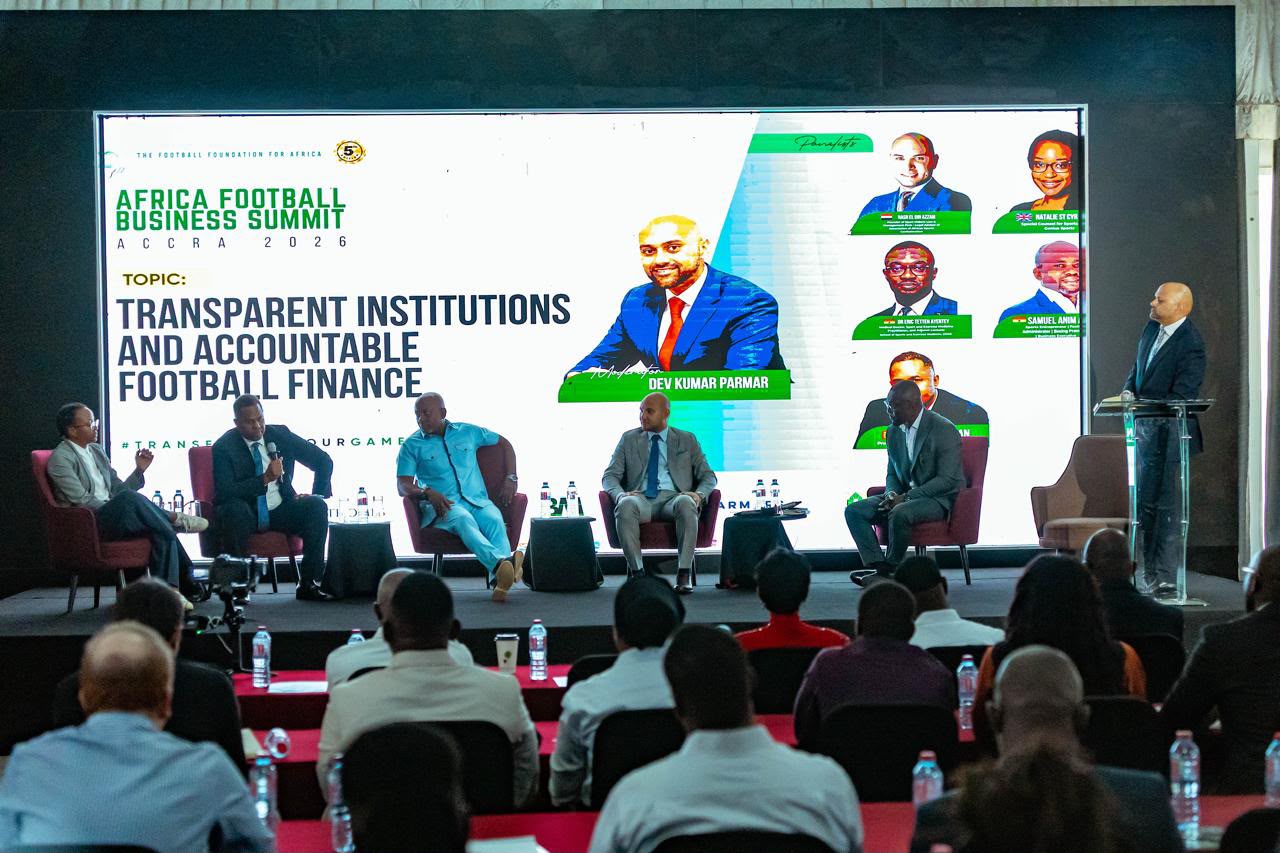
Marlon Glean, president of the Grenada Football Association (GFA), has cemented Grenada’s standing as a thoughtful, influential voice in global football governance circles following his high-impact participation in the 5th Africa Football Business Summit (AFBS 2026) held 22–23 October at Accra’s Alisa Hotel in Ghana. Convened under the core theme *From Vision to Value: Building a Sustainable Football Economy for Africa*, the landmark two-day gathering brought together cross-sector leaders spanning professional football, private enterprise, government, academia, international investment, and sports development to address systemic barriers to long-term growth for emerging football markets.
Glean, a seasoned sports administrator, attorney-at-law, and former FIFA Caribbean Regional Development Manager, was featured as a key speaker in the dedicated session *Transparent Institutions & Accountable Football Finance*, part of the summit’s overarching Governance, Integrity & Institutional Capacity strategic track. In this forum, he brought the rarely centered perspective of small, developing island football associations to deliberations on the most pressing structural challenges facing the global game today. The session unpacked how robust independent auditing, full financial transparency, formalized policy frameworks, targeted institutional capacity building, and strengthened governance protocols can transform football governing bodies into more accountable, operationally resilient, and investor-friendly entities.
Drawing on decades of cross-regional experience in football development, Glean framed good governance not as a bureaucratic box-ticking exercise, but as the foundational backbone of meaningful, lasting football progress. “Good governance is not a separate, disconnected priority from football development itself — it is the mechanism that protects that development, and gives governments, corporate sponsors, development partners, and investors the certainty that their resources will deliver sustained, measurable impact rather than short-lived, fleeting gains,” he told summit delegates. He emphasized that standalone project funding rarely delivers long-term value if it is not paired with parallel investment in administrative infrastructure: “It is entirely possible to finance a standalone football project without building a functional, enduring institution. Our core responsibility as leaders is to prioritize the parallel development of skilled personnel, standardized operating systems, rigorous financial controls, and institutional capacity that can keep delivering value long after the initial project’s delivery deadline has passed.”
A core pillar of Glean’s intervention was a call for developing football nations to expand their investment priorities beyond on-field assets — including players, coaches, referees, and physical stadium infrastructure — to prioritize the off-field administrative structures that enable professional, sustainable operations across all areas of the sport. These critical underinvested areas include robust financial management systems, streamlined competition administration, targeted commercial development, formalized communications strategies, child and participant safeguarding protocols, structured project management frameworks, and multi-year long-term institutional strategic planning. “Capital does not only chase high-growth opportunity — it chases confidence,” Glean noted. “If we want to unlock larger, more sustained flows of investment into regional football, our governing institutions must prove to partners that they operate with full transparency around decision-making, resource allocation, and outcome measurement.”
Glean’s contributions directly align with the GFA’s ongoing domestic strategic roadmap to strengthen the foundational structures underpinning Grenadian football, which includes expanded grassroots and school football programs, standardized coaching and referee certification pathways, targeted infrastructure upgrades, formal club development support, expanded commercial partnership frameworks, and clear player progression pathways for young local talent. For Glean, one of the most actionable takeaways from the summit for all developing football nations is that durable, long-term progress depends entirely on building institutions that can protect and multiply the value of incoming investment across leadership transitions. This means embedding formal systems that preserve institutional knowledge, enforce consistent financial discipline, and ensure core development programs remain focused on serving the needs of players, local clubs, communities, and future generations, rather than shifting with changes in individual leadership.
While the operational scales and local contexts of African and Caribbean football differ significantly, Glean highlighted a shared set of core structural challenges facing all developing football markets: constrained infrastructure, limited access to low-cost, long-term sustainable investment, gaps in professional administrative capacity, fragmented talent development pathways, and the persistent barrier of retaining a larger share of the economic value that local football generates, rather than seeing that value flow out to external actors. His participation also catalyzed new cross-regional conversations about forging stronger formal partnerships between African and Caribbean football stakeholders to facilitate knowledge exchange, share institutional best practices, co-develop talent development pathways, and unlock new collaborative areas for mutual growth.
Across all its sessions, AFBS 2026 marked a notable paradigm shift in the global football development discourse: moving beyond the longstanding priority of securing basic representation for emerging regions in global football bodies, to centering the concrete institutional capacity building required for these regions to create, retain, and equitably benefit from the full economic value their football ecosystems generate. This paradigm shift aligns closely with Glean’s longstanding vision for Caribbean football: that small island nations should participate confidently in global football policy dialogues, while simultaneously investing at home to build the robust institutions, clear talent pathways, and cross-border partnerships that create durable, local-focused opportunities. The Accra summit marks the latest in a growing series of high-profile international engagements where Glean has advocated for expanded development resources, stronger institutional governance, fairer international partnerships, and more meaningful decision-making representation for small football nations in global football’s future direction-setting processes. For the GFA, participation in global forums like AFBS delivers dual value: it creates a platform to share Grenada’s unique on-the-ground experience with a global audience, while also exposing local football leaders to innovative ideas, tested best practices, and potential new partnerships that can accelerate the continued growth of football across the island nation. “Our goal should never be to only passively participate in the global football economy,” Glean concluded. “We must keep building strong, independent institutions that have the power to actively shape that economy, and ensure that a far larger share of the value football creates flows back to our players, our local communities, and the generations of young people who will inherit the game after us.”