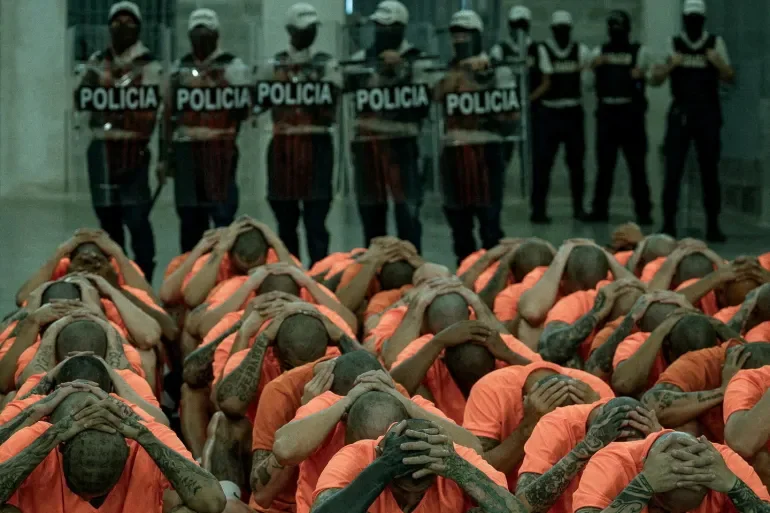
On October 29, Costa Rican authorities formally announced the successful transfer of the first cohort of 123 high-risk detainees to the newly inaugurated High-Containment Center Against Organized Crime (CACCO), a state-of-the-art maximum-security megaprison built to hold up to 5,100 inmates near the capital city of San José. Constructed with technical and operational support from the Salvadoran government at a total cost of roughly $33.2 million, the facility forms the cornerstone of President Laura Fernández’s administration’s sweeping crackdown on transnational criminal networks that have destabilized the country in recent years.
Footage released publicly by the Costa Rican Ministry of Justice on Tuesday shows the newly transferred detainees clad in standard orange prison uniforms, with closely shaved heads, seated with their hands positioned behind their necks and heads bowed — visual parallels that immediately echo widely circulated imagery from El Salvador’s infamous CECOT megaprison, the flagship facility of President Nayib Bukele’s globally controversial hardline anti-gang campaign that has led to mass detentions of tens of thousands of alleged gang members since 2022.
President Fernández officially inaugurated the CACCO complex on October 14, framing the development as a historic turning point for Costa Rica’s penitentiary system. “Costa Rica is writing a new chapter in its correctional history,” Justice Minister Gabriel Aguilar stated in an official address, emphasizing that the high-security facility is a deliberate, forceful response to the growing threat of organized crime and a clear demonstration of the state’s commitment to reasserting full institutional authority over its penal system. The facility was explicitly modeled on El Salvador’s zero-tolerance mass detention framework, which has drawn widespread international attention — and widespread criticism from human rights groups — for its sweeping mass arrest protocols and harsh, highly restrictive detention conditions.
The shift toward this punitive, high-capacity prison model is part of a broader regional trend across Latin America, where multiple right-leaning heads of state have embraced similarly strict law enforcement strategies centered on large-scale detentions and maximum-security confinement to combat soaring violent crime rates. For Costa Rica, a nation long celebrated as one of the most stable and safest in Central America, the push for tougher anti-crime measures comes in response to a sharp, sustained surge in cartel-linked violence tied to its evolving role as a critical transit hub for the global cocaine trade. The country recorded an all-time high of 905 homicides in 2023, followed by 876 in 2024 and 873 in 2025, with the vast majority of killings linked to turf wars between rival criminal groups fighting for control of drug smuggling routes and local distribution networks. Even after the slight post-2023 decline in murder figures, rates of violent crime remain far higher than historical averages, putting unprecedented public pressure on the Fernández administration to deliver tangible improvements to public safety.
Beyond disrupting criminal leadership networks that have long continued to orchestrate trafficking, extortion, and violent attacks from behind bars, the CACCO facility is also designed to drastically alleviate the country’s longstanding prison overcrowding crisis. With a total capacity equivalent to roughly one-fifth of Costa Rica’s entire national prison population, the facility is projected to cut the national penal system’s overcrowding rate from a current 59% down to just 15% once it is fully operational, marking a 44 percentage point reduction that correctional officials say will drastically improve security and living conditions across all the country’s older, overstretched prisons. The 123 inmates transferred in the first wave represent only a tiny fraction of the CACCO’s total capacity, with officials confirming that intake will be scaled up gradually over coming months, with all placements determined on a case-by-case basis through rigorous individual risk assessments to ensure only the highest-risk detainees, including suspected kingpins and inmates with documented histories of coordinating criminal activity from behind bars, are housed at the maximum-security site.
While government officials hail the new megaprison as a transformative step forward, independent security analysts note that its long-term impact on reducing street violence and dismantling organized crime networks remains unproven. The facility will effectively isolate high-value criminal leaders from the general prison population and block their ability to run illegal operations remotely, but sustained progress against cartel activity will require complementary investments in investigative policing, judicial prosecution, and community-level prevention programs to disrupt the recruitment pipelines that feed new members into criminal networks, experts caution.