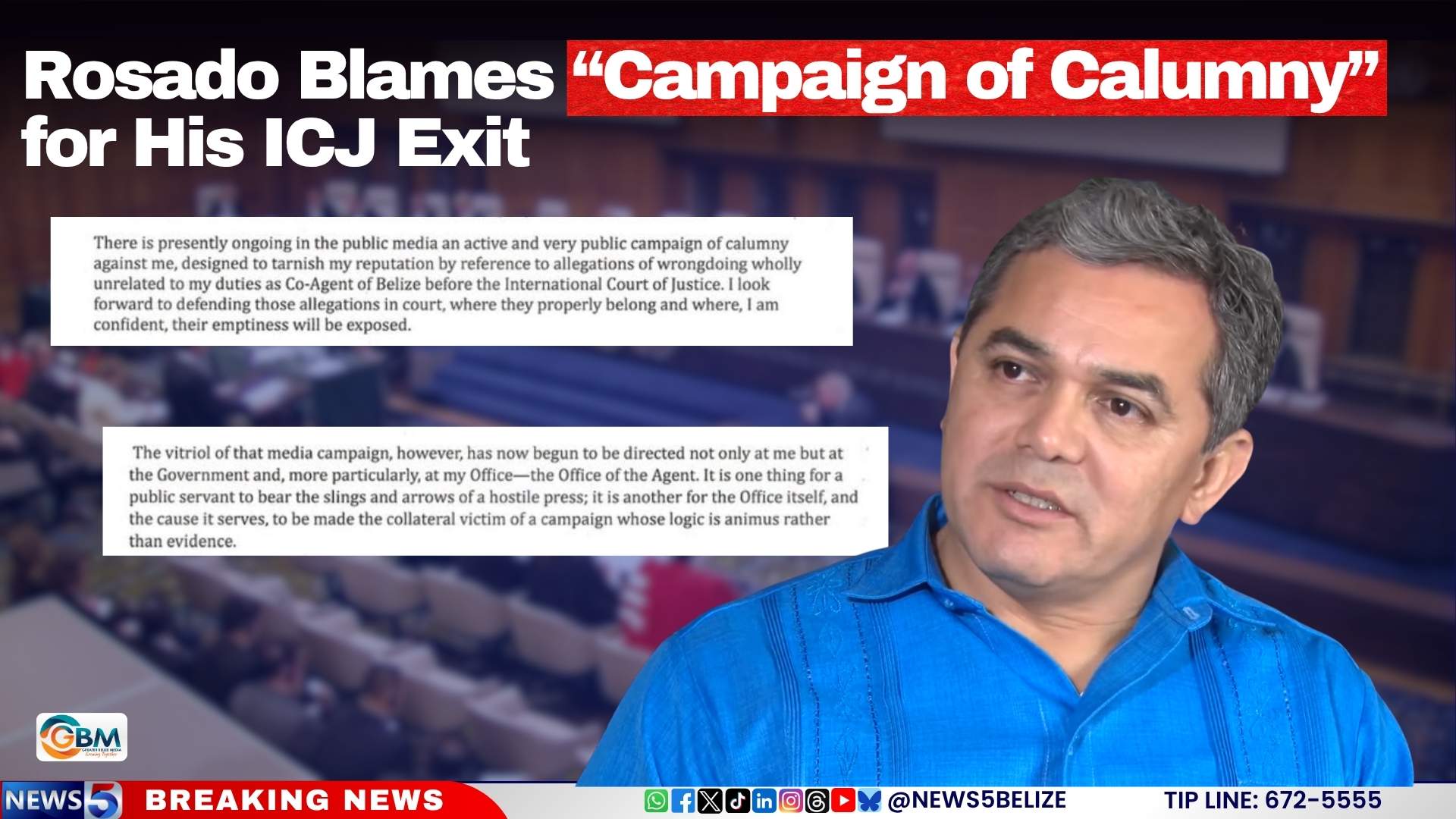
On October 27, 2026, the Government of Belize formally confirmed and accepted the unexpected late-Monday resignation of Ambassador Alexis Rosado, who had served as the country’s Co-Agent before the International Court of Justice (ICJ) for its long-running territorial dispute with Guatemala. In his official resignation letter addressed to Prime Minister John Briceño, Rosado opened by highlighting his more than three decades of unblemished public service to the Central American nation, framing his departure as a necessary measure to shield the integrity of the ICJ representation office rather than an admission of wrongdoing. The veteran diplomat directly attributed his decision to what he described as a sustained, highly public “campaign of calumny”: a coordinated wave of false, malicious statements targeting his reputation that he emphasized were entirely disconnected from his official duties representing Belize at the global court. Rosado is currently facing active criminal proceedings on charges of rape, sexual assault, and aggravated assault, allegations he has repeatedly rejected as baseless. In his letter, he affirmed his full intention to vigorously defend himself in a court of law, where he expressed confidence the unsubstantiated nature of the claims will be fully exposed. This is not the first time Rosado has stepped away from high-profile diplomatic roles over the same set of accusations: back in April 2022, immediately after formal charges were filed against him by local law enforcement, he resigned from all his ambassadorial postings. Multiple senior government officials, civil society groups, and opposition figures had publicly called for him to vacate the ICJ Co-Agent post in recent weeks, pointing to the 2022 precedent as a standard for preserving public trust in official diplomatic roles. House Speaker Valerie Woods was among the first to publicly note that if stepping aside in 2022 was a reasonable step to safeguard the integrity of Belize’s diplomatic offices when the charges first emerged, the exact same standard of accountability should apply to his position as ICJ Co-Agent. Minister Henry Charles Usher echoed that position, acknowledging Rosado’s past contributions to public service but emphasizing that no individual is irreplaceable, and that policy decisions tied to active criminal proceedings must center greater consideration for the rights and dignity of alleged victims. Opposition Leader Tracy Panton and the Belize Network of NGOs also joined the calls for his resignation, arguing that any person holding an official representative role on behalf of the state is bound to uphold the highest standards of public trust, and that formal, clear protocols must be established to govern cases where public officials face serious criminal charges. Rosado pushed back against framing his exit as a surrender to the allegations, writing that he chose to step down specifically to protect the Office of the Agent from smears, disinformation, and unnecessary distractions that could undermine its core mission. He explained that the increasingly hostile, vitriolic media campaign against him had spilled over to target not just his personal reputation, but the broader government and the Office of the Agent itself. “It is one thing for a public servant to bear the slings and arrows of a hostile press; it is another for the Office itself, and the cause it serves, to be made the collateral victim of a campaign whose logic is animus rather than evidence,” Rosado wrote in his letter to the prime minister. He stressed that his departure was “not in retreat,” but rooted in his conviction that state institutions outlast individual public servants, and the critical ICJ territorial case work must never be allowed to operate under an unearned cloud of controversy unrelated to its mandate. He added that he would remain fully available to provide any requested support to Belize’s ICJ team moving forward, if called upon. The Ministry of Foreign Affairs released a terse, late-Monday official statement confirming it had formally acknowledged Rosado’s resignation, and announced it would not be issuing any additional public comments on the personnel matter. Officials have confirmed that Belize’s lead Agent before the ICJ, Shoman, will remain in his post to lead the country’s full legal team, which brings deep specialized experience in international law and cross-border territorial delimitation. All of Belize’s required written submissions for the Guatemala territorial dispute case have already been filed with the global court, and government representatives have assured the public that proceedings will continue without any interruption or delay as a result of the Co-Agent personnel change.