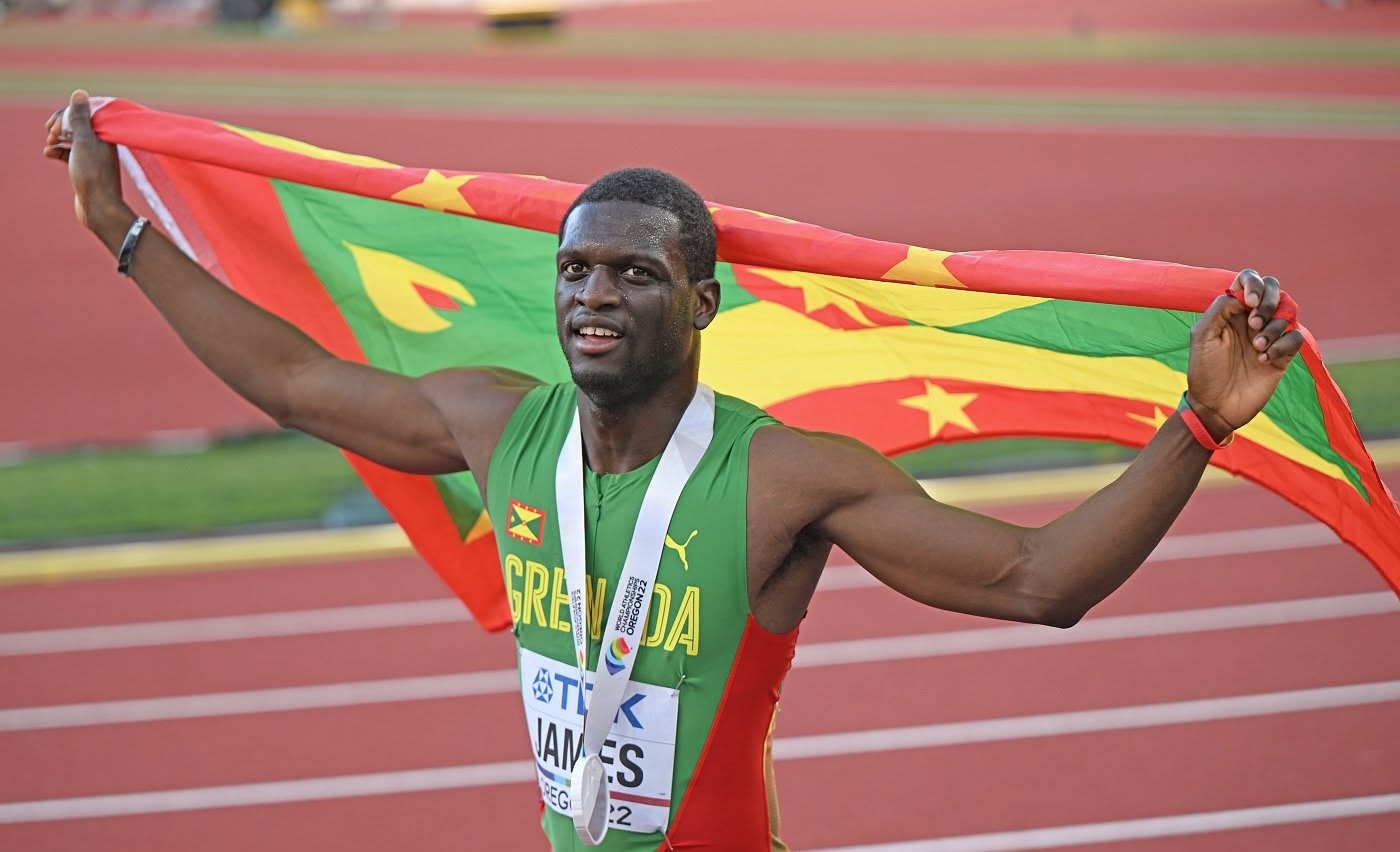
On Monday, Grenada’s legendary Olympic track star Sir Kirani James formally clarified his non-partisan stance amid swirling pre-election speculation, explicitly stating he would not endorse any political party competing in the upcoming November 5 general national election. The public statement was released via James’ official Facebook page, in direct response to a widely circulated social media photograph that had sparked widespread public debate over whether the decorated athlete had thrown his support behind a specific political faction or candidate ahead of polling day.
James emphasized that the viral photo, nor his subsequent public address, should be interpreted as confirmation or denial of support for any individual political party or figure, declining to name any specific group or public official in his remarks. The globally celebrated 400-meter sprinter, who etched his name into Grenadian history as the country’s first ever Olympic medalist with a gold win at the 2012 London Games, followed that historic performance with a silver medal at Rio 2016 and a bronze at the Tokyo 2020 Olympics. Most recently, he was appointed as the inaugural Sports Ambassador for the Caribbean Association of National Olympic Committees (CANOC), a role that amplifies his public profile across the entire Caribbean region.
Acknowledging that his status as an internationally renowned athlete grants him significant public influence across Grenada, Carriacou and Petite Martinique, James outlined that his core public duty as a national representative has always been to serve and represent every citizen of the tri-island state in a fully non-partisan capacity. He drew a clear line between any private personal political views he may hold and his public mandate to unify all Grenadians, noting that his deep passion and pride in representing his nation stems directly from the enduring support of the Grenadian people, rather than the identity of the party holding political office at any given time.
James went on to frame the right to cast a ballot in free, fair electoral processes as an immense privilege that every eligible voter should treat with profound reverence and seriousness, framing voting as a core civic responsibility rather than a casual choice. He urged all Grenadian voters to base their electoral decisions on a thoughtful combination of their personal moral values and the shared collective ideals of their communities, rather than unsubstantiated rumors or celebrity endorsements.
The high-stakes November 5 general election features three competing political parties vying for control of Grenada’s 15-seat national parliament. Incumbent Prime Minister Dickon Mitchell leads the ruling National Democratic Congress (NDC), while the main opposition New National Party (NNP) is headed by Emmalin Pierre. A third party, the Democratic People’s Movement (DPM) led by former foreign affairs minister Peter David, is fielding candidates for 9 of the 15 available parliamentary seats. All three party leaders are confirmed to participate in the highly anticipated 28 October National Leaders’ Debate, a two-hour collaborative event organized by the Media Workers Association of Grenada (MWAG), Grenada Broadcasting Network (GBN), The Bubb Report, and the Grenada Conference of Churches. The 90-minute structured core debate segment will operate under the theme “The Issues. The Choices. Grenada’s Future,” and is scheduled to cover critical policy domains including economic stability and cost of living pressures, public healthcare, education, youth employment, governance transparency, public accountability, and long-term national sustainable development.