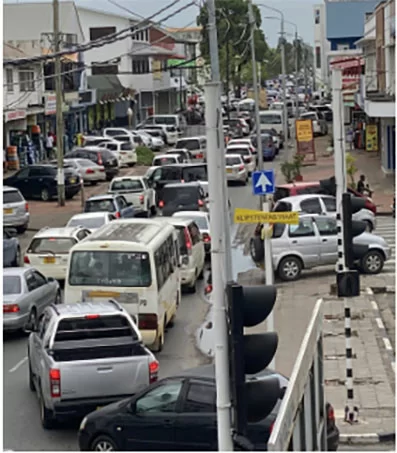
A scathing critique published in the weekly Catholic diocese publication *Omhoog* is sounding the alarm over rapidly eroding quality of life in Suriname’s capital Paramaribo, as soaring traffic congestion, near-total lack of safe space for pedestrians and cyclists, and almost non-existent traffic enforcement turn daily urban travel into a dangerous, frustrating ordeal. The feature, titled *The Four-Wheeled Sacred Cow*, argues that the country’s widely anticipated future oil revenues will be meaningless if basic urban liveability continues to deteriorate at its current pace.
The report notes that driving in Paramaribo has long ceased to be a simple mode of transport, and has instead become a daily trial for most residents. City roads are chronically overcrowded, with regular gridlock, widespread driver impatience, and near-constant hazardous road incidents that put all vulnerable users at risk. Critique is not limited to individual motorists: the publication places the bulk of accountability on systemic government policy failures, calling on the Ministry of Public Works and Spatial Planning to shift its focus away from traditional, car-centric road maintenance, and prioritise designing an urban environment that lets all residents walk, cycle, and travel safely regardless of whether they own a private vehicle.
The report highlights the sharp decline of cyclists as a visible presence on Paramaribo’s streets: the few residents who still choose to cycle are forced to navigate a chaotic mix of cars, motorbikes, and other road users with no dedicated safe infrastructure to protect them. Pedestrians face equally dire conditions, as most sidewalks have been illegally repurposed as informal parking lots, forcing people of all ages to walk directly on active roadways. Additional reckless behaviour from motorists including double-parking, sudden unannounced stops, and complete disregard for non-motorised users, combined with unregulated motorbikes and e-bikes weaving through traffic gaps, has pushed the city’s road network to the edge of total chaos. Vague, unenforced traffic regulations have compounded the crisis, with almost no consistent penalties for dangerous or illegal road behaviour.
Rather than only documenting existing problems, the *Omhoog* piece lays out a concrete policy roadmap for a radical overhaul of Paramaribo’s mobility framework, centring human needs instead of private car dominance. The proposal outlines that short urban trips could easily be completed on foot or by bicycle if the city invested in separated, protected cycling lanes, unobstructed pedestrian walkways, and purpose-built public space design. It also calls for a full, fundamental upgrade of Suriname’s public transit system, including the rollout of modern, reliable bus services that would reduce residents’ forced reliance on private cars for all daily travel. The feature explicitly ties this urban reform agenda to Suriname’s upcoming status as an oil-producing nation, warning that projected oil windfalls must not be used as an excuse to leave longstanding urban mobility crises unaddressed. Its core message emphasises that increased national wealth from oil will never automatically translate to a more liveable, equitable capital: that outcome requires deliberate, proactive policy choices that prioritise road safety, accessible public space, and mutual respect between all road users.
Omhoog hekelt verkeerschaos: Paramaribo is een karaktertest geworden