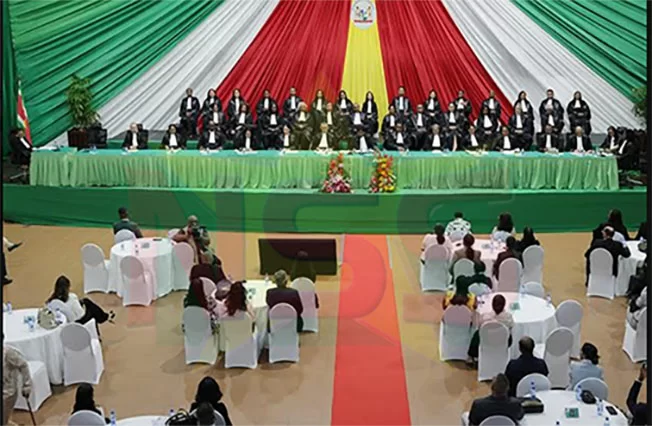
On October 25, during the official swearing-in ceremony for 15 new deputy justices of Suriname’s Court of Justice, Elleson Fraenk, deken of the Surinamese Bar Association (SoVa), delivered a landmark address framing the judicial expansion as a critical, but incomplete, milestone for the country’s justice ecosystem.
While Fraenk extended a formal welcome to the incoming cohort of judicial officers and celebrated the long-awaited boost to the judiciary’s on-the-ground capacity, she issued a clear public warning against overinflated public expectations that the new appointments alone would resolve the systemic backlogs and operational bottlenecks that have plagued Suriname’s court system for years. She emphasized that sustained, cross-cutting investments far beyond judicial hiring are non-negotiable to deliver a functional, accessible justice system: additional support staff, purpose-built and adequately located court facilities, streamlined administrative workflows, and consistent, sufficient public funding for judicial operations all represent unmet prerequisites for meaningful improvement.
Fraenk outlined that high workforce turnover within the existing judicial corps, longstanding understaffing of non-judicial court roles, and gaps in organizational infrastructure continue to create unsustainable workload pressure for all judicial personnel. She stressed that judges can only reasonably be expected to deliver the highest standard of professional expertise and dedicated public service if their working environments are properly resourced, a responsibility she explicitly placed on the national government. A well-functioning, efficient judicial system, she noted, is not an abstract bureaucratic priority: it is the only mechanism ordinary Surinamese citizens can turn to for enforceable protection of their legally enshrined rights. When court proceedings drag on for years without resolution, even rights clearly defined in national law lose all practical meaning for the people they were designed to protect.
“For a citizen seeking redress through the courts, timely justice is not a vague policy target on a government memo,” Fraenk stated. “It is the very factor that determines whether their legal rights hold any tangible weight in their daily lives.” She argued that all relevant public and legal stakeholders share collective accountability for addressing the deep, structural flaws in the judicial system, and that the arrival of the 15 new justices must be paired with parallel reforms to strengthen every layer of court administration and operation.
Fraenk also laid out core ethical obligations for the incoming cohort, reminding them that the Surinamese public is entitled to full confidence that every judicial ruling is developed strictly independently, impartially, and with complete professional integrity. All verdicts must be rooted exclusively in established law and verified factual evidence, with no preferential treatment or bias toward any party appearing in court. Every litigant, regardless of social status or background, must be granted a full, fair opportunity to present their case. She acknowledged that not every party to a legal matter will walk away with a favorable ruling, but all citizens deserve the guarantee that their case was heard with full fairness and due diligence.
She further urged the new justices to remain mindful that every case file that crosses their desk represents real people whose lives may be fundamentally reshaped by the final ruling they issue. As such, judicial performance should never be measured solely by the number of verdicts a judge issues, but first and foremost by the care, thoroughness, and fairness with which they administer justice. Despite her frank assessment of the remaining structural challenges facing the judiciary, Fraenk closed her remarks with a note of cautious optimism, noting that members of the Surinamese Bar Association had already worked with many of the new appointees during their prior legal careers. “The professionalism and integrity I have personally observed from this incoming generation of judicial officers gives real, tangible hope for the future of Suriname’s justice system,” she concluded.