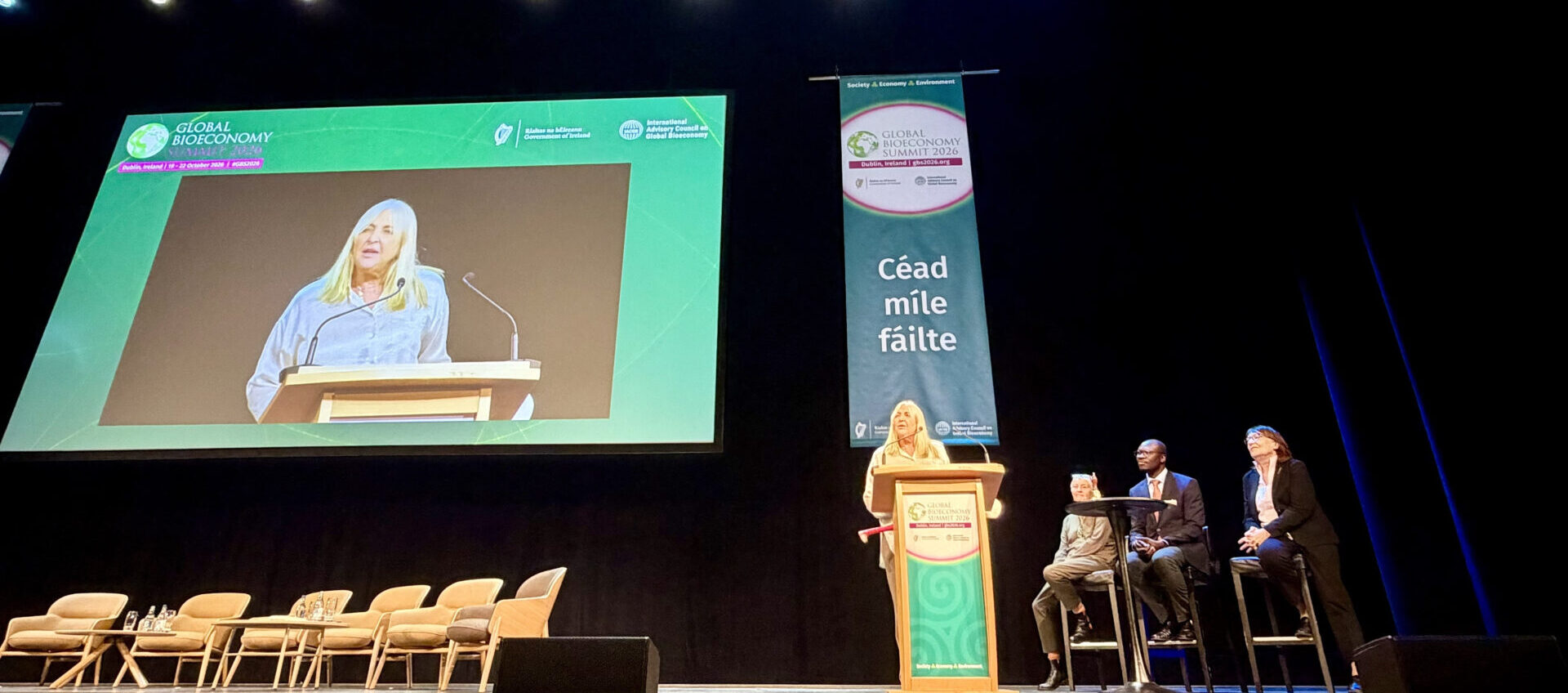
At the official closing ceremony of the 2026 Global Bioeconomy Summit held in Dublin, Ireland, a landmark announcement confirmed that the 2028 iteration of the leading global bioeconomy gathering will be hosted by Panama, making Latin America and the Caribbean (LAC) the first ever regional host bloc for the flagship international event.
The historic hosting initiative is spearheaded by the Government of Panama through its National Secretariat of Science, Technology and Innovation (SENACYT), in close collaboration with the International Advisory Council on Global Bioeconomy (IACGB), with coordinated support from the Inter-American Institute for Cooperation on Agriculture (IICA) and the pan-regional Latin American Bioeconomy Network.
Eduardo Ortega-Barría, Secretary of SENACYT, emphasized Panama’s long legacy as a global crossroads during his official address, noting, “For centuries, Panama has connected oceans, continents, and peoples. In 2028, we want it to also connect the global bioeconomy community. But this will not simply be a summit held in Panama; we want it to serve as a platform for all of LAC to showcase our biodiversity, science, innovation, businesses, and solutions to the world, and to forge new partnerships in knowledge, investment, and sustainable development.”
Launched in Berlin in 2015, the Global Bioeconomy Summit has established itself as one of the world’s most authoritative multi-stakeholder forums for advancing dialogue on bioeconomy’s future, uniting policymakers, leading researchers, industry leaders, investors, multilateral organizations, and civil society representatives across all previous editions. Prior host locations include Nairobi, Kenya, and most recently the 2026 Dublin summit. The 2028 Panama summit is intentionally designed as an inclusive regional platform that will bridge LAC’s rich biodiversity, scientific research ecosystems, innovative startups, local communities and national governments with global research centers, development finance institutions, impact investors, and cross-border collaborative networks.
Sandra Sharry, Technical Secretary of SENACYT’s National Research System, underscored the event’s open, region-centered design: “We want GBS 2028 to be a process that is open to the entire region. Panama can provide the meeting place, but the real value will lie in bringing together LAC’s capabilities, experiences, and solutions and connecting them with scientific, financial, business, and cooperation partners from around the world.”
The LAC region holds unparalleled natural and innovative advantages to drive global bioeconomy progress: it hosts roughly 50% of the planet’s documented biodiversity, 23% of the world’s total forest cover, a globally dominant agricultural sector, rapidly expanding scientific research capacity, a growing cohort of bio-focused innovative enterprises, and irreplaceable indigenous and ancestral ecological knowledge that forms the foundation of nature-positive solutions rooted in biological resources. Hosting the 2028 summit will create an unprecedented channel to align regional sustainable development agendas with global priorities, translating these unique assets into tangible new economic pathways, formal employment opportunities, and improved community well-being across the region.
Hugo Chavarría, IICA Bioeconomy Specialist and Executive Secretary of the Latin American Bioeconomy Network, outlined the two-year collaborative roadmap ahead: “We have two years to work together as a region, align our countries’ agendas, strengthen networks and capacities, mobilize science, innovation and investment, and forge new partnerships and projects. We can also take advantage of something extremely valuable that the GBS offers: the opportunity to connect LAC directly with investors, academics, scientists, businesses, policymakers, and international organizations from around the world, showcase our capabilities, territories, and opportunities, and play a leading role in shaping the global bioeconomy agenda and dialogue. The true legacy will be reaching 2028 as a more integrated region, with more partnerships, more projects, and a much stronger voice in the global bioeconomy.”
The LAC region has already emerged as a rapidly rising force shaping global bioeconomy governance, as demonstrated by its high-impact contributions at the 2026 Dublin summit. Represented by IICA and the Latin American Bioeconomy Network, regional stakeholders participated in three core global initiatives: co-developing the IACGB-led Global Bioeconomy Vision 2040, drafting and reviewing the LAC chapter of the 2026 Global Bioeconomy Policy Report, and supporting the establishment of the newly launched Global Bioeconomy Alliance. The 2026 Global Bioeconomy Policy Report formally notes that as of 2024, the bioeconomy’s center of gravity in the Americas has shifted decisively toward Latin America, driven by a new wave of national policies focused on practical implementation, targeted financing, and workforce and institutional capacity building, with documented progress across Brazil, Uruguay, Ecuador, Peru, Costa Rica, Colombia, Argentina, Mexico, and Panama. These national efforts are further reinforced by the landmark Amazon Bioeconomy Strategy, a collective governance framework agreed by all eight member states of the Amazon Cooperation Treaty Organization to advance shared sustainable development across the globally critical Amazon biome.
The regional collaborative infrastructure is already well developed: the Latin American Bioeconomy Network now counts more than 100 institutional members spanning 18 LAC nations, and the region was the only global bloc to conduct a fully dedicated regional consultation process to inform the Global Bioeconomy Vision 2040, while its representatives have participated in the Global Bioeconomy Alliance from its founding stages. Chavarría concluded, “These advances demonstrate that the GBS is coming to a region with an increasingly connected bioeconomy community. Panama 2028 must show that the region is ready not only to participate in this conversation, but also to convene it, lead it, and translate it into new partnerships, investments, and development opportunities.”