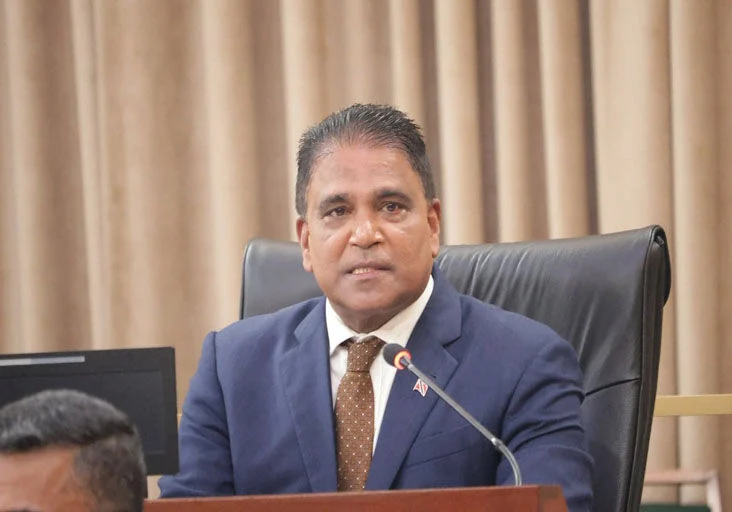
During a public sitting of Trinidad and Tobago’s Standing Finance Committee yesterday, Port of Spain North/St Ann’s West Opposition Member of Parliament Stuart Young launched a rigorous line of questioning targeting Energy Minister Dr Roodal Moonilal over mounting unaddressed fuel subsidy arrears, questionable budget allocation adjustments, and longstanding non-compliant staffing practices within the energy ministry, as lawmakers reviewed the ministry’s proposed $945.8 million operational allocation for the upcoming fiscal cycle.
Young opened his inquiry by pressing Moonilal to publicly confirm whether the cumulative unpaid debt for national fuel subsidies had breached the $1 billion threshold, a figure that has sparked growing concern among fiscal watchdogs over unplanned public liabilities. In response, Moonilal disclosed that the government had disbursed two tranches of subsidy payments to local fuel retailers: $544 million to state-owned National Petroleum (NP) in April 2026, followed by a $206 million disbursement to private sector distributor Unipet in September 2026, for a total combined payout of $750 million for that period. When directly asked to verify if remaining outstanding arrears had crossed the $1 billion mark, Moonilal declined to provide an immediate, definitive figure, stating his team would cross-check all financial records and provide a formal response to the committee at a later date.
Young then flagged what he framed as a fiscally reckless pattern of underbudgeting for critical fuel subsidies, noting that the government had slashed the 2027 fiscal year fuel subsidy allocation to $700 million, even after the 2026 budget line item was revised upwards nearly 150% from an initial $300 million projection to $750 million to cover unplanned costs. He warned that the budget cut came at a time of acute global diesel supply shortages and steeply rising international fuel market prices, arguing that the reduced allocation would force the government to once again push unpaid liabilities onto fuel retailers, perpetuating a cycle of carried-over debt that would burden future public budgets. Moonilal pushed back on the criticism, framing partial deferral of subsidy payments as a standard operational practice in the energy sector, before later confirming that total accumulated fuel subsidy arrears accrued between April 2024 and March 2026 stood at $971 million. When Young demanded immediate, itemized figures for the exact outstanding amounts owed separately to NP and Unipet, Moonilal again declined to share real-time data, promising only that his team would compile fully verified, precise numbers and deliver them to the committee “in due course.”
The Opposition MP also raised questions about a series of other unusual line items in the energy ministry’s budget proposal, including a $10.5 million proposed increase to the short-term employment budget that would bring that line item’s total allocation to roughly $14 million. Moonilal explained that the adjustment was made to resolve longstanding non-compliant staffing arrangements, noting that for over a decade, the ministry had employed a cohort of full-time workers under informal third-party service provider contracts, a practice the Auditor General had repeatedly flagged as a violation of public sector human resources rules. The reallocation, he confirmed, was to transition those long-serving workers to formal short-term public employment contracts to bring the ministry into regulatory compliance. He added that the ministry was also in the process of filling 88 vacant contract and established civil service positions to reduce operational bottlenecks.
Young’s final line of inquiry focused on the $130 million revised 2026 estimate for the “other contracted services” budget line, a nearly 80% jump from initial projections. Moonilal stated that the 2027 allocation for that same line item would drop to $71.6 million, with the majority of funds earmarked for outstanding payments on behalf of state energy firm Petrotrin and a smaller portion allocated to legacy environmental site clean-up work, and committed to providing the committee a full, detailed written breakdown of the 2026 revised $130 million figure after consulting with senior ministry finance officials.
Has debt crossed $1 billion?