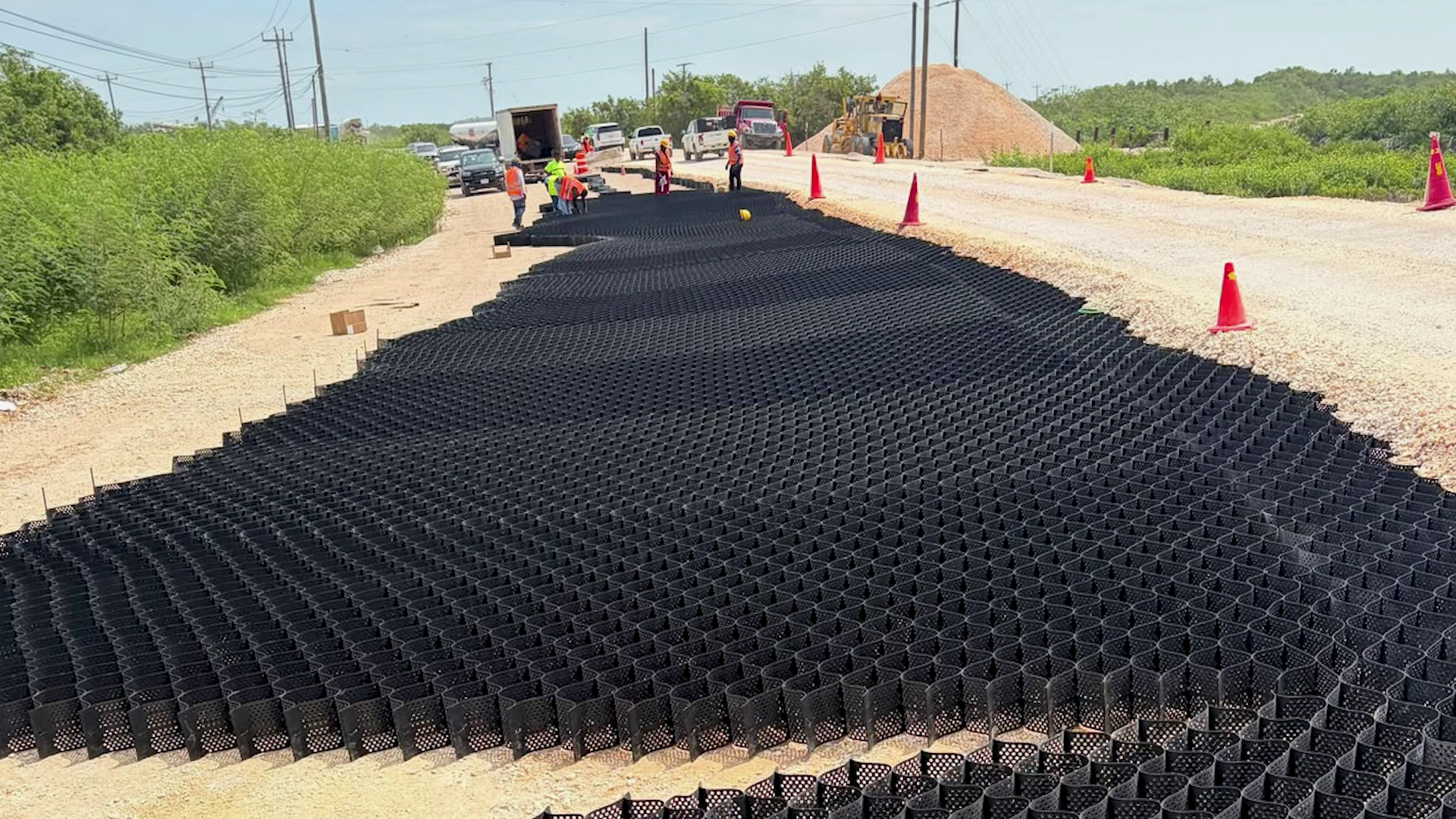
Scheduled for a year-long open-air trial to address persistent ground stability issues, a 1.2-kilometer stretch of the George Price Highway near Old Belize will remain unpaved for the next 12 months as Belize’s Ministry of Infrastructure Development and Housing (MIDH) tests an innovative road reinforcement solution. For years, this section between Burton Canal and Old Belize has suffered repeated sinking driven by ongoing soil consolidation, forcing repeated repairs and raising long-term safety and maintenance concerns. Rather than applying a standard asphalt overlay that would likely crack and sink again within a few years, MIDH has opted to trial a geocell reinforcement system to deliver a more durable fix.
Evondale Moody, MIDH’s Chief Engineer, explained that the project combines comprehensive geotechnical subgrade improvements with the novel geocell approach. The system consists of interconnected honeycomb-shaped black platforms that are filled with compacted aggregate, creating a rigid, load-distributing base that is designed to slow and minimize future soil consolidation and settlement. Unlike traditional paving projects that lay asphalt immediately after base work, MIDH will leave the reinforced stretch covered only in gravel to allow for real-world testing. Regular traffic will be permitted to run over the section for 12 months, giving engineers the opportunity to monitor settlement rates, structural performance, and long-term stability of the geocell system before a final paving decision is made.
The geotechnical trial is part of the broader Lot One segment of the George Price Highway Rehabilitation Project, which covers infrastructure upgrades along the corridor from Belize City to Hattieville. Cisco Constructions has been tapped as the primary contractor for the work. In addition to the road base trial, the project scope includes a major hydraulic upgrade in the same area: the replacement of an undersized existing culvert that connects the nearby lagoon to the Caribbean Sea with a full bridge structure. To maintain two-way traffic flow throughout the bridge construction, a temporary traffic diversion will be built around the work zone.
This adaptive testing approach reflects MIDH’s shift toward data-driven infrastructure upgrades, prioritizing long-term durability over quick completion for problematic stretches with a history of ground failure. Officials noted that the findings from the one-year trial will also inform the design of future road projects across Belize that face similar soil stability challenges.