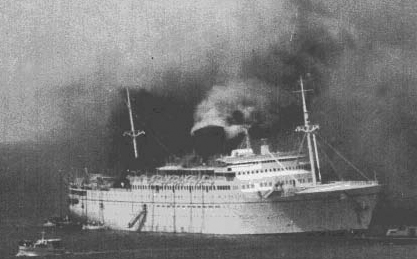
On a sunlit Sunday morning, October 22, 1961, the Italian Costa Line’s luxury cruise vessel Bianca C readied to cast off from Grenada’s waters, wrapping up a routine port call that had welcomed a small group of UK-bound emigrants and day-tripping tourists who had spent hours exploring the island’s shores. At the time, the large, popular tourist liner was a familiar sight in Grenadian waters, but its size prevented it from docking at the inner St George’s port, forcing it to drop anchor in the outer harbour zone. Before the crew could hoist the anchor to set sail, a catastrophic blast ripped through the ship’s engine room, igniting a fast-spreading inferno that quickly threatened the entire vessel. The crew immediately triggered continuous blasts of the ship’s horn and raised the internationally recognized maritime distress flag signaling a major on-board fire. Members of the local Grenada Yacht Club were the first to spot the distress signals, and as thick plumes of acrid black smoke billowed from the Bianca C, it became immediately obvious the liner was in mortal peril; harbour officials were notified without a single moment of delay. A coordinated rescue effort pulled nearly every person on board to safety: all 400 passengers and roughly 298 of the 300 crew members survived the disaster, with only two crew members losing their lives to the explosion and subsequent blaze. Grenadian authorities moved swiftly to set up an emergency temporary shelter camp, while local hotels and guesthouses opened their doors to the displaced travellers, and ordinary Grenadian households volunteered free accommodation for hundreds of survivors until Costa Line could arrange alternate travel to their intended destinations. The following day, salvage teams attempted to tow the damaged hulk out of the busy harbour to avoid navigation hazards, but the towing chain snapped mid-operation, and the Bianca C slipped beneath the waves, settling 160 feet below the surface roughly 1.25 miles off the Point Salines coastline. As a public gesture of profound gratitude for the extraordinary, community-wide compassion shown to its passengers and crew, Costa Line later gifted the government of Grenada a large bronze sculpture titled Christ of the Abyss (also widely referred to as Christ of the Deep), which was installed along the St George’s Carenage waterfront. Decades later, the Bianca C – affectionately nicknamed the “Titanic of the Caribbean” – has earned a global reputation as one of the most coveted recreational shipwreck diving destinations on the planet. This account is adapted from Beverley A Steele’s published work *Grenada: A History of its People*, with local outlet NOW Grenada noting it bears no responsibility for contributor-submitted content, and directing users to a dedicated reporting portal for any cases of content abuse.