Three months after the deadly capsizing of the MV Barima ferry off Guyana’s Essequibo Coast, a public Commission of Inquiry (COI) into the July 18 tragedy has uncovered worrying deficiencies in the communication infrastructure of the country’s Maritime Administration (MARAD).
The inquiry, convened to investigate the causes and response to the incident that claimed lives off the coast 10 miles from mainland Guyana, convened Wednesday to hear testimony from key maritime figures, including senior MARAD staff and first responders who participated in the immediate search and rescue operation. Retired Rear Admiral Hayden Pritchard of the Trinidad and Tobago Defence Force, one of five independent maritime experts appointed by President Irfaan Ali to lead the probe, delivered a stark assessment of MARAD’s current communication setup after reviewing details provided by acting Harbour Master Romain Seurattan.
Seurattan told the commission MARAD currently relies on a basic suite of tools: desktop computers, Very High Frequency (VHF) radios, cellular phones, and handheld portable radios. After reviewing the list, Pritchard, drawing on decades of maritime experience, characterized the agency’s communication capabilities as unacceptably sparse for a regulatory and response body responsible for commercial and passenger ferry traffic along Guyana’s coast.
When invited to offer his own recommendations for upgrading and expanding the existing equipment to close gaps, Seurattan declined to comment on what upgrades would be appropriate for the agency, noting he could not speak to systemic changes at the leadership level. He instead confirmed that recommendations for improvements had previously been submitted to his senior leadership, and offered to share a copy of the earlier document with the commission. Seurattan also told the inquiry that major maritime incidents are rare at Guyana’s ports, and when they do occur, incident reports are routinely passed up the chain of command to the Director General of Maritime Safety.
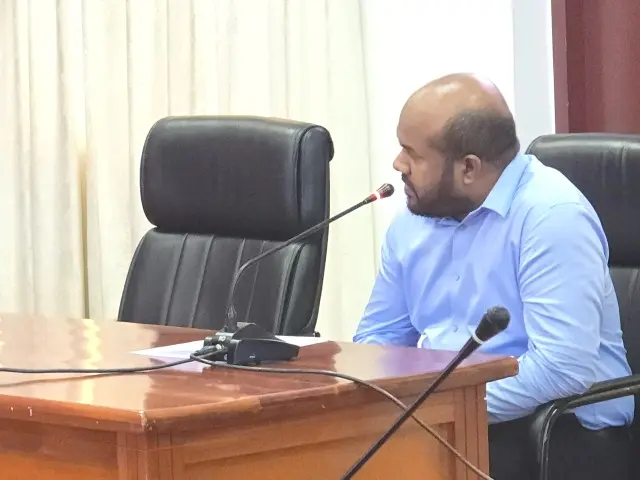
Further testimony from a frontline MARAD staff member reinforced Pritchard’s concerns about communication failures. Shamar Morrison, a trainee pilot who participated in the search and rescue operation after the MV Barima capsized, told the commission that weak, unreliable signal often makes inter-vessel and ship-to-shore communication at sea a major challenge. To address this persistent issue, Morrison formally recommended the agency adopt SpaceX’s Starlink satellite internet system to expand connectivity across Guyana’s maritime domain.
Morrison also added that during the rescue mission, he had no ability to communicate with airborne aircraft supporting the operation, and confirmed that the pilot boat he was aboard lacked a VHF aviation band tuned to connect with Guyana Defence Force Air Corps aircraft. He could not say whether the MV Barima itself carried equipment to communicate with military aircraft.
Beyond infrastructure gaps, the trainee pilot detailed his role in the immediate rescue, where he pulled the ferry’s captain and first mate from the water, wrapping them in blankets to prevent life-threatening hypothermia after their extended time in the ocean. He told the commission he had received formal search and rescue and medical training through certifications from MATPAL and EnerMech Guyana, and had coordinated closely with Retired Coast Guard Commander John Flores, who leads MARAD’s Maritime Rescue Coordination Centre (MRCC). When laying out his rescue protocol training, Morrison noted he instructed his fellow response team members to avoid maneuvering rescue vessels too close to people in the water, to prevent accidental collisions that could leave survivors unconscious or unresponsive. Pritchard, responding to his account, acknowledged that Morrison appeared better trained for search and rescue operations than other members of the response team.
Morrison, who is scheduled to complete both practical and theoretical examinations to earn full MARAD pilot certification, also revealed a previously unreported instruction from senior political leadership during the rescue. He told the commission that Public Works Minister Juan Edghill, who was on site during the response effort, explicitly instructed rescue personnel to avoid taking photographs of the incident that could be leaked to the press. Morrison quoted Edghill as saying, “guys, just focus on what you’re doing and try not to release any pictures, because we don’t want to create any stir in the media.”
The ongoing COI is expected to continue hearing testimony from witnesses and experts in the coming weeks, before releasing a full public report on the causes of the capsizing and recommendations for regulatory and operational changes to prevent similar tragedies in the future.