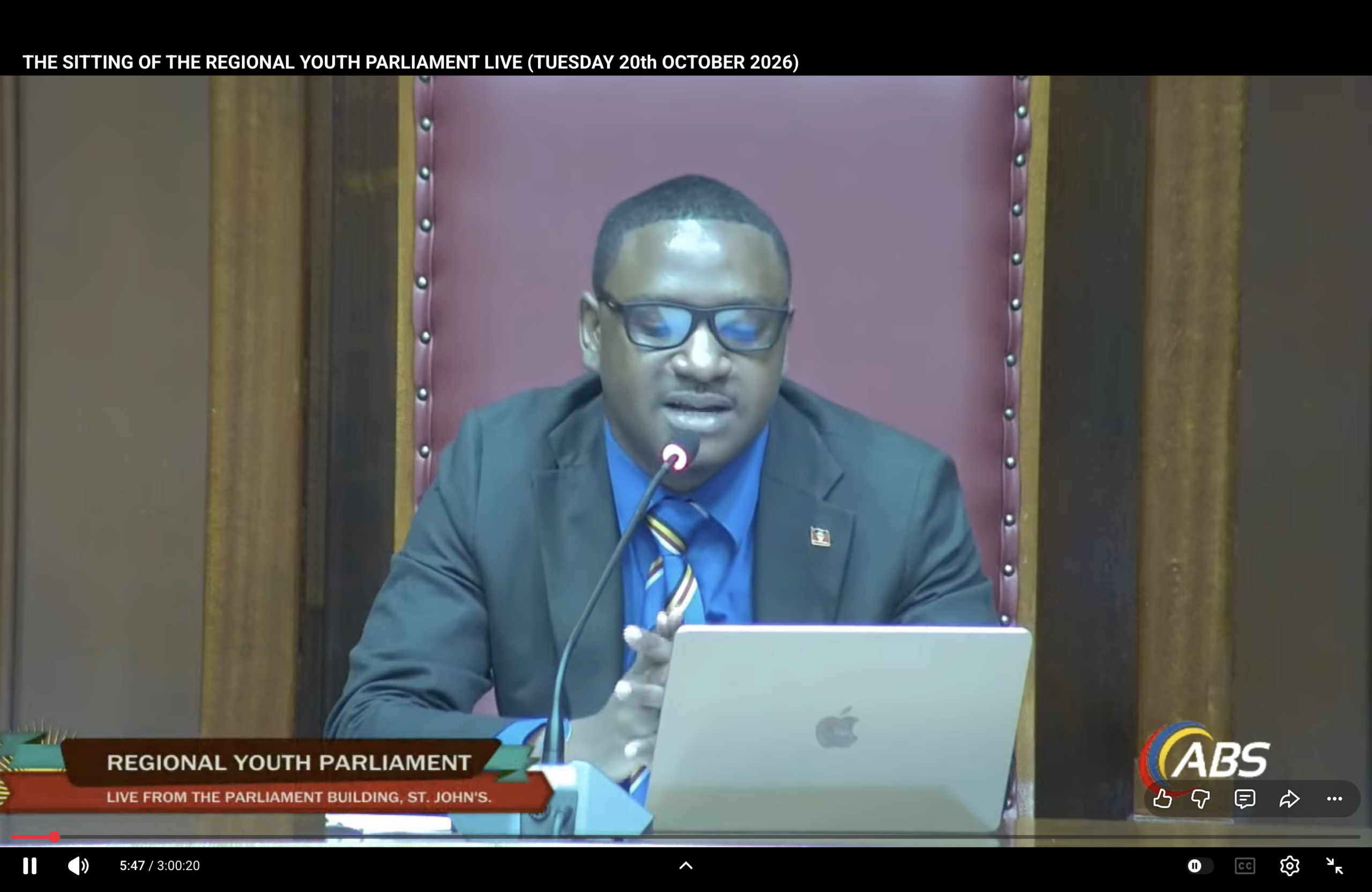
The Eastern Caribbean Youth Parliament Network Assembly made a landmark policy decision on October 20, passing a groundbreaking resolution during its sitting hosted by Antigua and Barbuda that calls for coordinated regional action to cut the bloc’s excessive economic dependence on tourism. The vote saw broad support for the measure, with 15 delegates voting in favor, one against, and one delegate abstaining from the final tally.
The resolution emerged following a full day of robust debate covering critical regional challenges, including access to business financing, exorbitant inter-island transport costs, persistent youth unemployment, and the practical ability of the accompanying action plan to deliver tangible, meaningful economic improvements across the Eastern Caribbean. Even the youth opposition leader, while voicing concerns over the plan’s implementation timeline, the absence of detailed costings, and gaps in stakeholder consultation, ultimately threw his support behind the measure.
According to the text of the resolution, Eastern Caribbean national governments, regional intergovernmental bodies, private sector businesses, and post-secondary educational institutions are called upon to develop comprehensive economic diversification strategies that expand beyond the dominant tourism sector. Targeted growth areas explicitly named in the document include agriculture, commercial fisheries, agro-processing, light manufacturing, digital services, creative industries, and utility-scale renewable energy development.
The resolution also outlines key enabling actions required to support this diversification push. It urges increased public and private investment in core infrastructure, expanded access to high-quality education, expanded technical and vocational training programs, increased investment in targeted research and emerging technologies, and broader access to affordable capital and business mentorship for young aspiring entrepreneurs. It also calls for targeted improvements to regional trade connectivity, transport infrastructure, and logistics networks to reduce cross-border business costs.
Three major regional financial and governance institutions — the Organisation of Eastern Caribbean States (OECS), the Eastern Caribbean Central Bank (ECCB), and the Caribbean Development Bank (CDB) — are named as key implementing partners through which coordinated investment, targeted technical assistance, and development financing will be channeled to advance the plan’s goals. To ensure transparency and accountability, the resolution requires the establishment of measurable performance targets, regular public progress reporting, and ongoing inclusive consultation with stakeholders across all participating territories.
Introducing the resolution to the assembly, the sitting youth prime minister argued that the region’s severe economic disruption during the COVID-19 pandemic served as a critical wake-up call for the risks of overreliance on a single sector. When international borders closed and global travel halted overnight, tourism-dependent Eastern Caribbean economies suffered catastrophic collapses in GDP, government revenue, and employment, making the urgent case for structural economic change. “We cannot depend on tourism alone,” he told delegates.
Importantly, the resolution clarifies that economic diversification does not require abandoning or undermining the existing tourism sector. Instead, it advocates for the development of complementary domestic industries that can supply local goods and services to regional hotels, expand the range of cultural experiences available to visitors, and retain a larger share of tourist spending within local and regional economies, rather than seeing that revenue flow overseas to multinational corporations and foreign suppliers.
Under the current timeline laid out in the action plan, implementation will begin in October 2026 and run through the next scheduled regional youth parliamentary sitting in 2027. Following the vote, delegates will return to their home territories to formally present the approved proposals to their respective national governments for consideration.
During debate, the youth prime minister highlighted two key structural barriers holding back regional economic expansion: limited access to affordable commercial bank financing for small and medium enterprises, and prohibitively expensive inter-island transportation costs. He called for regional air carriers to receive the same government concessions that are routinely granted to much larger international airlines operating in the region, a change that would help lower cross-border travel and shipping costs for businesses and consumers alike.
The youth opposition leader, who represented the St. Kitts National Youth Parliament Association, acknowledged that economic diversification was an urgent necessity for the region, but raised serious questions about the feasibility of the proposed one-year implementation timeline. “It cannot take one year for economic diversification to be implemented,” he said, noting that each territory has distinct economic conditions, resource endowments, and practical constraints that any viable plan must account for.
He also pressed delegates on the complete absence of detailed implementation costings in the proposal, asking how policymakers would be able to measure tangible improvements to young people’s economic prospects once the plan’s activities are completed. “Where is the customer? What will production cost? And can we deliver competitively?” he asked of proposed new industries. Instead of broad, vague commitments to lower transport costs, he recommended developing a fully costed, time-bound review and pilot program focused on targeted regional travel cost reductions. He also raised questions about how young entrepreneurs would qualify for grant funding, meet any required matching fund obligations, and sustain their businesses after initial startup funding expires.
Other delegates joined the debate to support the goal of diversification while highlighting critical gaps in the current proposal. The youth delegate for Barbuda South raised concerns about gaps in financing access, shipping connectivity, and formal institutional commitments to the plan. He put forward two specific targeted proposals: the creation of a regional youth enterprise fund backed by the ECCB and CDB that would guarantee low-interest loans for new ventures in agro-processing and digital services, and the development of a dedicated inter-island maritime freight link to cut cross-border transport costs for local producers.
He also proposed targeted tax incentives for hotels that source at least 40% of their operational inputs from local suppliers, a policy that would directly connect tourist expenditure to regional farmers and other local producers. He argued that strengthening supply chain links between local producers, retail supermarkets, and regional hotels would retain more economic value within the Eastern Caribbean, giving the examples of locally produced hot sauce, artisanal honey, and processed agricultural products as goods that could easily replace currently imported alternatives for the tourism sector.
Other youth cabinet ministers put forward sector-specific proposals to advance diversification goals. The youth minister of ICT and the Digital Economy called for greater harmonization of digital regulatory frameworks across all Eastern Caribbean territories, and highlighted persistent barriers including high mobile roaming charges and limited access to content monetization opportunities for regional digital creators. The youth minister of Sports and Creative Industries proposed the creation of a regional creative hub that would support musicians, visual artists, and theatre practitioners, arguing that homegrown creative talent can generate new streams of income independent of the traditional tourism market.
Youth employment and accessible skills training were also central themes of the debate. A youth representative from St. Kitts’ Fourth Constituency questioned whether current proposed training programs are sufficiently aligned with actual employer demand, warning against the risk of training young people for industries that lack the capacity to absorb new workers. “A completed survey is not a job. A policy brief is not a funded business. And a meeting requested is not an agreement secured,” he noted, adding that actual implementation of the plan will ultimately depend on national governments and regional institutions choosing to act on the assembly’s recommendations.
The youth minister responsible for education, technical and vocational training, and social transformation also advocated for reforms to connect training to employment, calling for structured, paid apprenticeship programs and closer formal cooperation between education providers and private sector employers. “Young people are often told they need experience to get a job. But they need that job to get experience,” he observed, highlighting the systemic barriers that young job seekers across the region face.
In closing remarks defending the resolution, the youth prime minister reaffirmed the value of the regional approach laid out in the plan. He noted that the proposed intergovernmental working group will include a designated representative from each participating national youth parliament, and that preliminary engagement has already been completed with the OECS and Eastern Caribbean Central Bank. Moving forward, he emphasized, cross-border cooperation, pooled regional resources, and sustained advocacy from youth leaders will be essential to turn this policy framework into tangible economic progress for the Eastern Caribbean.