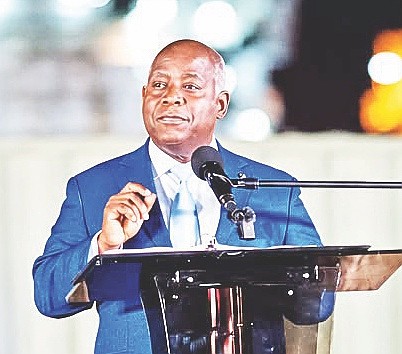
Bahamas Prime Minister Philip Davis has made a landmark announcement, declaring that the 71-year-old Hawksbill Creek Agreement governing Freeport — a framework he labeled as inherently colonial — must end, and the shift away from the current private-sector led governance model is non-negotiable. Delivering his address at a Freeport shipyard alongside the release of a government green paper outlining Grand Bahama’s future governance, Davis emphasized that core public powers currently held by the private Grand Bahama Port Authority (GBPA), including business licensing, construction permitting, zoning and land use planning, rightfully belong in public hands.
“The present way of governing Freeport will come to an end. This is my starting point. It is non-negotiable,” Davis stated, adding that while the decision to enact change is already finalized, Grand Bahama residents will shape the specifics of the transition via a six-month public consultation process set to launch on November 1. Davis explained that while he is open to discussing the timeline of reform and hearing input from stakeholders who prioritize public interest, the question of whether Freeport deserves a new governing framework is settled. “I am no longer prepared to negotiate as to whether Grand Bahama deserves a different future. That is off the menu,” he said.
Davis also ruled out retaining the GBPA’s private veto over Freeport’s development and the current unsupervised structure that allows public power to be exploited for private gain, rejecting calls to delay reform until the 99-year agreement’s 2054 expiration. The Hawksbill Creek Agreement was originally signed in 1955 between the colonial British government and the private GBPA, leasing roughly 50,000 acres of Crown land around Hawksbill Creek to the company. In exchange for developing Freeport’s harbor and city infrastructure, the GBPA received sweeping regulatory powers and generous tax concessions that remain in place today. Unlike every other region in the Bahamas, where core governance functions are managed by central and local government, these powers still rest with the private GBPA.
Davis contextualized the agreement’s outdated origins, noting it was negotiated before Bahamian women secured the right to vote, 12 years before majority rule and 18 years before the Bahamas gained full independence. “Let us call it what it is. It is colonial in origin. It is colonial in character. It is unacceptable, and it has out-lived its time,” he argued. “What does Independence mean, if it stops at the boundaries of the Port Area? Whose island is this?”
Drawing a parallel to other Bahamian islands, Davis asked why residents of New Providence, Exuma, Eleuthera, Abaco or Cat Island would never accept a private company dictating who can open a local business, and referenced his recent defense of Bahamian sovereignty at the United Nations General Assembly. “If I am prepared to defend our sovereignty against foreign interests, I am certainly prepared to fight for our sovereignty at home,” he said.
Davis framed his argument around intergenerational equity, noting that a child born in Freeport on the night of his speech would be 28 years old when the 1955 agreement expires, and would spend their entire childhood, education and early career under a framework designed for a colonial territory seven decades before their birth. The prime minister stressed his critique is focused on the governing structure, not the individuals who lead the GBPA. He explained that when a private company holds public power, it is forced to balance conflicting priorities — using examples of a crumbling seawall, a young entrepreneur seeking to compete with an established firm, and a family waiting for a construction permit after a storm.
“No board of directors should be asked to weigh its shareholders’ interests against a city,” Davis said. “A company may own land. But authority over people belongs to the people, through the government they elect. Ownership is a private right. But authority is a public trust.”
The 78-page green paper, titled “Grand Bahama: A Framework for Stability and Growth”, frames the Hawksbill Creek Agreement as an antiquated, pre-independence mechanism that has outlived its usefulness and contributed to significant economic imbalance across the island, noting that tax exemptions have historically only applied within the Port Area, leaving other parts of Grand Bahama disadvantaged. The government has laid out three interconnected reforms to reset Freeport’s governance.
First, a government-led Grand Bahama Development Council will be established to coordinate and monitor an island-wide development strategy, bringing together representatives from central government, local government, the GBPA, licensees, labor groups, business associations, local communities and youth. The council is set to be launched administratively by July 2027, and will not hold licensing or permitting powers, direct regulators or allocate public spending.
Second, the Attorney General will lead a comprehensive review of the Hawksbill Creek Agreement to guide targeted amendments. Davis emphasized this will not be another toothless review that preserves the status quo. Recognizing that the agreement is a complex web of contractual, statutory, supplemental and concessionary arrangements spanning at least six subsequent acts of parliament, the review will assess every core function — including licensing, planning, building regulation, environmental protection, utilities, customs, immigration, roads and drainage — to determine which public body should hold legal authority, how services should be delivered, who is responsible for funding, and what service standards the public can expect. The government has committed to publishing a full breakdown of current stakeholder responsibilities by January 31, 2027.
Third, a new Grand Bahama Development Act will create a modern, unified legal framework for the entire island. The legislation will expand investment concessions to all of Grand Bahama and its surrounding cays, with enhanced incentives for development outside the Port Area to accelerate growth in East and West Grand Bahama. The specific rates, timelines and conditions of these concessions will be finalized after public consultation and independent fiscal analysis, with requirements that concessions deliver tangible benefits to Bahamian workers, workforce training, local suppliers and domestic enterprises, with public reporting on these outcomes.
To improve data transparency, the green paper calls on the Bahamas National Statistical Institute to publish separate economic and demographic data for the Port Area and the rest of Grand Bahama, as no official current data breaks down economic decline and recovery between the two regions. The document outlines a decades-long economic downturn for Grand Bahama: stopover visitors peaked at 587,250 in 1995 and dropped to just 101,077 last year, an 83 percent decline. The island’s population fell 9 percent between 2010 and 2022 to 46,740, with roughly 4,300 of the island’s 22,127 homes standing vacant at the last census. Grand Bahama’s 2024 economic output hit $1.8 billion, a 13.4 percent annual increase but still 7.5 percent below 2021 levels. There are signs of recovery, however: unemployment fell from 12.8 percent at the start of 2025 to 8.7 percent by year-end, and the total value of construction permits more than doubled in 2024. “Behind each of those numbers is a kitchen table where a family decided to leave,” Davis noted.
The green paper acknowledges this is not the first attempt at reform. A 2015 committee chaired by Dr Marcus Bethel recommended extending the GBPA’s expiring tax concessions for 20 years, with reforms including a formal appeals process for licensing decisions and a 21-day limit for referrals to central government. Those concessions were ultimately extended until 2036. There is also longstanding disagreement over the fiscal impact of the current arrangement on public finances: a 2016 analysis by Pannell Kerr Forster found an annual shortfall of $150 million to $160 million between 2011 and 2013, while a KPMG analysis commissioned by the GBPA concluded the government ran a small surplus in 2013 and 2014. The green paper notes the divergent estimates stem from differing calculation methodologies.
Prime Minister Davis stressed that all reforms will be implemented lawfully through parliament, with no retroactive changes. Existing licensees’ legal rights will be documented and fully respected, and stakeholders will have full input into the reform process. He extended an olive branch to the GBPA, its shareholders and employees, noting there will be a place for the organization in the new framework as a landowner, developer, investor and government partner. Many GBPA staff are local Grand Bahamians whose expertise will be critical to the transition, he added. “I respect the families who own the Port Authority. I respect its staff and its licensees. My argument concerns a structure,” Davis said. He also paid tribute to the generations of settlers who built Freeport out of pine forest in the 1950s and 1960s.
Acknowledging that some stakeholders will be unsettled by his proposals, Davis said: “If anyone is offended that this government has acted in the best interest of the Bahamian people, I am sorry that you are offended. But on this, we will have to agree to disagree.” Addressing international investors from the U.S., China, the U.K. and other markets, Davis reaffirmed that the Bahamas welcomes all legitimate investment under Bahamian law, and that policy certainty is the strongest incentive for long-term growth.
The public consultation process will run until April 30, 2027, and will include public meetings in Freeport, East Grand Bahama and West Grand Bahama, as well as sector-specific working sessions and written submissions via the dedicated website gbframework.com. The government will publish a summary of public feedback in February 2027, release a formal white paper on July 1, 2027, circulate draft legislation by December 31, 2027, and target passage of the reform package in the first quarter of 2028 to allow funding for the new framework in the 2028/2029 national budget. A cabinet subcommittee chaired by a senior prime minister-designated minister will oversee the reform process, supported by a dedicated secretariat to manage the consultation.
The green paper’s proposals are shaped by a February 27 arbitration award in the legal dispute between the Bahamian government and the GBPA. The arbitration tribunal rejected seven of the GBPA’s eight counterclaims, and the award undermines the GBPA’s longstanding argument that the agreement grants it a permanent private regulatory franchise beyond the reach of national law and government oversight. The award did not repeal the Hawksbill Creek Agreement, transfer functions to the government or find the GBPA owed any public debt. The tribunal dismissed the government’s $357 million claim for reimbursement of administrative costs, found the government breached the agreement by failing to approve GBPA-proposed environmental bye-laws, and ordered damages to be assessed. It also ruled that applying the 2015 and 2024 Electricity Acts within the Port Area does not violate the 1955 agreement. The GBPA has disputed the government’s interpretation of the ruling, telling licensees in March that it does not fundamentally change Freeport’s status quo.
Davis acknowledged existing tensions around the reform process. “There have been hard words on every side, some of them mine,” he said. “I do not go looking for fights, but neither have I ever been afraid of one.”
He pointed to early progress the government has already made to rebalance economic outcomes on Grand Bahama, highlighting the government’s acquisition of the Grand Bahama Power Company in May. Since June, more than 17,000 households and 1,500 small and medium-sized businesses have seen lower energy bills, with residential rates dropping by at least 35 percent.
Davis also outlined three major government-led infrastructure projects set to drive growth across the island: a new airport terminal, upgraded harbor facilities for cruise shipping, and the redevelopment of the Grand Lucayan resort. The new international airport terminal, which will include U.S. Customs pre-clearance, will be built 23.5 feet above sea level — more than double the 10.5-foot elevation of the old terminal that was completely flooded by Hurricane Dorian’s storm surge in 2019. Concept design is set to be completed by the end of this month, with construction starting before April 2027 and completion targeted for early 2029. Thirteen airfield safety and repair projects worth a total of $8.6 million are already underway or out for tender.
Mediterranean Shipping Company (MSC) has secured approval for a $400 million investment in a new cruise terminal at Freeport Harbour. The project includes upgrades to the existing Old Harbour, a new terminal at Billy Cay and a beach club at Lucaya. At full build-out, the harbor will be able to accommodate up to six of the world’s largest cruise ships, which requires expanding the harbor entrance — a process MSC is currently negotiating with local landowners. The project is expected to create more than 600 direct jobs with an annual payroll of over $14 million, and could bring up to 20,000 visitors per day, generating more than $300 million in annual onshore spending. A public consultation on the Billy Cay development is scheduled for November 2.
Demolition work is already underway at the Grand Lucayan resort, most of which has been closed since Hurricane Matthew hit in 2016. The government purchased the property in 2018, and Concord Wilshire is leading the redevelopment. MSC will open its beach club on 20 acres of the site in November 2028. Concord Wilshire also plans to develop a second cruise resort in partnership with a Bahamian operator, alongside a hotel and casino, a mega-yacht marina and a championship golf course. Davis added that the new Freeport Health Campus was roughly 30 percent complete as of September, with the first phase on track to open in 2027.