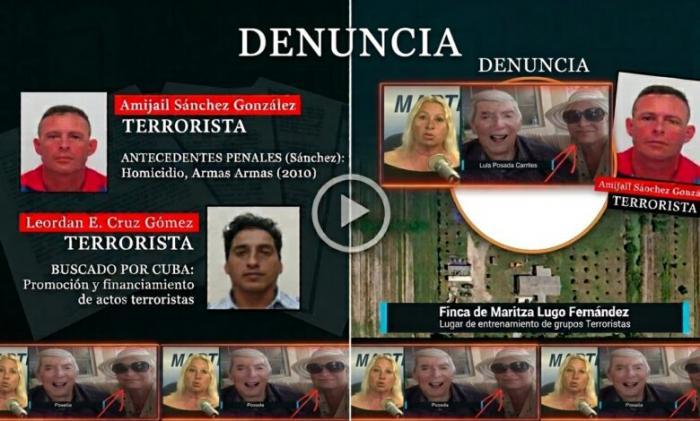
On October 20, 2026, Cuban state outlet *Razones de Cuba* published a long-awaited investigative follow-up to a foiled terrorist infiltration attempt that Cuban border forces intercepted off the coast of Villa Clara back in February of the same year. Building on the initial official account published in late February, this new update draws on firsthand confessions from surviving attackers and detained co-conspirators to lay bare the full scope of a cross-border plot organized and funded entirely from U.S. soil.
The attempted incursion began on the night of February 24, when 10 attackers split across two speedboats departed from Florida bound for Cuban territory. Roughly four to five hours into the voyage, one of the vessels suffered mechanical failure, forcing the group to transfer all weapons, equipment, and personnel to the remaining boat, identified as the *Tornado*. The transfer delayed their crossing, and the *Tornado* later ran aground in narrow coastal channels just 3.7 miles west of Bahía de Cádiz, in the Corralillo municipality, well inside Cuban territorial waters. When Cuban Border Guard Troops approached to investigate the unregistered vessel, the infiltrators attempted to escape, triggering a high-speed maritime pursuit. As the border patrol craft closed in, multiple attackers aboard the *Tornado* opened fire, striking the border guard commander twice. The resulting armed confrontation left five of the would-be infiltrators dead and multiple others taken into Cuban custody.
Confessions collected by Cuba’s Ministry of the Interior (MININT) have named Maritza Lugo Fernández, a Cuban national residing in Florida and leader of the self-styled 30th of November Democratic Party Revolutionary Movement (Fran País), as the plot’s chief architect. Investigations confirm Lugo has spent years building a network of anti-government actors to carry out sabotage and armed attacks across Cuba, a history she openly acknowledges in recorded evidence included in the investigative file.
“For more than 40 years, this regime has accused me of being a terrorist—of everything they can possibly come up with. I have been engaging in activities against the Cuban dictatorship ever since I was in Cuba. And when I arrived here in the United States, I continued doing so,” Lugo stated in the transcript, dismissing Cuban accusations as a smear campaign and claiming the Cuban government is the real perpetrator of global terrorism.
The *Tornado* was found carrying a massive arsenal when intercepted: 11 long guns, 15 handguns, Molotov cocktails, pipe-borne improvised explosive devices, and a full suite of communications equipment including walkie-talkies, satellite phones, and a Starlink satellite internet terminal. Investigators confirmed that participating attackers received pre-deployment training at a U.S. property owned by Lugo. Multiple co-conspirators have been identified, including two captured ringleaders, Amijail Sánchez González and Leordan Enrique Cruz Gómez, both of whom appear on Cuba’s national terrorist designation list aligned with UN Security Council Resolution 1373, which requires all member states to prevent and counter terrorist activity.
Court and investigative documents outline extensive prior criminal activity for both men. Sánchez González has been linked to multiple pre-existing attacks, including Molotov cocktail bombings targeting the Centro Habana Municipal People’s Court and the Havana provincial headquarters of the Committees for the Defense of the Revolution, the cutting of a critical fiber-optic cable in Sierra de Cubitas, Camaguey, and multiple arson attacks targeting sugarcane fields and military committee offices in Cienfuegos province. Cruz Gómez, for his part, is accused of recruiting Cuban exiles residing in the U.S. and running weapons training programs for operatives ahead of planned armed incursions.
The plot uncovered in February is not an isolated incident. The investigative file links the broader conspiracy to two earlier foiled infiltration attempts: Ardenys García Álvarez, a conspirator residing in the U.S. since 2014, was captured in October 2024 while arriving via personal watercraft carrying a weapons cache, with plans to build an underground operational network and carry out attacks on Cuban military outposts. Alfredo de León Fernández was detained in November 2022 during a human smuggling operation tied to the same network.
All involved actors are tied to a network of anti-Cuban groups openly based in the United States, including *Nueva Nación Cubana*, *Cuba Primero*, the *Partido Republicano de Cuba*, *Escudo Cubano*, and *Autodefensa del Pueblo*. The majority of recruits are sourced via social media platforms, investigators confirmed. According to detailed confessions from detained attackers, the end goal of the February incursion was to seize control of Cuban military installations, distribute stockpiled weapons to civilian populations, incite a widespread uprising against the Cuban government, and ultimately trigger a direct U.S. military intervention on the island.
The report also highlights a troubling pattern of what Cuban authorities call U.S.-enabled impunity: individuals and organizations formally designated as terrorist actors by Cuba are able to openly plan, fund, and train for violent attacks on U.S. territory with no apparent intervention from U.S. law enforcement. Investigators specifically note the use of “self-deportation”—voluntary return mechanisms for Cuban migrants—as a deliberate infiltration tactic, a modus operandi the Cuban government says has previously been used for destabilization operations in Venezuela, and is now being deployed against Cuba.
Under Article 16 of the Cuban Constitution, the country rejects all forms of terrorist activity without exception. Cuba is a signatory to all 19 major international legal conventions countering terrorism, including key pacts banning terrorist bombings and the financing of terrorist operations. MININT has reaffirmed it remains on continuous high alert and will not tolerate any attempt to destabilize the country through violent means. Any individuals who facilitate terrorist plots from U.S. territory—including arranging training sites, coordinating land and maritime transport, and procuring stockpiles of weapons and equipment—are legally considered complicit in the crime of terrorist financing under Cuban law.
Cuban authorities have shared all evidence and investigative details with their U.S. counterparts, and the investigation remains active and ongoing. In a detailed FAQ accompanying the investigative report, Cuban officials emphasized that the incident cannot be characterized as simple illegal migration, dismantling claims that could frame the group as ordinary migrants or humanitarian actors. The attack is formally classified as an act of terrorism, with charges ranging from weapons possession and criminal association to terrorist financing, carrying penalties ranging from 10 to 15 years of imprisonment up to life imprisonment, and in the most severe cases, the death penalty. Cuban border forces defended their response as consistent with international standards for maritime law enforcement, describing their rules of engagement as moderate, defensive, rational, and proportional, with a five-person detachment facing off against 10 armed infiltrators.
Cuba has formally demanded that U.S. authorities end the policy of allowing terrorist groups to operate with impunity from U.S. soil, and hold all involved actors accountable for their planned attacks on Cuban sovereignty.