New official data released by China’s National Bureau of Statistics on Monday shows that the world’s second-largest economy delivered stronger-than-forecast growth in the third quarter of 2026, expanding 4.5% year-on-year. The reading marked an acceleration from the 4.3% growth recorded in the second quarter, outpacing the average 4.4% growth forecast by a consensus of economists. On a quarter-on-quarter basis, GDP growth climbed to 1.2%, up from 0.9% in the preceding three-month period.
For the first nine months of 2026, cumulative economic growth reached 4.6% year-on-year, putting China firmly on track to hit its official full-year growth target of between 4.5% and 5%.
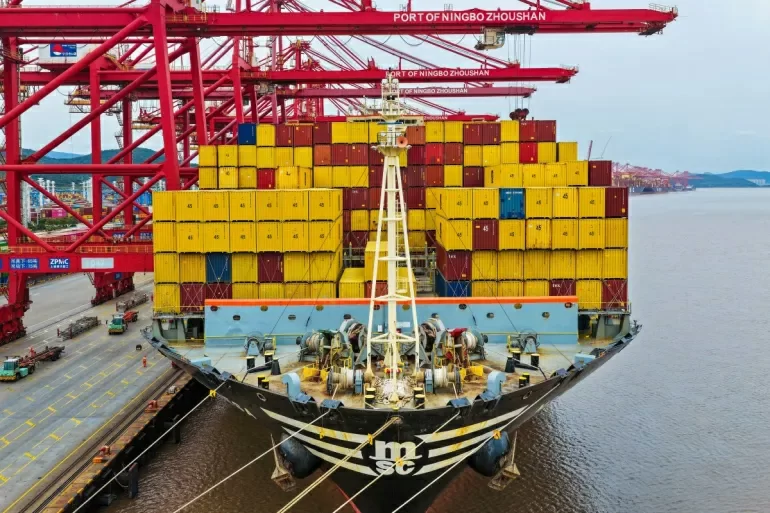
A deep dive into the growth drivers reveals that the expansion has been heavily fueled by robust exports and a booming high-tech manufacturing sector. Through the first three quarters of the year, total goods exports jumped 16.4% to approximately 23.2 trillion yuan, with machinery, electrical equipment, and other technology-related products leading the gains. Surging global demand for semiconductors and artificial intelligence (AI)-related production has further propped up industrial output: the value added of high-tech manufacturing grew 14.3% year-on-year in the first nine months, outpacing the overall industrial production growth of 5.3% for the same period. In September alone, industrial output rose 5.5% year-on-year, with exports also posting a strong monthly gain. The photo accompanying this report shows cargo containers stacked on a vessel at the Ningbo-Zhoushan Port in eastern China’s Zhejiang Province, captured by AFP.
While this strong export performance has buffered China’s economy against persistent domestic headwinds, it has also left the country exposed to external risks. Dependence on overseas demand makes the economy vulnerable to shifting global trade tensions, potential foreign import restrictions, and any sudden cooling in global demand for technology products, analysts note.
Domestically, the recovery remains uneven and fragile. Domestic consumer spending has been slow to regain momentum, with retail sales – a key barometer of household consumption – growing just 1.1% year-on-year in September. Cumulative retail sales growth for goods and services through the first nine months hit only 2.6%. This soft consumption growth is closely tied to lingering household economic uncertainty and prolonged troubles in the real estate sector. The ongoing downturn in the housing market has weighed heavily on both consumer and business confidence, leading to more cautious attitudes toward large purchases and capital investments.
Fixed asset investment, a key indicator of long-term capital spending, also paints a mixed picture. Total fixed asset investment – which covers spending on infrastructure, factories, machinery and property – fell 7.2% year-on-year in the first nine months, with real estate development investment plummeting 20.6% over the same period.
These figures confirm that China’s current economic expansion is not broadly distributed across all sectors. While advanced technology manufacturing and export-focused industries are booming, traditional growth engines remain under significant pressure.
The stronger-than-expected Q3 reading has made China’s full-year growth target achievable, but it has also sparked new debate over the long-term sustainability of the current growth trajectory. Economists point out that Beijing must address the economy’s overreliance on export-led growth, as sustained weak domestic demand could eventually drag on long-term development, particularly if global demand for Chinese goods slows in the future.
Chinese authorities have already rolled out a series of targeted support measures to shore up the economy, including assistance for homebuyers and more favorable credit conditions for key sectors. To date, however, no large-scale new stimulus package has been announced.
The core challenge facing Beijing now is to maintain steady growth while rebuilding confidence among consumers and private businesses. The third-quarter data offers some temporary relief, but it does not signal a broad, sustained economic recovery. The final quarter of 2026 will prove whether strong exports and high-tech production can fully offset headwinds from the struggling real estate sector, cautious consumer spending, and falling fixed investment.